Category Archives: LS32

Day 9

Day 9 covers Chapter 5, The Simile of Herbs, and introduces Chapter 6, Assurance of Future Buddhahood.

Having last month considered the meaning of The Simile of Herbs, we repeat what he had said in gāthās.

Thereupon the World-Honored One, wishing to repeat what he had said, sang in gāthās:

As the destroyer of the bonds of existence,
I, the King of the Dharma, have appeared in this world.
Since then I have expounded the Dharma variously
According to the desires of all living beings.

I am honorable, and my wisdom is profound.
Therefore, I have been reticent on this truth[,]
[That is, the reality of all things,] for a long time.
I did not make haste to expound it to all living beings.

If they had heard it [without expedients],
Men of ignorance would have had doubts,
And lost their way [to enlightenment] forever,
Though men of wisdom would have understood it by faith.

Therefore, Kāśyapa, I expounded [the Dharma]
With various expedients to all living beings
According to their capacities
In order to cause them to have the right view.

The Daily Dharma from June 24, 2016, offers this:

As the destroyer of the bonds of existence,
I, the King of the Dharma, have appeared in this world.
Since then I have expounded the Dharma variously
According to the desires of all living beings.

The Buddha proclaims these verses in Chapter Five of the Lotus Sūtra. This is another explanation for why he uses expedients to teach those who are not ready for his highest teaching. When we set aside the cravings that lead to suffering, and cultivate our desire for enlightenment, both for ourselves and all beings, then we are ready to receive the Buddha’s highest teaching.

The Daily Dharma is produced by the Lexington Nichiren Buddhist Community. To subscribe to the daily emails, visit zenzaizenzai.com

Day 8

Day 8 concludes Chapter 4, Understanding by Faith, and closes the second volume of the Sutra of the Lotus Flower of the Wonderful Dharma.

Having last month considered the transfer of wealth to the son, we conclude the prose section with the explanation that the Buddha is the rich man, the Śrāvakas the poor sons.

“World-Honored One! The great rich man is you. We are like [his son, that is,] your sons because you always tell us that we are your sons. World-Honored One! We once had many troubles in the world of birth and death because of the three kinds of sufferings.’ We were so distracted and so ignorant that we clung to the teachings of the Lesser Vehicle. At that time you caused us to think over all things and to clear away the dirt of fruitless discussions about them. We made strenuous efforts according to the teachings [of the Lesser Vehicle] and attained Nirvāṇa as a day’s pay. Having attained it, we had great joy, and felt satisfied [with the attainment of it]. We said, ‘We have obtained much because we made efforts according to the teachings of the Buddha.’ But when you saw that we clung to mean desires and wished to hear only the teachings of the Lesser Vehicle, you left us alone. You did not tell us that we had the treasure-store, that is, the insight of the Tathāgata. You expounded the wisdom of the Buddha[, that is, the Great Vehicle] with expedients, but we did not aspire for that vehicle because, when we had obtained the day’s pay of Nirvāṇa from the Buddha, we thought that we had already obtained enough. We did not wish to have what you had showed and expounded to the Bodhisattvas by your wisdom. You expounded the Dharma to us with expedients according to our capacities because you knew that we wished to hear the teachings of the Lesser Vehicle. We did not know that we were your sons. Now we know that you do not grudge your wisdom to anyone. Although we were your sons then as we are now, we wished to hear only the teachings of the Lesser Vehicle. If we had aspired for the teaching of the Great Vehicle, you would have already expounded it to us. Now you expound only the One Vehicle in this sūtra. You once reproached us Śrāvakas in the presence of the Bodhisattvas because we wished to hear the teachings of the Lesser Vehicle. [At that time we thought that you had taught us only the Lesser Vehicle,] but now we know that you have been teaching us the Great Vehicle from the outset. Therefore, we say that the great treasures of the King of the Dharma have come to us although we did not seek them, and that we have already obtained all that the sons of the Buddha should obtain.”

How often do I settle for a “day’s pay,” self-satisfied with that attainment, and fail to appreciate the great treasure that is my inheritance.

Day 7

Day 7 concludes Chapter 3, A Parable, and begins Chapter 4, Understanding by Faith.

Last month considered the expedient lessons of the past from Chapter 3, A Parable. Before continuing I need to reset the end of Day 7. The following text is moved from Chapter 4, Understanding by Faith. This should be the last modification needed to bring the English breaks in line with the Shindoku.

“World-Honored One! Allow us to explain our understanding by telling a parable. Suppose there lived a man [in a certain country]. When he was a little boy, he ran away from his father. [The boy] lived in another country for a long time, say, for ten, twenty or fifty years. As time passed by, he became poorer. He wandered about all directions, seeking food and clothing.

“While wandering here and there, he happened to walk towards his home country. At that time his father stayed in a city [of that country]. He had been vainly looking for his son ever since. He was now very rich. He had innumerable treasures. His storehouses were filled with gold, silver, lapis lazuli, coral, amber and crystal. He had many servants, clerks, and secretaries. He also had countless elephants, horses, carts, cows, and sheep. He invested his money in all the other countries, and earned interest. He dealt with many merchants and customers.

“The poor son, having wandered from town to town, from country to country, from village to village, came to the city where his father was living. The father had been thinking of him for more than fifty years since he had lost him, but never told others [that he had a missing son]. He was alone, pining for his son. He thought, ‘I am old and decrepit. I have many treasures. My storehouses are filled with gold, silver, and other treasures. But I have no son [other than the missing one]. When I die, my treasures will be scattered and lost. I have no one to transfer my treasures to. Therefore, I am always yearning for my son.’ The father thought again, ‘If I can find my son and give him my treasures, I shall be happy and peaceful, and have nothing more to worry about.’

“World-Honored One! At that time the poor son, who had worked at various places as a day worker, happened to come to the house of his father. Standing by the gate of the house, he saw his father in the distance. His father was sitting on a lion-like seat, putting his feet on a jeweled footstool. Brāhmaṇas, kṣatriyas, and householders surrounded him respectfully. He was adorned with a necklace of pearls worth ten million. The secretaries and servants were standing on either side of him, holding insect-sweepers made of white hairs. Above him was a jeweled awning, from which streamers of flowers were hanging down. Perfume was sprayed and beautiful flowers were strewn on the ground. He was exhibiting treasures and engaging in trade. Adorned with these various things, he looked extraordinarily powerful and virtuous.

“Seeing the exceedingly powerful father, the poor son was frightened. He regretted that he had come there. He thought, ‘Is he a king or someone like a king? This is not the place where I can get something by labor. I had better go to a village of the poor, where I can work to get food and clothing easily. If I stay here any longer, I shall be forced to work.’

“Having thought this, the poor son ran away. The rich man, who was sitting on the lion-like seat, recognized him at first sight as his son. He was delighted. He thought, ‘Now I have found the person to whom I can transfer my treasures and storehouses. I have been thinking of my son all this time, but I have had no way to find him. Now he has come by himself all of a sudden. This is just what I wanted. I am old, but not too old to lose any attachment [to my treasures].’

“He immediately dispatched a man standing beside him to quickly bring back the poor son. The messenger ran up to the poor son and caught him. The poor son was frightened. He cried, ‘You Devil! I have done nothing wrong. Why do you catch me?’

“The messenger pulled him by force. The poor son thought, ‘I am caught though I am not guilty. I shall be killed.’ More and more frightened, the poor son fainted and fell to the ground. Seeing all this in the distance, the father said to the messenger, ‘I do not want him any more. Do not bring him forcibly! Pour cold water on his face and bring him to himself! Do not talk with him any more!’

“The father said this because he had realized that his son was too base and mean to meet a noble man [like his father]. He knew that the man was his son, but expediently refrained from telling to others that that was his son. [The messenger poured water on the son. The son was brought to himself.] The messenger said to him, ‘Now you are released. You can go anywhere you like.’

“The poor son had the greatest joy that he had ever had. He stood up and went to a village of the poor to get food and clothing.

Kanta Tsukamoto Shonin‘s Spring Writings offers this on this section:

Even if we meet the teaching of the Lotus Sutra, which makes us awaken our Buddha-nature, most of us do not study or understand it because it is a difficult teaching and is too noble, and we run away just like the son when he saw the rich man. After all, we alone are responsible for making our lives empty or fruitless, because we are unaware of our ability or potential. Even though we tend to be like this, the Eternal Buddha always wishes to lead and support all of us, as his children, with great compassion. In order to make us awaken the Buddha-nature, He leads us according to our natures, capacities and circumstances, and dispatches someone to us to give us various advice, even if it takes a long time. It is just like the rich man who approached his son wearing dirty clothing, to encourage him.Spring Writings

Day 6

Day 6 continues Chapter 3, A Parable

Last month considered the reason Śākyamuni felt the expedient was needed. Before moving on I need to adjust where the split between Day 6 and Day 7 occurs in Chapter 3, A Parable. The following gāthās shift from Day 7 back to Day 6.

(The Buddha said to Śāriputra:)
I am like the father.
I am the Saint of Saints.
I am the father of the world.

All living beings are my children.
They are deeply attached
To the pleasures of the world.
They have no wisdom.

The triple world is not peaceful.
It is like the burning house.
It is full of sufferings.
It is dreadful.

There are always the sufferings
Of birth, old age, disease and death.
They are like flames
Raging endlessly.

I have already left
The burning house of the triple world.
I am tranquil and peaceful
In a bower in a forest.

Underscore All living beings are my children. They are deeply attached To the pleasures of the world. They have no wisdom.

Day 5

Day 5 begins Chapter 3, A Parable

Last month concluded Day 5 with Śāriputra’s plea of behalf of others for the Buddha to explain this Dharma that they had never heard before. I’ve reconsidered where I’m dividing the end of Day 5, moving it to the conclusion of the first telling of the Parable of the Burning House.

Thereupon the Buddha said to Śāriputra:
“Did I not tell you, ‘The Buddhas, the World-Honored Ones, expound the Dharma with expedients, that is, with various stories of previous lives, with various parables, with various similes, and with various discourses only for the purpose of causing all living beings to attain Anuttara-samyak-saṃbodhi’? All these teachings of the Buddhas are for the purpose of teaching Bodhisattvas. Śāriputra! Now I will explain this with a parable. Those who have wisdom will be able to understand the reason if they hear the following parable.

“Śāriputra! Suppose there lived a very rich man in a certain country, in a certain village, in a certain town. He was old. His wealth was immeasurable. He had many paddy fields, houses, and servants. His manor house was large, but had only one gate. In that house lived many people, numbering a hundred or two hundred or five hundred. The buildings were in decay, the fences and walls corrupt, the bases of the pillars rotten, and the beams and ridgepoles tilting and slanted.

“All of a sudden fires broke out at the same time from all sides of the house, and it began to burn. In this house lived children of the rich man, numbering ten or twenty or thirty. The rich man was very frightened at the great fires breaking out from the four sides of the house. He thought, ‘I am able to get out of the gate of the burning house safely, but my children are still inside. They are engrossed in playing. They do not know that the fires are coming towards them. They are not frightened or afraid. They are about to suffer, but do not mind. They do not wish to get out.’ Śāriputra! He also thought, ‘I am strong-muscled. I will put them in a flower-plate or on a table and bring them out.’

“But he thought again, ‘This house has only one gate. Worse still, the gate is narrow and small. My children are too young to know this. They are attached to the place where they are playing. They may fall [out of the plate or table] and get burned. I had better tell them of the danger. This house is already burning. They must come out quickly so as not to be burned to death.’

“Having thought this, he said to his children as he had thought, ‘Come out quickly!’ He warned them with these good words out of his compassion towards them, but they were too much engrossed in playing to hear the words of their father. They were not frightened or afraid. They did not wish to come out. They did not know what a fire was, what a house was, and what they would lo e. They ran about happily. They only glanced at their father occasionally.

“Thereupon the rich man thought, ‘This house will be burned down soon by this great fire. If they and I do not get out at once, we shall be burned. I will save them from this danger with an expedient.

“An idea came to his mind that his children would be attracted by the various toys which they wished to have. He said to them, ‘The toys you wish to have are rare and difficult to obtain. You will be sorry if you do not get them now. There are sheep-carts, deer carts, and bullock-carts outside the gate. You can play with them. Come out of this burning house quickly! I will give you any of them according to your wishes.’

“Hearing of the toys from their father, the children rushed quickly out of the burning house, pushing one another, and striving to be first, because they thought that they could get what they each wished to have. The rich man, who saw them having come out safely and sitting in the open on the crossroad with no more hindrance, felt relieved and danced with joy. They said to their father, ‘Father! Give us the toys! Give us the sheep-carts, deer-cart and bullock-carts you promised us!’

“Śāriputra! Then the rich man gave each of them a large cart of the same size. The cart was tall, wide and deep, adorned with many treasures, surrounded by railings, and having bells hanging on the four sides. A canopy adorned with rare treasures was fixed on the top of it. Garlands of flowers, tied with jeweled ropes, were hanging from the canopy. In the cart were quilts spread one on another, and a red pillow. The cart was yoked with white bullocks. The color of the skin of the white bullocks was bright; their build, beautiful and stout; and their pace, regular. They could run as swift as the wind. The cart was guarded by many attendants. [This great rich man gave one of these carts to each of his children] because his wealth was so immeasurable that his various storehouses were full [of treasures]. He thought, ‘My treasures are limitless. I should not give inferior, smaller carts to them. They are all my children. Therefore, I love them without partiality. I have a countless number of these large carts of the seven treasures. I gave one of these to each of my children equally. There should be no discrimination. The large carts are numerous enough to be given to all the people of this country. Needless to say, I can give them to my sons. [Therefore, I did.]’

I’ll be reconsidering both Day 6 and Day 7, which do not appear at natural breaks.

Day 4

Day 4 finishes Chapter 2, Expedients, and completes the first volume of the Sūtra of the Lotus flower of the Wonderful Dharma.

Having last month witnessed Śākyamuni’s first turning of the wheel of the Dharma, we learn of Śākyamuni’s decision to expound his wisdom.

Śāriputra, know this!
Then I saw many sons of mine,
Thousands of billions in number,
Seeking the enlightenment of the Buddha.
They came to me respectfully.
They had already heard
Expedient teachings
From the past Buddhas.

I thought:
“I appeared in this world
In order to expound my wisdom.
Now is the time to do this.”

Śāriputra, know this!
Men of dull capacity and of little wisdom cannot believe the Dharma.
Those who are attached to the appearances of things are arrogant.
They cannot believe it, either.

I am now joyful and fearless.
I have laid aside all expedient teachings.
l will expound only unsurpassed enlightenment
To Bodhisattvas.

The Bodhisattvas who hear the Dharma
Will be able to remove the mesh of doubts.
The twelve hundred Arhats also
Will become Buddhas.

Śākyamuni’s explanation –

Then I saw many sons of mine,
Thousands of billions in number,
Seeking the enlightenment of the Buddha.

– is a graphic reminder of the love of our spiritual father.

Day 3

Day 3 covers the first half of Chapter 2, Expedients.

Having last month learned the goal of all Buddhas is to show the insight of the Buddha, we conclude Day 3’s portion of Chapter 2, Expedients.

“Śāriputra! The Buddhas appear in the evil worlds in which there are the five defilements. The worlds are defiled by the decay of the kalpa, by illusions, by the deterioration of the living beings, by wrong views, and by the shortening of lives. Śāriputra! When a kalpa is in decay, the living beings [in that kalpa] are so full of illusions, so greedy, and so jealous that they plant many roots of evil. Therefore, the Buddhas divide the One Buddha-Vehicle into three as an expedient.

“Śāriputra! Some disciples of mine, who think that they are Arhats or Pratyekabuddhas, will not be my disciples or Arhats or Pratyekabuddhas if they do not hear or know that the Buddhas, the Tathāgatas, teach only Bodhisattvas.

“Śāriputra! Some bhikṣus and bhikṣunīs do not seek Anuttara-samyak-saṃbodhi because they think that they have already attained Arhatship, that they have already reached the final stage of their physical existence, and that the Nirvāṇa attained by them is the final one. Know this! They are arrogant because it cannot be that the bhikṣus who attained Arhatship do not believe the Dharma. Some bhikṣus who live in a period in which no Buddha lives after my extinction may not believe the Dharma after they attain Arhatship because in that period it will be difficult to meet a person who keeps, reads, and recites this sūtra, and understands the meanings of it. They will be able to understand the Dharma when they meet another Buddha.

“Śāriputra and all of you present here! Understand the Dharma by faith with all your hearts! There is no vehicle other than the One Buddha-Vehicle.”

The Daily Dharma from March 12, 2017, offers this:

Śāriputra! Some disciples of mine, who think that they are Arhats or Pratyekabuddhas, will not be my disciples or Arhats or Pratyekabuddhas if they do not hear or know that the Buddhas, the Tathāgatas, teach only Bodhisattvas.

The Buddha makes this declaration to his disciple Śāriputra in Chapter Two of the Lotus Sutra. When the Buddha says he only teaches Bodhisattvas, he does not mean that he excludes anyone from his teaching. It is only when we realize and develop our capacities as Bodhisattvas, beings who exist to benefit all beings, rather than being preoccupied with our own suffering, can we hear, practice and appreciate the Buddha Dharma.

The Daily Dharma is produced by the Lexington Nichiren Buddhist Community. To subscribe to the daily emails, visit zenzaizenzai.com

Day 2

Day 2 completes Chapter 1, Introductory.

Having last month considered the life of the lazy man, we conclude Chapter 1, Introductory.

The ray of light of [Sun-Moon-] Light Buddha,
That is, the good omen, was the same as what I see now.
Judging from this, the present Buddha also will expound
The Sūtra of the Lotus Flower of the Wonderful Dharma.

The good omen I see now is like that of old.
This is an expedient employed by the Buddhas.
The present Buddha is also emitting a ray of light
In order to reveal the truth of the reality [of all things].

[Mañjuśrī said to the multitude:]

All of you, know this, join your hands together,
And wait with one mind!
The Buddha will send the rain of the Dharma
And satisfy those who seek enlightenment.

The Buddha will remove
Any doubt of those who seek
The teaching of the Three Vehicles.
No question will be left unresolved.

The light of the Buddha’s wisdom reveals the truth of the reality of all things. Pay attention. Wait with one mind.

Day 1

Day 1 covers the first half of Chapter 1, Introductory

Having last month considered in gāthās the Bodhisattvas illumined by the light from the Buddha, we considered the offerings of those Bodhisattvas.

I also see some Bodhisattvas
Offering delicious food and drink
And hundreds of kinds of medicines
To the Buddha and the Sangha.

Some offer garments and beautiful robes
Worth tens of millions
Or beyond monetary value
To the Buddha and the Sangha.

Some offer thousands of billions
Of jeweled houses made of candana
And wonderful bedding
To the Buddha and the Sangha.

Some offer pure gardens and forests
Abounding in flowers and fruits,
And furnished with rivers, springs,
and pools for bathing,
To the Buddha and the Saṃgha.

I see those Bodhisattvas
Making offerings of those wonderful things
Joyfully and untiringly
In order to attain unsurpassed enlightenment.

This is the week of Fall Ohigan, a weeklong focus on living the life of the Six Paramitas. And the No. 1 Paramita: Giving. Just one more example of how the Introductory chapter sets the stage for what is to come.

Day 32

Day 32 covers Chapter 28, The Encouragement of Universal-Sage Bodhisattva, closing the Eighth Volume of the Sutra of the Lotus Flower of the Wonderful Dharma.

Having last month heard Universal-Sage Bodhisattva’s dhārāṇi spells, we learn of the supernatural powers of Universal­Sage.

[He said to the Buddha:]

“World-Honored One! It is by my supernatural powers, know this, that a Bodhisattva can hear these dhārāṇis. Anyone who keeps the Sūtra of the Lotus Flower of the Wonderful Dharma [while it is] propagated in the Jambudvipa, should think, ‘I can keep [this sūtra] only by the supernatural powers of Universal­Sage.’ Anyone who keeps, reads and recites this sūtra, memorizes it correctly, understands the meanings of it, and acts according to it, know this, does the same practices that I do. He should be considered to have already planted deeply the roots of good under innumerable Buddhas [in his previous existence]. He will be caressed on the head by the hands of the Tathāgatas. Anyone who copies this sūtra will be reborn in the Heaven of the Trāyastriṃs̒a Gods immediately after his present life. On that occasion, eighty-four thousand goddesses will come and receive him, making many kinds of music. A crown of the seven treasures will be put on his head, and he will enjoy himself among the ladies in waiting. Needless to say, [more merits will be given to] the person who [not only copies this sūtra but also] keeps, reads and recites it, memorizes it correctly, understands the meanings of it, and acts according to it. Anyone who keeps, reads and recites this sūtra, and understands the meanings of it, will be given helping hands by one thousand Buddhas immediately after his present life. He will be fearless. He will not fall into any evil region. He will be reborn in the Tusiita Heaven. There he will go to Maitreya Bodhisattva who, adorned with the thirty-two marks, will be surrounded by great Bodhisattvas, and attended on by hundreds of thousands of billions of goddesses. He will be given the benefits of these merits. Therefore, anyone who has wisdom should copy this sūtra with all his heart, cause others to copy it, and also keep, read and recite it, memorize it correctly, and act according to it.

“World-Honored One! I will protect this sūtra with my supernatural powers so that it may be propagated and not be destroyed in the Jambudvipa after your extinction.”

Rather than be distracted by the idea of being reborn in the Heaven of the Trāyastriṃsa Gods … [where] eighty-four thousand goddesses will come and receive him or reborn in the Tusiita Heaven … attended on by hundreds of thousands of billions of goddesses, let’s consider this description of Universal Sage Bodhisattva – Samantabhadra – by Taigen Daniel Leighton in his book Faces of Compassion:

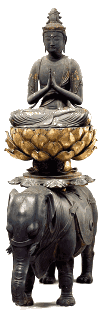
Fugen, samantabhadra, Universal SageSamantabhadra is the bodhisattva of enlightening activity in the world, representing the shining function of wisdom. Samantabhadra also embodies the luminous web of the interconnectedness of all beings, and radiant visions that express it. …

Samantabhadra and Manjushri are often paired together as attendants on either side of Shakyamuni Buddha, with Manjushri on his lion representing the essence of wisdom, and Samantabhadra, mounted on an elephant, representing the application of wisdom actively benefiting the world.

On the Shutei Mandala Gohonzon, Universal Sage Bodhisattva is on the left of the Daimoku in the row below Śākyamuni, with Mañjuśrī on the right of the Daimoku beneath Many Treasures.
Lotus World: An Illustrated Guide to the Gohonzon