
Category Archives: LS32

Day 14

Day 14 covers all of Chapter 9, The Assurance of Future Buddhahood of the Śrāvakas Who Have Something More to Learn and the Śrāvakas Who Have Nothing More to Learn, and opens Chapter 10, The Teacher of the Dharma.

Having last month heard the prediction for the two thousand Śrāvakas, we conclude Chapter 9 in gāthās.

Thereupon the World-Honored One, wishing to repeat what he had said, sang in gāthās:

I assure the future Buddhahood
Of these two thousand Śrāvakas
Who are now present before me.
They will become Buddhas in their future lives.

They will make offerings to as many Buddhas
As the particles of dust as previously stated.
They will protect the store of the teachings of those Buddhas,
And attain perfect enlightenment.

They will go to the worlds of the ten quarters.
Their [Buddha-]names will be the same.
They will sit at the place of enlightenment
And obtain unsurpassed wisdom at the same time.

Their [Buddha-]names will be Treasure-Form.
[The adornment of] their worlds, [the number of] their disciples,
[The duration of the period of] their right teachings,
[And that of] the counterfeit of them will be the same.

By their supernatural powers, they will save
The living beings of the worlds of the ten quarters.
Their fame will extend far and wide.
They will enter into Nirvana in the course of time.

Thereupon the two thousand Śrāvakas, of whom some had something more to learn while others had nothing more to learn, having heard the Buddha assure them of their future Buddhahood, danced with joy, and sang in a gāthā:

You, the World-Honored One, are the light of wisdom.
Hearing from you
That we are assured of our future Buddhahood,
We are as joyful as if we were sprinkled with nectar.

The Daily Dharma from May 11, 2017, offers this on the response of the 2,000 Śrāvakas:

These verses are sung by two thousand of the Buddha’s disciples in Chapter Nine of the Lotus Sūtra. When these followers of the Buddha were told that they would become as enlightened as he was, then many others like them realized that they too had this capacity. The superiority of the Lotus Sūtra lies not in having better explanations of what the Buddha taught, or in some supernatural ability it has to change the world. The superiority of the Lotus Sūtra is its completeness. It leads all beings to the joy of enlightenment.

The Daily Dharma is produced by the Lexington Nichiren Buddhist Community. To subscribe to the daily emails, visit zenzaizenzai.com
Day 13

Day 13 covers all of Chapter 8, The Assurance of Future Buddhahood of the Five Hundred Disciples.

Having last month concluded Day 13, we start again from the top of Chapter 8, The Assurance of Future Buddhahood of the Five Hundred Disciples.

Thereupon Pūrṇa, the son of Maitrāyanī having heard from the Buddha the Dharma expounded with expedients by the wisdom of the Buddha] according to the capacities of all living beings, and having heard that [the Buddha] had assured the great disciples of their future attainment of Anuttara-samyak-saṃbodhi, and also having heard of the previous life of the Buddha, and also having heard of the great, unhindered, supernatural powers of the Buddhas, had the greatest joy that he had ever had, became pure in heart, and felt like dancing [with joy]. He rose from his seat, came to the Buddha, and worshipped him at his feet with his head. Then he retired to one side of the place, looked up at the honorable face with unblenching eyes, and thought:

‘The World-Honored One is extraordinary. What he does is exceptional. He expounds the Dharma with expedients by his insight according to the various natures of all living beings of the world, and saves them from various attachments. The merits of the Buddha are beyond the expression of our words. Only the Buddha, only the World-Honored One, knows the wishes we have deep in our minds.’

See Thursday’s note for where I am and why I’m not adding any comment to these posts.

retreat photo
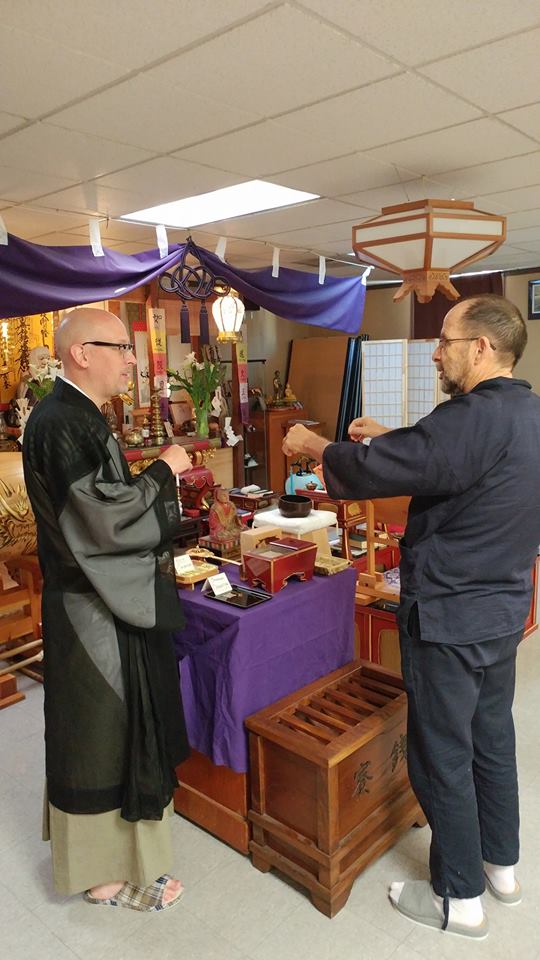
Kanjin Cederman Shonin and I in one of our many discussions.

Day 12

Day 12 concludes Chapter 7, The Parable of the Magic City, and completes the Third Volume of the Sutra of the Lotus Flower of the Wonderful Dharma.

Having last month witnessed in gāthās the turning of the wheel of the Dharma by the Great-Universal-Wisdom-Excellence Buddha, we watch as the sixteen princes renounce the world and become śramaṇeras.

The sixteen princes renounced the world,
And became śramaṇeras.
They begged the Buddha to expound the teaching
Of the Great Vehicle, saying:
“We and our attendants wish to attain
The enlightenment of the Buddha.
May we have the purest eyes of wisdom
Just as yours!”

Knowing the wishes of the [princes who were] young boys
And the practices they performed in their previous existence,
The Buddha taught them the six paramitas
And many supernatural things
With innumerable stories of previous lives
And with various parables and similes.

The gāthās of the Sūtra of the Lotus Flower of the Wonderful Dharma
Were sung [by the Buddha] to expound the true teaching,
That is, [to expound] the Way which Bodhisattvas should practice.
The gāthās were as many as there are sands in the River Ganges.

Having expounded this sūtra, the Buddha entered a quiet room,
And practiced dhyāna-concentration.
Concentrating his mind, he sat at the same place
For eighty-four thousand kalpas.

Seeing him still in dhyāna,
The śramaṇeras wished to expound
The unsurpassed wisdom of the Buddha
To many hundreds of millions of living beings.

They each sat on a seat of the Dharma
And expounded this sūtra of the Great Vehicle.
Also after the peaceful extinction of that Buddha,
They proclaimed this sūtra, and helped propagate it.

They each saved
Six hundred billions of living beings,
That is, as many living beings
As there are sands in the River Ganges.

After the extinction of that Buddha,
Some heard the Dharma [from one of the śramaṇeras].
They were reborn in the world of a Buddha,
Accompanied by [the śramaṇera, that is,] their teacher.

See yesterday’s note for where I am and why I’m not adding any comment to these posts.

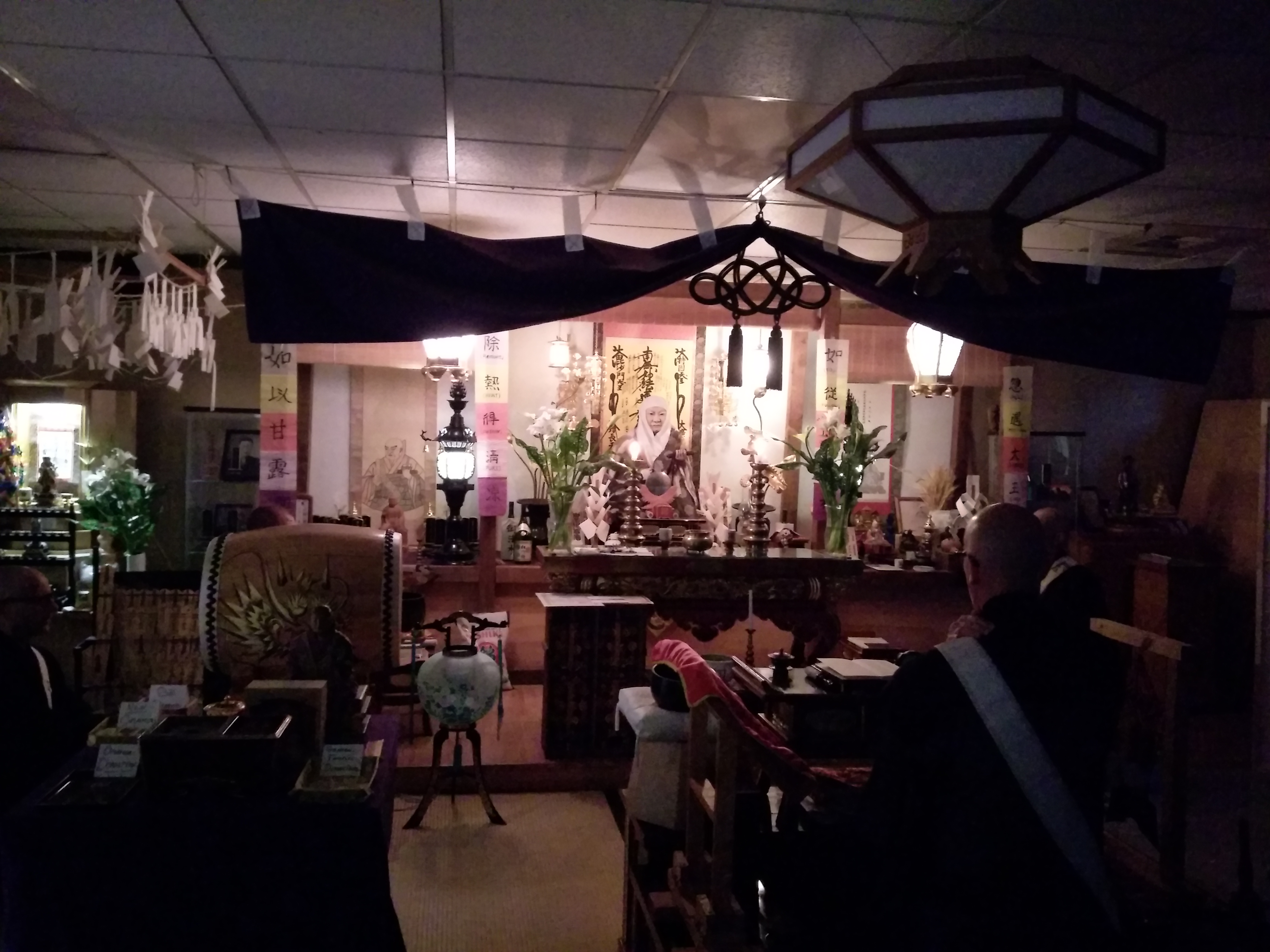
Evening service

Day 11

Day 11 continues Chapter 7, The Parable of the Magic City

Having last month seen the reaction of the Brahman-heavenly-kings of the five hundred billion worlds in the south, we conclude this portion with the view from the zenith.

“Thereupon Great-Universal-Wisdom-Excellence Tathāgata gave his tacit consent to their appeal.

“The great Brahman-[heavenly-]kings of the five hundred billion worlds in the southwest, west, northwest, north, northeast, and nadir also did the same. The great Brahman-heavenly-kings of the five hundred billion worlds in the zenith, who saw their palaces illumined more brightly than ever, also danced with joy. They wondered why [their palaces were so illumined]. They visited each other and discussed the reason, saying, ‘Why are our palaces illumined so brightly?’ There was a great Brahman­heavenly-king called Sikhin among them. He said to the other Brahmans in gāthās:

Our palaces are adorned
More brightly than ever.
Why are they illumined
By this powerful light?

We have never seen nor heard
Of such a wonderful thing as this before.
Did a god of great virtue or a Buddha appear
Somewhere in the universe?

“Thereupon the Brahman-heavenly-kings of the five hundred billion [worlds] went down, carrying flower-plates filled with heavenly flowers, in order to find [the place from where the light had come]. Their palaces also moved as they went. They [reached the Well-Composed World and] saw that Great-Universal­Wisdom-Excellence Tathāgata was sitting on the lion-like seat under the Bodhi-tree of the place of enlightenment, surrounded respectfully by gods, dragon-kings, gandharvas, kiṃnaras, mahoragas, men and non-human beings. They also saw that the sixteen princes were begging the Buddha to turn the wheel of the Dharma. They worshipped the Buddha with their heads, walked around him a hundred thousand times, and strewed heavenly flowers to him. The strewn flowers were heaped up to the height of Mt. Sumeru. The Brahman-heavenly-kings offered flowers also to the Bodhi-tree of the Buddha. Having offered flowers, they offered their palaces to the Buddha, saying, ‘We offer these palaces to you. Receive them and benefit us out of your compassion towards us!’ In the presence of the Buddha, they simultaneously praised him in gāthās with all their hearts:

How good it is to see a Buddha,
To see the Honorable Saint who saves the world!
He saves all living beings
From the prison of the triple world.

The All-Knower, the Most Honorable One of Gods and Men,
Opens the gate of the teachings as sweet as nectar,
And saves all living beings
Out of his compassion towards them.

There has been no Buddha
For the past innumerable kalpas.
Before you appeared,
The worlds of the ten quarters were dark.

The living beings in the three evil regions
And asuras are increasing.
The living beings in heaven are decreasing.
Many fall into the evil regions after their death.

They do not hear the Dharma from a Buddha
Because they did evils,
Their appearances are getting worse;
And their power and wisdom, decreasing.
Because they did sinful karmas,
They lose pleasures and the memory of pleasures.
They are attached to wrong views.
They do not know how to do good.
They are not taught by a Buddha;
Therefore, they fall into the evil regions.

Now you have appeared for the first time after a long time,
And become the eyes of the world.
You have appeared in this world
Out of your compassion towards all living beings,
And finally attained perfect enlightenment.
We are very glad.
All the others also rejoice at seeing you,
Whom they have never seen before.

Our palaces are beautifully adorned
With your light.
We offer them to you.
Receive them out of your compassion towards us!

May the merits we have accumulated by this offering
Be distributed among all living beings,
And may we and all other living beings
Attain the enlightenment of the Buddha!

Note: I’m attending the Choeizan Enkyoji Buddhist Temple summer retreat in Seattle. While I will continue to post a portion of the daily section each evening, I won’t be able to add my commentary.

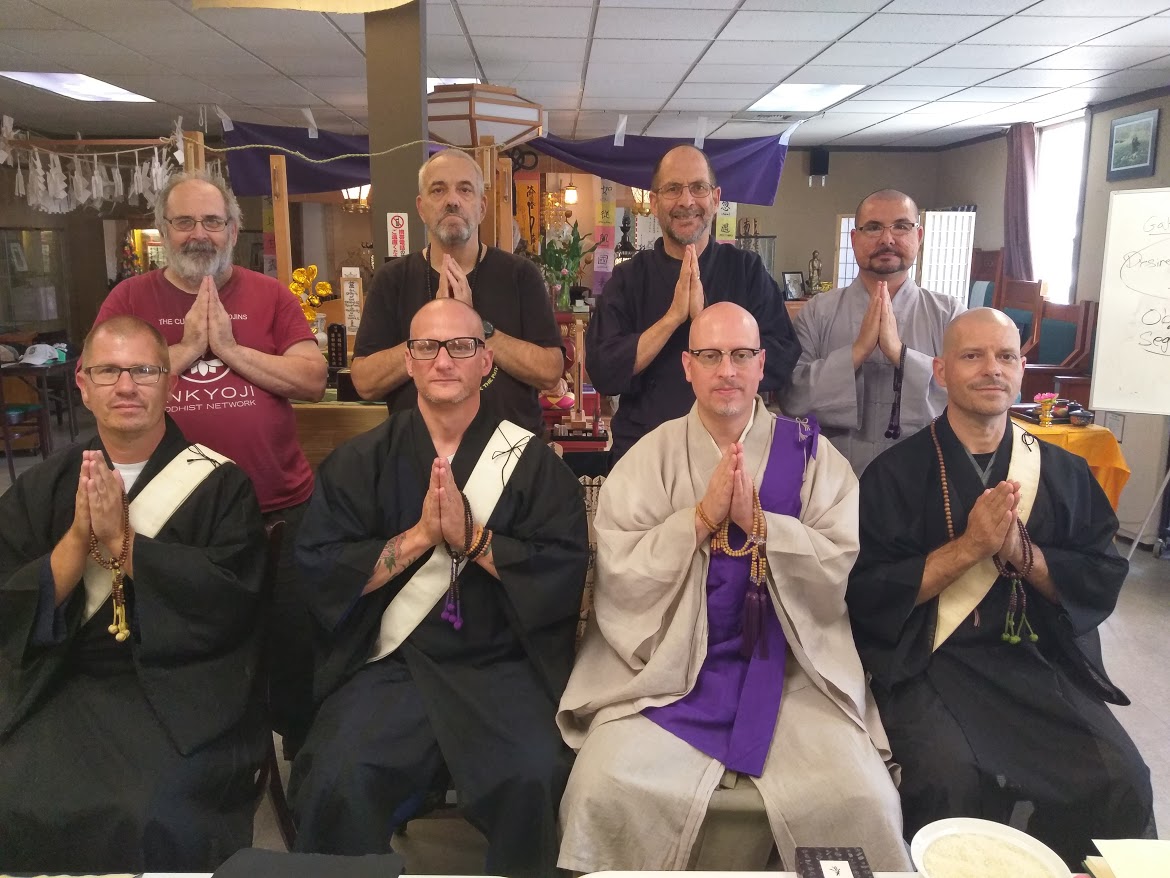
Seattle Choeizan Enkyoji Buddhist Temple summer retreat participants

Day 10

Day 10 concludes Chapter 6, Assurance of Future Buddhahood, and opens Chapter 7, The Parable of a Magic City.

Having last month covered the prediction of future Buddhahood for Great Kātyāyana in gāthās, we turn to the prediction for Great Maudgalyāyana.

Thereupon the World-Honored One said again to the great multitude:

“Now I will tell you. This Great Maudgalyāyana will make various offerings to eight thousand Buddhas, respect them, and honor them. After the extinction of each of those Buddhas, he will erect a stūpa-mausoleum a thousand yojanas high, and five hundred yojanas wide and deep. He will make it of the seven treasures: gold, silver, lapis lazuli, shell, agate, pearl and ruby. He will offer flowers, necklaces, incense applicable to the skin, incense powder, incense to burn, canopies, banners and streamers to the stūpa-mausoleum. After that he will make the same offerings to two hundred billions of Buddhas. Then he will become a Buddha called Tamālapattra-candana-Fragrance, the Tathāgata, the Deserver of Offerings, the Perfectly Enlightened One, the Man of Wisdom and Practice, the Well-Gone, the Knower of the World, the Unsurpassed Man, the Controller of Men, the Teacher of Gods and Men, the Buddha, the World-Honored One. The kalpa in which he will become that Buddha will be called Joyfulness; and his world, Mind­Happiness. The ground [of his world] will be even, made of crystal, adorned with jeweled trees, and purified with strewn flowers of pearls. Anyone will rejoice at seeing it. Innumerable gods, men, Bodhisattvas and Śrāvakas will live there. The duration of the life of that Buddha will be twenty-four small kalpas. His right teachings will be preserved for forty small kalpas, and the counterfeit of his right teachings also will be preserved for forty small kalpas.”

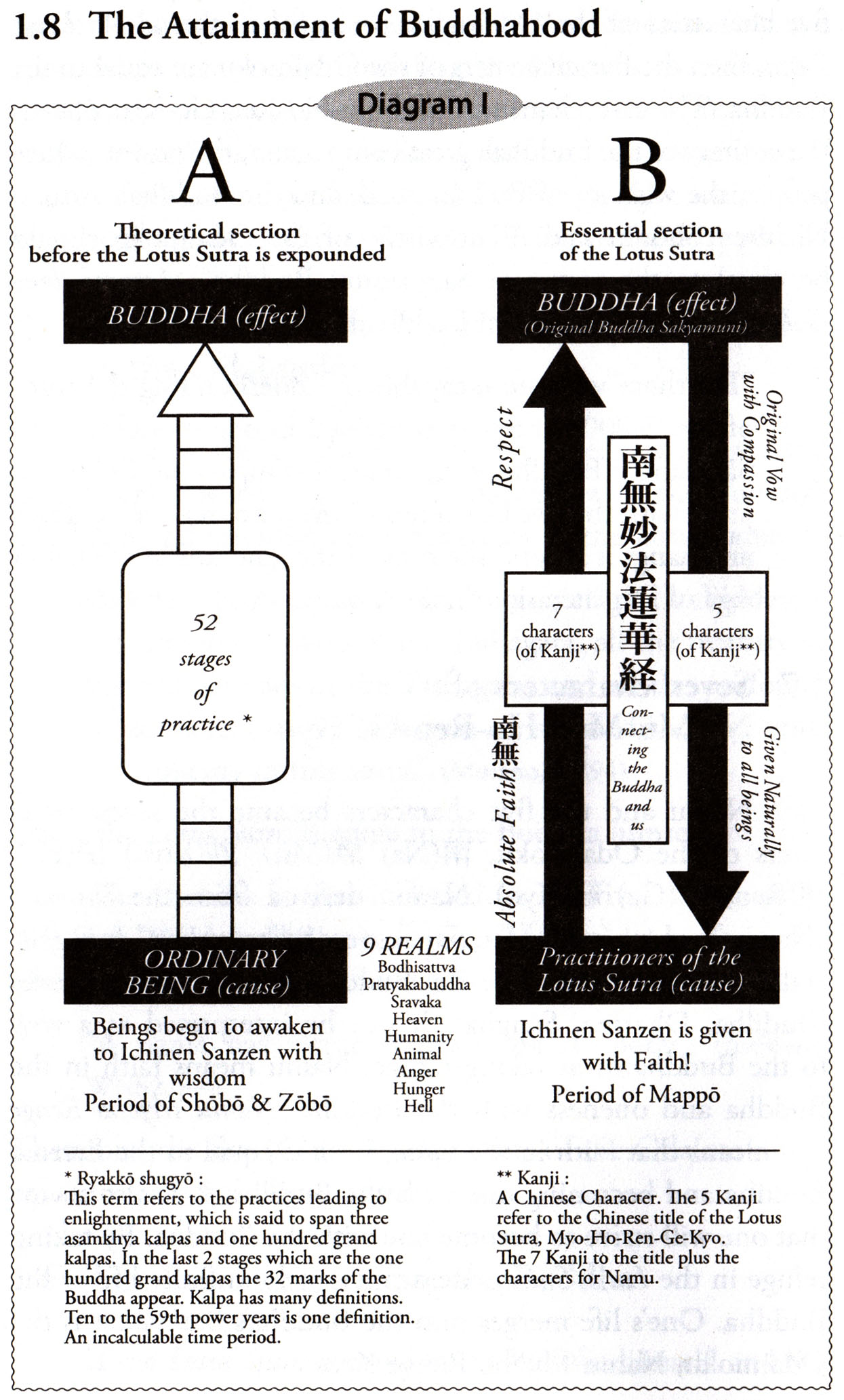
Recently I’ve been reading “Buddha Seed: Understanding the Odaimoku Namu Myoho Renge Kyo” and this is a good place to insert a discussion of The Attainment of Buddhaood.

Click for full size

Most appropriate at this point is Side A.

The pre-Lotus Sūtra teachings and the theoretical section (Shakumon), chapters 1-14 of the Lotus Sutra are shown as Diagram I-A. In these teachings, Śākyamuni appeared as an historical person bound by the limitations of space and time. Cause and effect were also presented as separate and distinct. In addition to the common meaning of cause and effect, cause also derived from the nine realms {from the realm of hell, hunger (greed), anger, animality, human, heaven, Śrāvaka (learning), Pratyakabuddha (realization) to the realm of bodhisattva}. Effect also derived from the Buddha, the realm of Buddha, enlightenment of Buddha or circumstance of Buddha.

Of course what we have today is the Seven Character Practice illustrated on Side B.

Through the practice of the seven characters of the Odaimoku, people can unite with the Eternal Buddha as a part of his life. This is known as Sokushin Jōbutsu, attaining buddhahood with one’s present form. This is also referred to as Juji Jōbutsu, attaining buddhahood by upholding the Lotus Sutra and the Odaimoku and practicing the Sūtra in one’s daily life.

Day 9

Day 9 covers Chapter 5, The Simile of Herbs, and introduces Chapter 6, Assurance of Future Buddhahood.

Having last month heard The Simile of Herbs, we consider the capacities, appearances, entities and natures of the hearers.

“The various teachings I expound are of the same content, of the same taste. Those who emancipate themselves [from the bonds of existence,] from illusions, and from birth and death, will finally obtain the knowledge of the equality and differences of all things. But those who hear or keep my teachings or read or recite the sutras in which my teachings are expounded, or act according to my teachings, do not know the merits that they will be able to obtain by these practices. Why is that? It is because only I know their capacities, appearances, entities and natures. Only I know what teachings they have in memory, what teachings they have in mind, what teachings they practice, how they memorize the teachings, how they think of the teachings, how they practice the teachings, for what purpose they memorize the teachings, for what purpose they think of the teachings, for what purpose they practice the teachings, and for what purpose they keep what teachings. Only I see clearly and without hindrance that they are at various stages [of enlightenment]. I know this, but they do not know just as the trees and grasses including herbs in the thickets and forests do not know whether they are superior or middle or inferior. My teachings are of the same content, of the same taste. Those who emancipate themselves [from the bonds of existence,] from illusions, and from birth and death, will finally attain Nirvana, that is, eternal tranquility or extinction. They will be able to return to the state of the Void.

“Although I knew the equality and differences of all things, I refrained from expounding it to them in order to protect them because I saw their [various] desires.

The Daily Dharma from Dec. 20, 2016, offers this:

Only I see clearly and without hindrance that they are at various stages [of enlightenment]. I know this, but they do not know just as the trees and grasses including herbs in the thickets and forests do not know whether they are superior or middle or inferior.

The Buddha makes this declaration in Chapter Five of the Lotus Sūtra, as he explains the simile of herbs. This is a good reminder for us on the Bodhisattva path of how important it is to have respect for all beings. We can believe we know whether someone else is less enlightened than we are, or even more enlightened than we are. But for Bodhisattvas, this belief is irrelevant. Only the Buddha knows who is where on the path. We do not need to know. We just need to find ways to benefit others, no matter how close they may be to enlightenment.

The Daily Dharma is produced by the Lexington Nichiren Buddhist Community. To subscribe to the daily emails, visit zenzaizenzai.com
Day 8

Day 8 concludes Chapter 4, Understanding by Faith, and closes the second volume of the Sutra of the Lotus Flower of the Wonderful Dharma.

Having last month discussed the son’s “greatest joy” at escaping his inheritance, now it’s time consider the expedient used by the father.

Thereupon the rich man thought of an expedient to persuade his son to come to him. He [wished to] dispatch messengers in secret. He said to two men looking worn-out, powerless and virtueless, ‘Go and gently tell the poor man that he will be employed here for a double day’s pay. If he agrees with you, bring him here and have him work. If he asks you what work he should do, tell him that he should clear dirt and that you two also will work with him.’

“The two messengers looked for the poor son. Having found him, they told him what they had been ordered to tell. The poor son [came back with them,] drew his pay in advance, and cleared dirt with them. Seeing him, the father had compassion towards him, and wondered [why he was so base and mean]. Some days later he saw his son in the distance from the window. The son was weak, thin, worn-out, and defiled with dirt and dust. The father took off his necklace, his garment of thin and soft cloth, and other ornaments. He put on tattered and dirty clothing, smeared himself with dust, and carried a dirt-utensil in his right hand. He looked fearful. He [came to the workers and] said, ‘Work hard! Do not be lazy!’

“With this expedient the father came to his son. He said to him, ‘Man! Stay here and work! Do not go anywhere else! I will pay you more. Do not hesitate to take trays, rice, flour, salt and vinegar as much as you need! You can have an old servant if you want to. Make yourself at home! I feel like your father. Do not worry any more! I am old, and you are young. When you work, you do not deceive [the other workers]. You are not lazy. You do not get angry [with the other workers], or reproach them. You are not like the other workers who do these evil things. From now on I will treat you as my son.’

“The rich man gave him a name and called him son. The poor son was glad to be treated kindly, but still thought that he was a humble employee. Therefore, the rich man had him clear dirt for twenty years. After that the father and son trusted each other. Now the son felt no hesitation in entering the house of his father, but still lodged in his old place.

There was a time when I, too, felt unworthy. How could I be the beneficiary of such treasures? I was “glad to be treated kindly, but still thought that [I] was a humble employee.

This quote from the Lecture on the Lotus Sutra fits well here:

Every day we look around us and we see our worlds our lives as being perhaps small and full of suffering or troubles. Yet the image that is presented to us in the ceremony in the air is an expansive one and one of great beauty. Just as the seating of the two Buddhas side by side presents us with a view of the eternity of time, the image of the joined worlds is one of infinite space. So now we have an expansive time element and an expansive space element all in one moment.

When we place ourselves in front of the Honzon as presented in the Lotus Sutra in these chapters we place ourselves outside of our present time and our present space. Again this allows us the opportunity to view our current condition in this life as really one of great reward. How many people everyday participate in such a grand drama?

It is not easy for us to see this as we live out our lives and experience our day-to-day problems. Yet this is the invitation that the Buddha makes to us – to realize that we are not merely some lonely person chanting Odaimoku and practicing the Lotus Sutra, but that we are actually participants in a drama unlike anything that can be contained by either space or time.Lecture on the Lotus Sutra

Day 7

Day 7 concludes Chapter 3, A Parable, and begins Chapter 4, Understanding by Faith.

Having last month considered the teaching of the One Buddha Vehicle, we are reminded that the Buddha is our father and we are all Bodhisattvas.

(The Buddha said to Śāriputra:)
All of you
All Are of my you children.
I am your father.

You were under the fires of many sufferings
For the past innumerable kalpas.
Therefore, I saved you
From the triple world [with expedients].

I once told you that you had attained extinction.
But you eliminated only birth and death
[By that extinction].
The extinction you attained was not the true one.
What you should do now is
Obtain the wisdom of the Buddha.

The Bodhisattvas in this multitude
Should hear
With one mind
The true teaching of the Buddhas.

The Buddhas, the World-Honored Ones,
Say only expediently [that some are not Bodhisattvas]
To tell the truth,
All living beings taught by them are Bodhisattvas.

The Daily Dharma from March 24, 2016, offers this:

This verse comes from Chapter Three of the Lotus Sūtra. In Chapter Two, the Buddha declared that he only teaches Bodhisattvas. If we believe that we are not Bodhisattvas, we could conclude that the Buddha does not teach us. Part of what the Buddha is explaining here is that we are all Bodhisattvas. The way to reach the Buddha’s enlightenment is by living as Bodhisattvas: beings whose every breath is intended to improve our world.

The Daily Dharma is produced by the Lexington Nichiren Buddhist Community. To subscribe to the daily emails, visit zenzaizenzai.com
Day 6

Day 6 continues Chapter 3, A Parable

Having last month considered the expedient used to save the children, we now consider whether this constituted a falsehood.

“The children rode in the large carts, and had the greatest joy that they had ever had because they had never expected to get them. Śāriputra! What do you think of this? Do you think that the rich man was guilty of falsehood when he gave his children the large carts of treasures?”

Śāriputra said:

“No, World-Honored One! He saved his children from the fire and caused them to survive. [Even if he had not given them anything,] he should not have been accused of falsehood because the children should be considered to have already been given the toys [they had wished to have] when they survived. He saved them from the burning house with the expedient. World-Honored One! Even if he had not given them the smallest cart, he should not have been accused of falsehood because he thought at first, ‘I will cause them to get out with an expedient.’ Because of this, he should not. Needless to say, he was not guilty of falsehood when he remembered his immeasurable wealth and gave them the large carts in order to benefit them.”

The Buddha said to Śāriputra:

“So it is, so it is. It is just as you say. Śāriputra! The same can be said of me. [I thought, ‘] I am the father of the world. I eliminated fear, despondency, grief, ignorance and darkness. I obtained immeasurable insight, powers and fearlessness. I have great supernatural powers, the power of wisdom, the paramita of expedients, the paramita of wisdom, great compassion, and great loving-kindness. I am not tired of seeking good things or of benefiting all living beings. I have appeared in the triple world, which can be likened to the rotten and burning house, in order to save all living beings from the fires of birth, old age, disease, death, grief, sorrow, suffering, lamentation, stupidity, darkness, and the three poisons, to teach all living beings, and to cause them to attain Anuttara-samyak-saṃbodhi. I see that all living beings are burned by the fires of birth, old age, disease, death, grief, sorrow, suffering and lamentation. They undergo various sufferings because they have the five desires and the desire for gain. Because they have attachments and pursuits, they have many sufferings in their present existence, and will suffer in hell or in the world of animals or in the world of hungry spirits in their future lives. Even when they are reborn in heaven or in the world of humans, they will still have many sufferings such as poverty or parting from their beloved ones or meeting with those whom they hate. Notwithstanding all this, however, they are playing joyfully. They are not conscious of the sufferings. They are not frightened at the sufferings or afraid of them. They do not dislike them or try to get rid of them. They are running about this burning house of the triple world, and do not mind even when they undergo great sufferings.[‘]

The Daily Dharma from April 25, 2017, offers this:

The Buddha offers this explanation to his disciple Śāriputra in Chapter Three of the Lotus Sūtra. He compares his teaching of suffering and Nirvāṇa to a father luring his children from a dangerous house with a promise of better toys. The children were so preoccupied with their own entertainment that they could not hear their father’s warning. In this triple world of beautiful forms, fascinating ideas and consuming desires, it is easy to stay with our childish games and ignore the Buddha’s teaching. Our maturity as Bodhisattvas comes when we set these aside for the benefit of all beings.

The Daily Dharma is produced by the Lexington Nichiren Buddhist Community. To subscribe to the daily emails, visit zenzaizenzai.com

Day 5

Day 5 begins Chapter 3, A Parable

Having last month sung in gāthās of Śāriputra’s future Buddhahood, we witness the reaction of the great multitude to the news.

At that time the great multitude included bhikṣus, bhikṣunīs, upāsakās and upāsikās, that is, the four kinds of devotees; and gods, dragons, yakṣas, gandharvas, asuras, garuḍas, kiṃnaras and mahoragas. When they saw that Śāriputra was assured of his future attainment of Anuttara-samyak-saṃbodhi by the Buddha, they danced with great joy. They took off their garments and offered them to the Buddha. Śakra-Devanam-Indra, the Brahman Heavenly-King, and innumerable other gods also offered their wonderful heavenly garments and the heavenly flowers of mandāravas and mahā-mandāravas to the Buddha. The heavenly garments, which had been released from the hands of the gods, whirled in the sky. The gods simultaneously made many thousands of millions of kinds of music in the sky, and caused many heavenly flowers to rain down.

They said, “The Buddha turned the first wheel of the Dharma at Varanasi a long time ago. Now he turns the wheel of the unsurpassed and greatest Dharma.”

Thereupon the gods, wishing to repeat what they had said, sang in gāthās:

The Buddha turned the wheel of the teaching of the Four Truths
At Varanasi a long time ago.
He taught that all things are composed of the five aggregates
And that they are subject to rise and extinction.

Now he turns the wheel of the Dharma,
The most wonderful, unsurpassed, and greatest.
The Dharma is profound.
Few believe it.
So far we have heard
Many teachings of the World-Honored One.
But we have never heard
Such a profound, wonderful, and excellent teaching as this.
We are very glad to hear this
From the World-Honored One.

Śāriputra, a man of great wisdom,
Was assured of his future Buddhahood.
We also shall be able
To become Buddhas,
And to receive
The highest and unsurpassed honor in the world.

The Buddha expounds his enlightenment, difficult to understand,
With expedients according to the capacities of all living beings.
We obtained merits by the good karmas which we did
In this life of ours and in our previous existence.
We also obtained merits by seeing the Buddha.
May we attain the enlightenment of the Buddha by these merits!

Yes, such a profound, wonderful, and excellent teaching.