Category Archives: LS32

Day 28

Day 28 covers all of Chapter 24, Wonderful-Voice Bodhisattva, and concludes the Seventh Volume of the Sutra of the Lotus Flower of the Wonderful Dharma.

Having last month met Wonderful-Voice Bodhisattva in the All-Pure-Light-Adornment World, we hear his request to visit the Sahā World and Pure-Flower-Star-King-Wisdom Buddha’s travel advice.

When he was illumined by the light of Śākyamuni Buddha, he said to the Pure-Flower-Star-King-Wisdom Buddha:

“World-Honored One! I wish to visit the Sahā-World, bow to Śākyamuni Buddha, attend on him, and make offerings to him. I also wish to see Mañjuśrī Bodhisattva, who is the Son of the King of the Dharma. [I also wish to see] Medicine-King Bodhisattva, Brave-In-Giving Bodhisattva, Star-King-Flower Bodhisattva, Superior-Practice-Intent Bodhisattva, Adornment-King Bodhisattva, and Medicine-Superior Bodhisattva.”

Thereupon Pure-Flower-Star-King-Wisdom Buddha said to Wonderful-Voice Bodhisattva:

“Do not despise that world! Do not consider it to be inferior [to our world]! Good Man! The Sahā-World is not even. It is full of mud, stones, mountains’ and impurities. The Buddha [of that world] is short in stature! So are the Bodhisattvas [of that world]. You are forty-two thousand yojanas tall. I am six million an eight hundred thousand yojanas tall. You are the most handsome. You have thousands of millions of marks of merits, and your light is wonderful. Do not despise that world when you go there! Do not consider that the Buddha and Bodhisattvas of that world are inferior [to us]! Do not consider that that world is inferior [to ours]!”

The Daily Dharma from June 28, 2016, offers this:

In Chapter Twenty-Four of the Lotus Sūtra, the Buddha sends a light from his forehead to the world in which Wonderful-Voice Bodhisattva lives. When that Bodhisattva saw this light from Śākyamuni Buddha, he asked permission from the Buddha he was attending to visit our world of conflict. The instruction he receives from his Buddha reminds us that no matter what advantages we have gained from our practice of the Buddha Dharma, these do not make us any better or worse than those we are determined to benefit.

The Daily Dharma is produced by the Lexington Nichiren Buddhist Community. To subscribe to the daily emails, visit zenzaizenzai.com

Day 27

Day 27 concludes Chapter 23, The Previous Life of Medicine-King Bodhisattva.

Having last month covered the predictions of salvation, we come to the merits to be obtained.

“Star-King-Flower! Anyone who hears [especially] this chapter of the Previous Life of Medicine-King Bodhisattva also will be able to obtain innumerable merits. The woman who hears and keeps this chapter of the Previous Life of Medicine-King Bodhisattva will not be a woman in her next life. The woman who hears this sūtra and acts according to the teachings of it in the later’ five hundred years after my extinction, will be able to be reborn, after her life in this world, [as a man sitting] on the jeweled seat in the lotus flower blooming in the World of Happiness where Amitayus Buddha lives surrounded by great Bodhisattvas. He [no more she] will not be troubled by greed, anger, ignorance, arrogance, jealousy, or any other impurity. He will be able to obtain the supernatural powers of a Bodhisattva and the truth of birthlessness. When he obtains this truth, his eyes will be purified. With his purified eyes, he will be able to see seven billion and two hundred thousand million nayuta Buddhas or Tathāgatas, that is, as many Buddhas as there are sands in the River Ganges. At that time those Buddhas will praise him, saying simultaneously from afar, ‘Excellent, excellent, good man! You kept, read and recited this sūtra, thought it over, and expounded it to others under Śākyamuni Buddha. Now you have obtained innumerable merits and virtues, which cannot be burned by fire or washed away by water. Your merits cannot be described even by the combined efforts of one thousand Buddhas. Now you have defeated the army of Mara, beaten the forces of birth and death, and annihilated all your enemies. Good man! Hundreds of thousands of Buddhas are now protecting you by their supernatural powers. None of the gods or men in the world surpasses you. None but the Tathāgatas, none of the Śrāvakas or Pratyekabuddhas or Bodhisattvas surpasses you in wisdom and dhyāna-concentration.’ Star-King-Flower! [He is a Bodhisattva.] This Bodhisattva will obtain these merits and the power of wisdom.

“Anyone who rejoices at hearing this chapter of the Previous Life of Medicine-King Bodhisattva and praises [this chapter], saying, ‘Excellent,’ will be able to emit the fragrance of the blue lotus flower from his mouth and the fragrance of the candana of Mt. Ox-Head from his pores, and obtain these merits in his present life.

I take the promises of the Lotus Sutra in faith and try to ponder the meaning beyond the literal. First we have “The woman who hears this sūtra and acts according to the teachings of it in the later’ five hundred years after my extinction, will be able to be reborn, after her life in this world, [as a man sitting] on the jeweled seat in the lotus flower blooming in the World of Happiness where Amitayus Buddha lives surrounded by great Bodhisattvas. He [no more she] will not be troubled by greed, anger, ignorance, arrogance, jealousy, or any other impurity…” And then we have “Anyone who rejoices at hearing this chapter of the Previous Life of Medicine-King Bodhisattva and praises [this chapter], saying, ‘Excellent,’ will be able to emit the fragrance of the blue lotus flower from his mouth and the fragrance of the candana of Mt. Ox-Head from his pores, and obtain these merits in his present life.” As promises go, I think I’d rather be a woman.

Day 26

Day 26 concludes Chapter 21, The Supernatural Powers of the Tathāgatas, includes Chapter 22, Transmission, and introduces Chapter 23, The Previous Life of Medicine-King Bodhisattva.

Having last month concluded this day’s portion of The Previous Life of Medicine-King Bodhisattva, we return to the top and the Supernatural Powers of the Tathāgatas.

Thereupon the Buddha said to the great Bodhisattvas headed by Superior-Practice:

“The supernatural powers of the Buddhas are as immeasurable, limitless, and inconceivable as previously stated. But I shall not be able to tell all the merits of this sūtra to those to whom this sūtra is to be transmitted even if I continue telling them by my supernatural powers for many hundreds of thousands of billions of asaṃkhyas of kalpas. To sum up, all the teachings of the Tathāgata, all the unhindered, supernatural powers of the Tathāgata, all the treasury of the hidden core of the Tathāgata, and all the profound achievements of the Tathāgata are revealed and expounded explicitly in this sūtra. Therefore, keep, read, recite, expound and copy this sūtra, and act according to the teachings of it with all your hearts after my extinction! Iµ any world where anyone keeps, reads, recites, expounds or copies this sūtra, or acts according to its teachings, or in any place where a copy of this sūtra is put, be it in a garden, in a forest, under a tree, in a monastery, in the house of a person in white robes, in a hall, in a mountain, in a valley, or in the wilderness, there should a stupa be erected and offerings be made to it because, know this, the place [where the stupa is erected] is the place of enlightenment. Here the Buddhas attained Anuttara-samyak-saṃbodhi. Here the Buddhas turned the wheel of the Dharma. Here the Buddhas entered into Parinirvana.”

The Daily Dharma from May 7, 2017, offers this:

To sum up, all the teachings of the Tathāgata, all the unhindered, supernatural powers of the Tathāgata, all the treasury of the hidden core of the Tathāgata, and all the profound achievements of the Tathāgata are revealed and expounded explicitly in this sūtra. Therefore, keep, read, recite, expound and copy this sūtra, and act according to the teachings of it with all your hearts after my extinction!

The Buddha makes this declaration to Superior-Practice Bodhisattva (Jōgyo, Viśiṣṭacārītra) in Chapter Twenty-One of the Lotus Sūtra. In Chapter Two, the Buddha told those gathered to hear him teach that his highest teaching could not be attained by reasoning alone. These two passages show us faith to look beyond the words in this book to find the Buddha Dharma in every aspect of our lives, and the ever-present Buddha leading us all to enlightenment.

The Daily Dharma is produced by the Lexington Nichiren Buddhist Community. To subscribe to the daily emails, visit zenzaizenzai.com

Day 25

Day 25 covers all of Chapter 20, Never-Despising Bodhisattva, and opens Chapter 21, The Supernatural Powers of the Tathāgatas.

Having last month learned of the retribution earned by those who abused Never-Despising Bodhisattva, we begin again in gāthās.

Thereupon the World-Honored One, wishing to repeat what he had said, sang in gāthās:

There was once a Buddha,
Called Powerful-Voice-King.
His supernatural powers and wisdom
Were immeasurable.
Leading all living beings, he is honored
By gods, men and dragons with offerings.

Some time after the extinction of that Buddha,
His teachings had almost died out.
At that time there lived a Bodhisattva
Called Never-Despising.
The four kinds of devotees at that time
Were attached to views.

Never-Despising Bodhisattva
Went to them,
And said,
“I do not despise you
Because you will practice the Way
And become Buddhas.”

When they heard this,
They spoke ill of him and abused him.
But Never-Despising Bodhisattva
Endured all this.

Thus he expiated his sin.
When he was about to pass away,
He heard this sūtra,
And had his six sense-organs purified.
He prolonged his life
By his supernatural powers,
And expounded this sūtra
To many people.

Those who were attached to views
Were led into the Way
To the enlightenment of the Buddha
By this Bodhisattva.

Never-Despising [Bodhisattva] met
Innumerable Buddhas after the end of his life.
He expounded this sūtra,
And obtained innumerable merits,
He quickly attained the enlightenment of the Buddha
By these accumulated merits.

Nichiren Shu has an appropriate brochure that focuses on the lesson of Never-Despising Bodhisattva. The brochure begins:

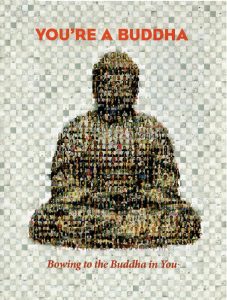
When we press our palms together in gassho and bow to greet others, we are seeing the Buddha within them that is part of their true nature. Never-Despising Bodhisattva never met a man or woman he didn’t like. Within every person, he could see the divine Buddha nature or Buddha seed within waiting to be acknowledged and nourished. This is one of the most compelling teachings of Buddhism. We are all Buddhas. Everything we need is already inside us. It’s just a matter of our faith and practice to peel away layers to reveal what is already there.

You're A Buddha
Click on the image to read the brochure.

Day 24

Day 24 concludes Chapter 19, The Merits of the Teacher of the Dharma and closes the Sixth Volume of the Sutra of the Lotus Flower of the Wonderful Dharma.

Having last month completed the merits of the nose, we come to the merits of the tongue.

“Furthermore, Constant-Endeavor! The good men or women who keep, read, recite, expound or copy this sūtra, will be able to obtain twelve hundred merit of the tongue. Anything which tastes good, bad, delicious, distasteful, bitter or astringent, will become as delicious as the nectar of heaven and not distasteful when it is put on their tongues. When they expound the Dharma to the great multitude with their tongues, they will be able to raise deep and wonderful voices, to cause their voices to reach the hearts of the great multitude so that the great multitude may be joyful and cheerful. Hearing their speeches given in good order by their deep and wonderful voices, Śakra, Brahman, and the other gods and goddesses will come and listen to them. In order to hear the Dharma, dragons, dragons’ daughters, gandharvas, gandharvas’ daughters, asuras, asuras’ daughters, garuḍas, garuḍas’ daughters, kiṃnaras, kiṃnaras’ daughters, mahoragas, and mahoragas’ daughters also will come to them, respect them, and make offerings to them. Bhikṣus, bhikṣunīs, upāsakās, and upāsikās; and kings, princes, ministers, and their attendants [also will come and hear the Dharma]. The wheel-turning[holy-]kings of small [countries], and the wheel-turning-[holy-]kings of great [countries, each of whom has the] seven treasures and one thousand children, also will come with their [treasures, children and] internal and external retinues, riding in their [movable] palaces, and hear the Dharma. These [good men or women, that is,] Bodhisattvas will expound the Dharma so well that the brahmanas, householders, and people of their country will, throughout their lives, attend on them, and make offering to them. The Śrāvakas, Pratyekabuddhas, Bodhisattvas, and Buddhas also will wish to them. [These good men or women] will expound the Dharma in the places which the Buddhas will face. They will keep all the teaching of the Buddhas and raise deep and wonderful voices of the Dharma.”

The Daily Dharma from May 22, 2017, offers this:

When they expound the Dharma to the great multitude with their tongues, they will be able to raise deep and wonderful voices, to cause their voices to reach the hearts of the great multitude so that the great multitude may be joyful and cheerful. Hearing their speeches given in good order by their deep and wonderful voices, Śakra, Brahman, and the other gods and goddesses will come and listen to them.

The Buddha declares these lines to Constant-Endeavor Bodhisattva in Chapter Nineteen of the Lotus Sūtra, describing those who keep the Lotus Sūtra. When we share the Buddha Dharma with others, it is as if the Buddha’s mind is finding voice in our words. It should then come as no surprise to us that beings of all dispositions will want to hear more of what the Buddha has taught us. When we “practice the sūtra with our bodies,” as Nichiren described, when we make this teaching a part of our lives, then we find the words we need to reach all beings and lead them to the Buddha’s enlightenment.

The Daily Dharma is produced by the Lexington Nichiren Buddhist Community. To subscribe to the daily emails, visit zenzaizenzai.com

Day 23

Day 23 covers all of Chapter 18, The Merits of a Person Who Rejoices at Hearing This Sutra, and opens Chapter 19, The Merits of the Teacher of the Dharma.

Having last month begun the Merits of the Teacher of the Dharma, we repeat what we said and sing in gāthās of the merits of the eyes:

Thereupon the World-Honored One, wishing to repeat what he had said, sang in gāthās:

Listen! I will tell you of the merits
Of those who fearlessly expound
To the great multitude
This Sūtra of the Lotus Flower of the Wonderful Dharma.

They will be able to obtain the excellent yes
Adorned with eight hundred merits.
Their eyes will be pure
Because of this adornment.

With their eyes given by their parents,
They will be able to see Mt. Meru, Mt. Sumeru,
The Surrounding Iron Mountains,
And the other mountains,
And the forests, oceans and rivers
Inside and outside the one thousand million Sumeru-worlds.

They will be able to see the living beings
Of those worlds [each being composed of the six regions]
Down to the Avici Hell and up to the Highest Heaven.
Although they have not yet obtained heavenly eyes,
They will be able to see all this
With their natural eyes.

Underscore with this first of the sense organs They will be able to see all this With their natural eyes.

Day 22

Day 22 covers all of Chapter 17, The Variety of Merits.

Having last month concluded Maitreya’s gāthās of praise for the Buddha, we come to the innumerable merits to obtained by understanding by faith the longevity of the Buddha.

Thereupon the Buddha said to Maitreya Bodhisattva-mahāsattva: “Ajita! Anyone who hears that my life is so long, and understands it by faith even at a moment’s thought, will be able to obtain innumerable merits. Suppose good men or women practiced [the six pāramitās] except the prajñā-pāramitā, that is, the five pāramitās: the dāna-pāramitā, the sīla-pāramitā, the kṣānti-pāramitā, the vīrya-pāramitā, and the dhyāna-pāramitā, for eighty billion nayuta kalpas in order to attain Anuttara-samyak-saṃbodhi. These merits of the good men or women are far less than one hundredth or one thousandth of the merits of the person [who understand my longevity by faith even at a moment’s thought], or less than his merits divided by one hundred thousand billion. [The superiority of his merits to theirs] cannot be explained by any calculation or parable or simile.

It cannot be that the good man who obtained merits [by understanding my longevity by faith even at a moment’s thought] falters in walking the Way to Anuttara-samyak-saṃbodhi.”

The Daily Dharma from April 10, 2017, offers this:

The Buddha makes this declaration to the Bodhisattva Maitreya in Chapter Seventeen of the Lotus Sūtra. We all have experiences that take a long time either to understand or to realize what affect they have had on our lives. We may even forget the experience and not be able to connect it with a present situation. This is also true with the experience of hearing the Buddha teach. We hear him declare that he is ever-present, always leading us to enlightenment. Then the memory of that teaching becomes obscured by our daily pursuits and attachments. By reminding ourselves and each other of this highest teaching, we regain our right minds and walk confidently on the path to the Buddha’s own enlightenment (Anuttara-samyak-saṃbodhi).

The Daily Dharma is produced by the Lexington Nichiren Buddhist Community. To subscribe to the daily emails, visit zenzaizenzai.com

Day 21

Day 21 covers all of Chapter 16, The Duration of the Life of the Tathāgata.

Having last month considered the duration of the life of the Tathāgata, we begin the Parable of the Skillful Physician and His Sick Children.

“I will tell you a parable. There was once an excellent and wise physician. He was good at dispensing medicines and curing diseases. He had many sons, numbering ten, twenty, or a hundred. [One day] he went to a remote country on business. After he left home, the sons took poison. The poison passed into their bodies, and the sons writhed in agony, rolling on the ground. At that time the father returned home. Some sons had already lost their right minds while the others still had not. All the sons saw their father in the distance and had great joy. They begged him on their knees, saying, ‘You came back safely. We were ignorant. We took poison by mistake. Cure us, and give us back our lives!’

“Seeing his sons suffering so much, the father consulted books of prescriptions, and collected good herbs. having a good color, smell and taste. He compounded a medicine by pounding and sieving the herbs, and gave it to them, saying, ‘This is a very good medicine. It has good color, smell and taste. Take it! It will remove the pain at once and you will not suffer any more.’

“The sons who had not lost their right minds saw that this good medicine had a good color and smell, took it at once, and were cured completely. But the sons who had already lost their right minds did not consent to take the medicine given to them, although they rejoiced at seeing their father come home and asked him to cure them, because they were so perverted that they did not believe that this medicine having a good color and smell had a good taste.

I read this portion of the parable many times before I realized this lesson in faith. We can test the appearance of something and the smell of it, but it is only when we consume something that we can learn of its taste. Fear that something will not taste good prevents us from trying. Faith allows us to consume the Sūtra of the Lotus Flower of the Wonderful Dharma and to know the truth of its good taste.

Day 20

Day 20 completes Chapter 15, The Appearance of Bodhisattvas from Underground, and concludes the Fifth Volume of the Sutra of the Lotus Flower of the Wonderful Dharma.

Having last month heard Śākyamuni’s response to the greetings of the four great Bodhisattvas, we come to the reaction of Maitreya Bodhisattva.

Thereupon Maitreya Bodhisattva and the [other] Bodhisattvas [who had already been present in the congregation before the arrival of the Bodhisattvas from underground], eight thousand times as many as the sands of the River Ganges in number, thought:

‘We have never before seen these great Bodhisattva-mahāsattvas who sprang up from underground, stood before [Śākyamuni,] the World-Honored One, joined their hands together towards him, and made offerings to him. [Now we see that their leaders] inquire after him.’

Thereupon Maitreya Bodhisattva-mahāsattva, seeing what the Bodhisattvas numbering eight thousand times as many as the sands of the River Ganges had in their minds, and also wishing to remove his own doubts, joined his hands together towards the Buddha, and asked him in gāthās:

We have never seen
These many thousands of billions
Of Bodhisattvas.
Tell me, Most Honorable Biped!
Where did they come from?
They have gigantic bodies,
Great supernatural powers, and inconceivable wisdom.
They are resolute in mind.
They have a great power of patience.
All living beings are glad to see them.
Where did they come from?

They are each accompanied
By as many attendants
As there are sands
In the River Ganges.

Some great Bodhisattvas are each accompanied by attendants
Sixty thousand times as many as the sands of the River Ganges.
They are seeking the enlightenment of the Buddha
With all their hearts.

The number of these great teachers is sixty thousand times
The number of the sands of the River Ganges.
They came together and made offerings to you.
Now they protect and keep this sūtra.
The attendants or disciples accompanying
Each [of the other great Bodhisattvas] number
Fifty thousand times or forty thousand times
Or thirty thousand times or twenty thousand times
Or ten thousand times or a thousand times
Or a hundred times as many as the sands of the River Ganges,
Or a half, a third, or a quarter
Of the number of the sands of the River Ganges,
Or as many as the sands of the River Ganges Divided by a billion;
Or ten million nayuta, a billion or fifty million,
Or a million, ten thousand, a thousand or a hundred,
Or fifty, ten, three, two or one.
[The great Bodhisattvas] who are accompanied
By less attendants are even more numerous.
Some [great Bodhisattvas] have no attendants
Because they prefer a solitary life.
They are the most numerous.
They came together to you.

No one will be able to count
All [these great Bodhisattvas] even if he uses
A counting wand for more kalpas
Then the number of the sands of the River Ganges.

These Bodhisattvas have
Great powers, virtues and energy.
Who expounded the Dharma to them? Who taught them?
Who qualified them to attain [perfect enlightenment]?

Under whom did they begin to aspire for enlightenment?
What teaching of the Buddha did they extol?
What sūtra did they keep and practice?
What teaching of the Buddha did they study?

These Bodhisattvas have supernatural powers
And the great power of wisdom.
The ground of this world quaked and cracked.
They sprang up from under the four quarters of this world.

World-Honored One!
I have never seen them before.
I do not know
Any of them.

They appeared suddenly from underground.
Tell me why!
Many thousands of myriads
Of millions of Bodhisattvas
In this great congregation
Also want to know this.

There must be some reason.
Possessor of Immeasurable Virtues!
World-Honored One!
Remove our doubts!

The Daily Dharma from July 24, 2016, offers this:

We have never seen
These many thousands of billions
Of Bodhisattvas.
Tell me, Most Honorable Biped!
Where did they come from?

Maitreya Bodhisattva sings these verses to the Buddha in Chapter Fifteen of the Lotus Sūtra. In the story, the Buddha has asked who among those gathered to hear him teach will continue teaching this Wonderful Dharma in our world of suffering after the Buddha passes into his final extinction. Some Bodhisattvas say they will teach in other worlds, since the beings of this world are too defiled to hear the Buddha’s teaching. Other Bodhisattvas vow to remain in our world, but the Buddha tells them not to bother. At that moment, the ground cracks open, and innumerable Bodhisattvas spring up and vow to carry on the work of the Buddha. Maitreya and others had never seen these Bodhisattvas before. His asking the Buddha respectfully to explain what they do not understand. This example emphasizes that we must continue to question how the Buddha’s teaching applies to our lives rather than dogmatically accepting whatever happens.

The Daily Dharma is produced by the Lexington Nichiren Buddhist Community. To subscribe to the daily emails, visit zenzaizenzai.com

Day 19

Day 19 concludes Chapter 14, Peaceful Practices, and begins Chapter 15, The Appearance of Bodhisattvas from Underground.

Having last month witnessed the arrival of Bodhisattvas from Underground, we conclude this portion of the chapter with the introduction of the leaders and their greeting to Śākyamuni.

Those Bodhisattvas had four leaders: 1. Superior-Practice, 2. Limitless-Practice, 3. Pure-Practice, and 4. Steadily-Established-Practice. These four [great] Bodhisattvas were the highest leaders [of those Bodhisattvas]. In the presence of the great multitude, they joined their hands together towards Śākyamuni Buddha, looked up at him, and inquired after him saying:

“World-Honored One! Are you in good health? Are you peaceful or not? Are the living beings, whom you are to save, ready to receive your teachings or not? Do they not fatigue you?’

Thereupon the four great Bodhisattvas sang in gāthās:

World-Honored One, are you peaceful?
Are you in good health?
Are you not tired
With teaching the living beings?
Are they ready
To receive your teaching,
Or are they not?
Do they not fatigue you?

Rev. Ryusho Jeffus offers this observation in Physicians Good Medicine:

The Bodhisattvas who arose in Chapter 15, The Appearance of Bodhisattvas from Underground, did not go to the Buddha and say, “What will you give us?” They went to the Buddha and asked him how he was, if he was in good health, and if he was well enough to teach. They did not sit and wait for things to come to them. They vowed to spread the Lotus Sutra in this Sahā world. They promised the Buddha that they would work tirelessly to teach others no matter the difficulty they faced.
Physician's Good Medicine