Category Archives: LS32

Day 30

Day 30 covers all of Chapter 26, Dhāraṇīs

Having last month heard the dharani spells of World-Holding Heavenly-King, we come to the rākṣasas and the Mother of Devils.

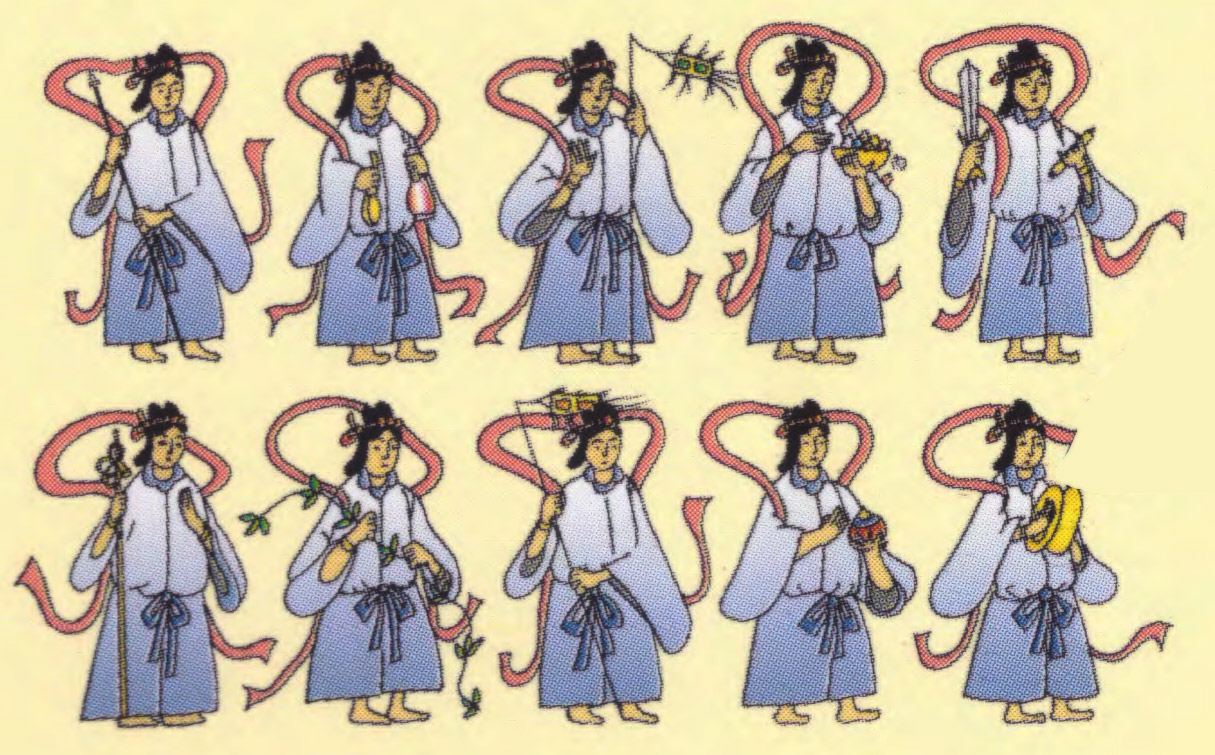
There are rākṣasas called 1. Lambā, 2. Vilambā, 3. Crooked-Teeth, 4. Flower-Teeth, 5. Black-Teeth, 6. Many-Hairs, 7. Insatiable, 8. Necklace-Holding, 9. Kuntī, and 10. Plunderer-Of-Energy-Of-All-Beings. These ten rākṣasas [and their attendants] came to the Buddha, together with Mother-Of-Devils and her children and attendants. They said to the Buddha simultaneously:

“World-Honored One! We also will protect the person who reads, recites and keeps the Sūtra of the Lotus Flower of the Wonderful Dharma so that he may have no trouble. No one shall take advantage of the weak points of this teacher of the Dharma.”

Then they uttered spells before the Buddha:

“Ideibi (1), ideibin (2), ideibi (3), adeibi ( 4), ideibi (5), deibi (6), deibi (7), deibi (8), deibi (9), deibi (10), rokei (11), rokei (12), rokei (13), rokei (14), takei (15), takei (16), takei (17), tokei (18), tokei (19).”

Whenever I get to this stopping point, I like to resurrect the drawing of the 10 rākṣasas from Lotus World.

10 Rākṣasas Daughters from book Lotus World

Day 29

Day 29 covers all of Chapter 25, The Universal Gate of World-Voice-Perceiver Bodhisattva.

Having last month skipped ahead to discuss the light of World-Voice-Perceiver, we return to how World-Voice-Perceiver Bodhisattva goes about this Sahā-World.

Endless-Intent Bodhisattva said to the Buddha:

“World-Honored One! How does World-Voice-Perceiver Bodhisattva go about this Sahā-World? How does he expound the Dharma to the living beings? What expedients does he employ?”

The Buddha said to Endless-Intent Bodhisattva:

“Good man! In a certain world, World-Voice-Perceiver Bodhisattva takes the shape of a Buddha and expounds the Dharma to those who are to be saved by a Buddha. He takes the shape of a Pratyekabuddha and expounds the Dharma to those who are to be saved by a Pratyekabuddha. He takes the shape of a Śrāvaka and expounds the Dharma to those who are to be saved by a Śrāvaka. He takes the shape of King Brahman and expounds the Dharma to those who are to be saved by King Brahman. He takes the shape of King Sakra and expounds the Dharma to those who are to be saved by King Śakra. He takes the shape of Freedom God and expounds the Dharma to those who are to be saved by Freedom God. He takes the shape of Great-Freedom God and expounds the Dharma to those who are to be saved by Great-Freedom God. He takes the shape of a great general in heaven and expounds the Dharma to those who are to be saved by a great general in heaven. He takes the shape of Vaiśravaṇa and expounds the Dharma to those who are to be saved by Vaiśravaṇa. He takes the shape of the king of a small country and expounds the Dharma to those who are to be saved by the king of a small country. He takes the shape of a rich man and expounds the Dharma to those who are to be saved by a rich man. He takes the shape of a householder and expounds the Dharma to those who are to be saved by a householder. He takes the shape of a prime minister and expounds the Dharma to those who are to be saved by a prime minister. He takes the shape of a brahmana and expounds the Dharma to those who are to be saved by a brahmana. He takes the shape of a bhikṣu, a bhikṣunī, an upāsakā or an upāsikā and expounds the Dharma to those who are to be saved by a bhikṣu, a bhikṣunī, an upāsakā or an upāsikā. He takes the shape of a wife and expounds the Dharma to those who are to be saved by the wife of a rich man, of a householder, of a prime minister, or of a brahmana. He takes the shape of a boy or a girl and expounds the Dharma to those who are to be saved by a boy or a girl. He takes the shape of a god, a dragon, a yakṣa, a gandharva, an asura, a garuda, a kiṃnara, a mahoraga, a human being or a nonhuman being and expounds the Dharma to those who are to be saved by one or another of these living beings. He takes the shape of Vajra-Holding God and expounds the Dharma to those who are to be saved by Vajra-Holding God.

During the last two cycles through the Lotus Sūtra I’ve been creating a Microsoft Word copy of the sūtra broken out by the 32 days. During this second cycle through this process I’ve been adding the diacritical marks such as the ū in Sūtra. It was while searching and replacing Day 29 that I noticed sūtra doesn’t appear anywhere in this chapter, let alone Lotus Sūtra. “World-Voice-Perceiver Bodhisattva takes the shape of a Buddha and expounds the Dharma to those who are to be saved by a Buddha,” but maybe not the Lotus Sūtra. Curious.

Day 28

Day 28 covers all of Chapter 24, Wonderful-Voice Bodhisattva, and concludes the Seventh Volume of the Sutra of the Lotus Flower of the Wonderful Dharma.

Having last month witnessed Śākyamuni Buddha illumining one hundred and eight billion nayuta Buddha-worlds, we now meet Wonderful-Voice Bodhisattva in the All-Pure-Light-Adornment World.

At that time there was a Bodhisattva called Wonderful-Voice in the All-Pure-Light-Adornment World. He had already planted roots of virtue a long time ago. He had already made offerings to many hundreds of thousands of billions of Buddhas, and attended on them. He had already obtained profound wisdom. He had already obtained hundreds of thousands of billions of great samadhis, that is, as many great samadhis as there are sands in the River Ganges, such as the samadhi as wonderful as the banner of a general, the samadhi for the traveling of the king of the stars, the samadhi for freedom from causality, the samadhi for the seal of wisdom, the samadhi by which one could understand the words of all living beings, the samadhi by which one could collect all merits, the samadhi for purity, the samadhi for exhibiting supernatural powers, the samadhi for the torch of wisdom, the samadhi for the Adornment-King, the samadhi for pure light, the samadhi for pure store, the samadhi for special teachings, and the samadhi for the revolution of the sun.

And I pause here to consider what this bodhisattva had already accomplished.

Day 27

Day 27 concludes Chapter 23, The Previous Life of Medicine-King Bodhisattva.

Having last month covered the litany of comparisons illumining just how great is this Sutra of the Lotus Flower of the Wonderful Dharma, we come to the predictions of salvation.

“Star-King-Flower! This sūtra saves all living beings. This sūtra saves them from all sufferings, and gives them great benefits. All living beings will be able to fulfill their wishes by this sūtra just as a man who reaches a pond of fresh water when he is thirsty, just as a man who gets fire when he suffers from cold, just as a man who is given a garment when he is naked, just as a party of merchants who find a leader just as a child who meets its mother, just as a man who gets a ship when he wants to cross [a river], just as a patient who finds a physician, just as a man who is given a light in the darkness, just as a poor man who gets a treasure, just as the people of a nation who see a new king enthroned, just as a trader who reaches the seacoast. Just as a torch dispels darkness, this Sūtra of the Lotus Flower of the Wonderful Dharma saves all living beings from all sufferings, from all diseases, and from all the bonds of birth and death. The merits to be given to the person who, after hearing this Sūtra of the Lotus Flower of the Wonderful Dharma, copies it, or causes others to copy it, cannot be measured even by the wisdom of the Buddha. Neither can the merits to be given to the person who copies this sūtra and offers flowers, incense, necklaces, incense to burn, powdered incense, incense applicable to the skin, streamers, canopies, garments, and various kinds of lamps such as lamps of butter oil, oil lamps, lamps of perfumed oil, lamps of campaka oil, lamps of sumanas oil, lamps of pāṭala oil, lamps of vārṣika oil, and lamps of navamālikā oil [to the copy of this sūtra].

The Daily Dharma from Feb. 25, 2017, offers this:

The Buddha gives this description of the merits of the Lotus Sūtra to Star-King-Flower Bodhisattva in Chapter Twenty-Three of the Lotus Sūtra. The comparison of our bodily desires to our desire for enlightenment shows the kind of joy we can expect when we realize what this teaching can accomplish. Anyone whose thirst is quenched is sure to become thirsty again, now matter how pleasant it is to drink. The Buddha Dharma fulfills a thirst of which we may not even be aware. We are certain that things in this world of conflict will bring us joy. When we realize they can only bring us pleasure, and know the difference between joy and pleasure, we become aware of our true wishes and what this sūtra does for us.

The Daily Dharma is produced by the Lexington Nichiren Buddhist Community. To subscribe to the daily emails, visit zenzaizenzai.com

Day 26

Day 26 concludes Chapter 21, The Supernatural Powers of the Tathāgatas, includes Chapter 22, Transmission, and introduces Chapter 23, The Previous Life of Medicine-King Bodhisattva.

Having last month discussed Gladly-Seen-By-All-Beings’ offerings to the Buddha, we conclude this portion of The Previous Life of Medicine-King Bodhisattva.

“The Buddhas of those worlds praised him, saying simultaneously, ‘Excellent, excellent, good man! All you did was a true endeavor. You made an offering to us according to the true Dharma. This offering excels the offerings of flowers, incense, necklaces, incense to burn, powdered incense, incense applicable to the skin, streamers and canopies of heavenly cloth, and the incense of the candana grown on this shore of the sea. It also excels the offerings of countries, cities, wives and children. Good man! This is the most excellent and honorable offering because you made it to us according to the Dharma.’

“Having said this, they became silent. The body of the Bodhisattva kept burning for twelve hundred years, and then was consumed. Having made this offering according to the Dharma, Gladly-Seen-By-All-Beings Bodhisattva passed away. In his next life, he appeared again in the world of Sun-Moon-Pure-Bright-Virtue Buddha. It was in the house of King Pure-Virtue [in that world] that he suddenly appeared with his legs crossed [in the person of the son of the king] . He said to his father in a gāthā:

Great King, know this, [in my previous existence]
I walked about this world, and at once obtained
The samadhi by which I can transform myself
Into any other living being. With a great endeavor,
I gave up my own dear body.

“Having sung this gāthā, he said to his father, ‘Sun-Moon-Pure-Bright-Virtue Buddha is still alive. [In my previous existence] I made offerings to him, and obtained the dharanis by which I can understand the words of all living beings. I also heard from him the eight hundred thousands of billions of nayuta of kankaras of bimbaras of asaṃkhyas of gāthās of this Sūtra o the Lotus Flower of the Wonderful Dharma. Great King! Now I will make another offering to the Buddha.’

“Having said this, he sat on a platform of the seven treasures. The platform went up to the sky seven times as high as the tala-tree. He came to the Buddha [who was staying in the sky], worshiped the feet of the Buddha with his head, joined his ten fingers [and palms] together, and praised the Buddha in a gāthā:

Your face is most wonderful.
Your light illumines the worlds of the ten quarters.
I once made offerings to you.
Now I have come to see you again.

The Daily Dharma from Nov. 23, 2016, offers this:

Your face is most wonderful.
Your light illumines the worlds of the ten quarters.
I once made offerings to you.
Now I have come to see you again.

Gladly-Seen-By-All-Beings Bodhisattva sings these verses to Sun-Moon-Pure-Bright-Virtue Buddha in a story told in Chapter Twenty-Three of the Lotus Sūtra. That Bodhisattva was the previous life of Medicine-King Bodhisattva who accepted all of the misfortunes of this world of delusion and ignorance so that he could benefit all beings living here. When we awaken our nature as Bodhisattvas, and resolve to use the Buddha’s teachings to purify this world, then we are assured we will never fail to meet Buddhas and repay the good they do for us.

The Daily Dharma is produced by the Lexington Nichiren Buddhist Community. To subscribe to the daily emails, visit zenzaizenzai.com

Day 25

Day 25 covers all of Chapter 20, Never-Despising Bodhisattva, and opens Chapter 21, The Supernatural Powers of the Tathāgatas.

Having last month learned that Never-Despising Bodhisattva was Śākyamuni in a previous life, we come to the retribution earned by those who abused Never-Despising Bodhisattva.

“Great-Power-Obtainer! The four kinds of devotees: the bhikṣus, bhikṣunīs, upāsakās, and upāsikās at that time failed to meet the Buddha, hear the Dharma, and see the Saṃgha for twenty thousand million kalpas because they abused me with anger. They suffered much in the Avici Hell for one thousand kalpas. Having expiated their sin in this way, they met [me, who was] Never-Despising Bodhisattva again, and were led into the Way to Anuttara-samyak-saṃbodhi.

“Great-Power-Obtainer! What do you think of this? The four kinds of devotees who always abused [me, who was] that Bodhisattva at that time are now present here in this congregation in the persons of the five hundred Bodhisattvas including Bhadrapala, the five hundred bhikṣunīs including Lion-Moon, and the five hundred upāsakās including Thinking-Of-Buddha. Now they do not falter in seeking Anuttara-samyak-saṃbodhi.

“Great-Power-Obtainer, know this! This Sūtra of the Lotus Flower of the Wonderful Dharma benefits Bodhisattva-mahāsattvas, and causes them to attain Anuttara-samyak-saṃbodhi. Therefore, they should keep, read, recite, expound and copy this sūtra after my extinction.”

This time through the Lotus Sūtra I’ve been caught by the various examples of Śākyamuni’s patience. It certainly makes the setbacks and apparent lack of progress I experience seem surreally insignificant.

Day 24

Day 24 concludes Chapter 19, The Merits of the Teacher of the Dharma and closes the Sixth Volume of the Sutra of the Lotus Flower of the Wonderful Dharma.

Having last month covered the merits of the nose in prose, we move to the gāthās.

Thereupon the World-Honored One, wishing to repeat what he had said, sang in gāthās:

Their nose will be purified.
They will be able to know
The smells of all things,
Be they good or bad.

They will be able to recognize by smell
The sumanas-flowers and jātika-flowers;
Tamala[pattra] and candana;
Aloes and sappanwood;
Various flowers and fruits;
And all Jiving beings including men and women.

Anyone who expounds the Dharma will be able to locate
All living beings from afar by smell.
He will be able to locate by smell
The wheel-turning-kings of great [countries],
The wheel-turning-kings of small [countries],
And their sons, ministers and attendants.

He will be able to locate by smell
The wonderful treasures of personal ornaments,
The underground stores of treasures,
And the ladies of the wheel-turning-kings.

He will be able to recognize persons
By smelling their ornaments or garments
Or by smelling their necklaces
Or by smelling the incense applied to their skin.

Anyone who keeps
This Sūtra of the Lotus Flower of the Wonderful Dharma
Will be able to know by smell
Whether the gods are walking, sitting, playing or performing wonders.

Anyone who keeps this sūtra
Will be able to locate by smell, without moving about,
The flowers and fruits of trees,
And the oil taken from sumanas-flowers.

He will be able to recognize by smell
The flowers of the candana-trees
Blooming in steep mountains,
And the living beings in those mountains.

Anyone who keeps this sūtra
Will be able to locate by smell
The living beings in the Surrounding Iron Mountains,
In the oceans, and underground.

He will be able to know by smell
Whether asuras and their daughters
And their attendants are fighting
Or playing with each other.

He will be able to locate by smell
Lions, elephants, tigers,
Wolves, wild oxen and buffalos
In the wilderness and in steep places.

He will be able to know by smell
Whether an unborn child is a boy or a girl,
Or a child of ambiguous sex,
Or the embryo of a nonhuman being.

He will be able to know by smell
Whether a woman is an expectant mother,
Or whether she will give an easy birth
To a happy child or not.

He will be able to know by smell
What a man or a woman is thinking of,
Or whether he or she is greedy, ignorant or angry,
Or whether he or she is doing good.

He will be able to recognize by smell
The gold, silver, and other treasures
Deposited underground,
And the things enclosed in a copper box.

He will be able to know by smell
The values of various necklaces,
And the deposits of their materials,
And also to locate the necklaces [when they are lost].

He will be able to recognize by smell
The mandārava-flowers,
And the mañjūṣaka-flowers,
And the pārijātaka-trees in heaven.

He will be able to know by smell
Whether a heavenly palace
Adorned with jeweled flowers
Is superior, mean or inferior.

He will be able to recognize by smell
Gardens, forests, excellent palaces,
And the wonderful hall of the Dharma in heaven,
And other stately buildings where [the gods] enjoy themselves.

He will be able to know by smell
Whether the gods are hearing the Dharma
Or satisfying their five desires,
Or coming, going, walking, sitting or reclining.

He will be able to know by smell
Whether the goddesses, clad in the garments
Adorned with fragrant flowers,
Are playing as they are moving about.

He will be able to know by smell
Who has reached the Heaven of Brahman,
Who has entered into dhyāna,
And who has come out of it.

He will be able to know by smell
The person who has appeared for the first time in the Light-Sound Heaven
Or in the Universal-Pure Heaven or in the Highest Heaven,
And who has disappeared from there.

Anyone who keeps this sūtra
Will be able to locate by smell
The bhikṣus who are sitting or walking about
In seeking the Dharma strenuously,
And the bhikṣus who are reading or reciting [this] sūtra
Or devoting themselves
To sitting in dhyāna
Under the trees of forests.

He will be able to know by smell
The Bodhisattvas who are resolute in mind,
And who are sitting in dhyāna or reading [this] sūtra
Or reciting it or expounding it to others.

He will be able to locate by smell
The World-Honored One who is expounding the Dharma
Out of his compassion
Towards all living beings who respect him.

He will be able to know by smell
Those who rejoice at hearing [this] sūtra
From the Buddha,
And act according to the Dharma.

Anyone who keeps this sūtra
Will be able to have these merits of the nose
Although he has not yet obtained the nose
Of the Bodhisattva [who attained] the
Dharma-without-āsravas.

The Daily Dharma from Aug. 2, 2016, offers this:

He will be able to know by smell
What a man or a woman is thinking of,
Or whether he or she is greedy, ignorant or angry,
Or whether he or she is doing good.

The Buddha gives this explanation to Constant-Endeavor Bodhisattva in Chapter Nineteen of the Lotus Sūtra, describing those who keep the Lotus Sūtra. As Bodhisattvas we chose to come into this world, as frightening and dangerous as it is, to make things better for all beings. We do not lose any of the six senses we have, but learn to use them in ways that may seem impossible to others. Any of our senses can be deluded. When we remove our attachments and delusions, we see with the Buddha’s eye the world as it is.

The Daily Dharma is produced by the Lexington Nichiren Buddhist Community. To subscribe to the daily emails, visit zenzaizenzai.com

Day 23

Day 23 covers all of Chapter 18, The Merits of a Person Who Rejoices at Hearing This Sutra, and opens Chapter 19, The Merits of the Teacher of the Dharma.

Having last month concluded the merits of the Merits of a Person Who Rejoices at Hearing This Sutra, we move on to the Merits of the Teacher of the Dharma.

Thereupon the Buddha said to Constant-Endeavor Bodhisattva-Mahāsattva:

“The good men or women who keep, read, recite, expound or copy this Sūtra of the Lotus Flower of the Wonderful Dharma, will be able to obtain eight hundred merits of the eye, twelve hundred merits of the ear, eight hundred merits of the nose, twelve hundred merits of the tongue, eight hundred merits of the body, and twelve hundred merits of the mind. They will be able to adorn and purify their six sense-organs with these merits.

All of which, as we will find out, with the six natural sense-organs our parents gave us. Here’s to imagining obtaining the heavenly sense-organs.

Day 22

Day 22 covers all of Chapter 17, The Variety of Merits.

Having last month covered the gāthās and the benefits of hearing of the longevity of the Buddha, we conclude Maitreya’s gāthās of praise for the Buddha.

You expounded the teachings
Immeasurable and inconceivable,
And benefited living beings
As limitless as the sky.

[The gods] rained down mandārava-flower ,
And mahā-mandārava-flowers of heaven.
Sakras and Brahmans came from the [other] Buddha-worlds
As many as there are sands in the River Ganges.

[The gods] rained down candana and aloes [powder],
And offered it to the Buddhas.
The powder came down fluttering
Just as birds fly down from the sky.

Heavenly drums automatically sounded
Wonderful in the sky.
Thousands of billions of heavenly garments
Whirled down.

[The gods] burned priceless incense which was put
In wonderful incense-burners of many treasures.
The incense-burners automatically went around,
And the odor was offered to the World-Honored Ones.

The great Bodhisattvas lined up vertically one upon another
To the Heaven of Brahman, holding
Billions of lofty and wonderful canopies and streamers
Made of the seven treasures.

[The great Bodhisattvas] hoisted before the Buddha
Jeweled banner adorned with excellent streamers.
They also praised the Tathāgatas
With tens of millions of gāthās.

I have never seen these things before.
All living beings
Rejoice at hearing
That the duration of your life is immeasurable.

Your fame is extended over the worlds of the ten quarters.
You benefit all living beings.
The root of good which they have planted
Will help them aspire for unsurpassed [enlightenment].

Underscore “The root of good which they have planted
Will help them aspire for unsurpassed [enlightenment]
” and visualize a root feeding a tree of enlightenment.

Day 21

Day 21 covers all of Chapter 16, The Duration of the Life of the Tathāgata.

Having last month considered the Eternal Buddha’s purpose, we come to the duration of the life of the Tathāgata.

“Good men! The duration of my life, which I obtained by the practice of the way of Bodhisattvas, has not yet expired. It is twice as long as the length of time as previously stated. Although I shall never enter into Nirvāṇa, I say to men of little virtue, ‘I shall pass away.’ I teach them with this expedient. Why is that? It is because, if they see me for a long time, they will not plant the roots of good, but become poor and base, and cling to the five desires so much that they will be caught in the nets of wrong views. If they think that I am always here, and do not think that I will pass away, they will become too arrogant and lazy to realize the difficulty of seeing me, and they will not respect me. Therefore I say [to them] expediently, ‘Bhikṣus, know this! It is difficult to see a Buddha who appears in [this] world.’ Why is that? It is because some men of little virtue cannot see me even during many hundreds of thousands of billions of kalpas while the others can. Therefore, I say [to them], ‘Bhikṣus! It is difficult to see a Tathāgata.’ Those who hear this and know that it is difficult to see me, will adore me, admire me, and plant the roots of good. Therefore l say [to them], ‘I shall pass away,’ although I shall not.

“Good men! All the Buddhas, all the Tathāgatas, do the same as I do. [They expound their teachings] for the purpose of saving all living beings. Therefore, [their teachings] are true, not false.

The Daily Dharma from March 30, 2017, offers this:

Although I shall never enter into Nirvāṇa, I say to men of little virtue, ‘I shall pass away.’ I teach them with this expedient. Why is that? It is because, if they see me for a long time, they will not plant the roots of good, but become poor and base, and cling to the five desires so much that they will be caught in the nets of wrong views.

The Buddha gives this explanation in Chapter Sixteen of the Lotus Sutra. This Chapter is the first time he reveals himself as the Ever-Present Buddha who became enlightened in the far distant past and will continue to lead all beings to enlightenment into the far distant future. The Buddha uses the death of his physical body as an expedient so that those who take him for granted will make efforts to practice his teachings. When we practice the Wonderful Dharma of the Lotus Sūtra, then we learn to see the Buddha in ourselves and all beings.

The Daily Dharma is produced by the Lexington Nichiren Buddhist Community. To subscribe to the daily emails, visit zenzaizenzai.com