
Category Archives: LS32

Day 4

Day 4 finishes Chapter 2, Expedients, and completes the first volume of the Sutra of the Lotus flower of the Wonderful Dharma.

Having last month covered the truth of the reality of all things, we come to some predictions of enlightenment.

Those who met a past Buddha,
Who heard the Dharma from him,
And who obtained various merits and virtues
By almsgiving or by observing the precepts
Or by patience or by making endeavors
Or by dhyana or by wisdom,
Have already attained
The enlightenment of the Buddha.

Those who, after the extinction of a Buddha,
Were good and gentle,
Have already attained
The enlightenment of the Buddha.

Those who, after the extinction of a Buddha,
Erected billions of stupas,
And who purely and extensively adorned [those stupas]
With treasures
Such as gold, silver, crystal,
Shell, agate, ruby, and lapis lazuli,
And who offered those adornments to his sariras;
Or those who made the mausoleum [of the Buddha]
With stone, bricks, or clay,
Or with many kinds of wood,
Such as candana, aloes, or agalloch;
Or those who made the mausoleum of the Buddha
With heaps of earth
In the wilderness;
Or the boys who made the stupa of the Buddha
With heaps of sand by playing,
Have already attained
The enlightenment of the Buddha.

Those who carved an image of the Buddha
With the [proper] physical marks in his honor
Have already attained
The enlightenment of the Buddha.

Those who made an image of the Buddha
With the seven treasures;
Or those who made it
Of copper, copper-gold alloy, nickel,
Pewter lead, tin, iron, wood, or clay;
Or those who made it in plaster work,
Have already attained
The enlightenment of the Buddha.

Those who drew or caused others to draw in color
A picture of the Buddha adorned with his physical marks,
Each mark representing one hundred merits,
Have already attained the enlightenment of the Buddha.

The boys who by playing drew
A picture of the Buddha
With a piece of grass or wood,
Or with a brush,
Or with the back of their fingernails,
Became able to accumulate merits one by one.
Having great compassion towards others,
They attained the enlightenment of the Buddha,
Taught only Bodhisattvas,
And saved many living beings.

Those who respectfully offered
Flowers, incense, streamers, and canopies
Enshrined in a stupa-mausoleum;
Or those who caused men to make music
By beating drums, by blowing horns and conches,
And by playing reed-pipes, flutes, lyres, harps,
Lutes, gongs, and copper cymbals,
And offered the wonderful sounds produced thereby
To the image or picture of the Buddha;
Or those who sang joyfully in praise of him for his virtues;
Or those who just murmured [in praise of him],
Have already attained
The enlightenment of the Buddha.

Those who, without concentrating their minds,
Offered nothing but a flower to the picture of the Buddha,
Became able to see
Innumerable Buddhas one after another.

Those who bowed to the image of the Buddha,
Or just joined their hands together towards it,
Or raised only one hand towards it,
Or bent their head a little towards it
And offered the bending to it,
Became able to see innumerable Buddhas one after another.
They attained unsurpassed enlightenment,
Saved countless living beings,
And entered into the Nirvana-without-remainder
Just as fire dies out when wood is gone.

Those who entered a stupa-mausoleum
And said only once “Namo Buddhaya,”
Without even concentrating their minds,
Have already attained the enlightenment of the Buddha.

Those who heard the Dharma
In the lifetime of a past Buddha
Or after his extinction
Have already attained the enlightenment of the Buddha.

Of all these, I always want to clip and save this:

The boys who by playing drew
A picture of the Buddha
With a piece of grass or wood,
Or with a brush,
Or with the back of their fingernails,
Became able to accumulate merits one by one.
Having great compassion towards others,
They attained the enlightenment of the Buddha,
Taught only Bodhisattvas,
And saved many living beings.

Merit comes not from what you do in praise but from your intent in praising.
Day 3

Day 3 covers the first half of Chapter 2, Expedients.

Having last month covered the gathas concerning the confusion sown by the Buddha’s revelations, we come to Sariputra’s question.

Thereupon Sariputra, seeing the doubts of the four kinds of devotees, and also because he, himself, did not understand [why the Buddha had said this], said to the Buddha:

“World-Honored One! Why do you extol so enthusiastically [what you call] the highest [Truth, and the power of the Buddhas to employ) expedients? [Why do you extol) the Dharma which [you say] is profound, wonderful, and difficult to understand? I have never heard you say all this before. The four kinds of devotees also have the same doubts. World-Honored One! Explain all this! Why do you extol so enthusiastically the Dharma which [you say] is profound, wonderful, and difficult to understand?”

Thereupon Sariputra, wishing to repeat what he had said, sang in gathas:

Sun of Wisdom, Great Honorable Saint!
You expound the Dharma for the first time after a long time.
You say that you obtained
The powers, fearlessness, samadhis,
Dhyana-concentrations, emancipations,
And other inconceivable properties [of a Buddha].

No one asks you about the Dharma you attained
At the place of enlightenment.
[The Dharma] is too difficult for me to measure.
[So it is for others; therefore,] no one asks you.

Although you are not asked, you extol the teachings
[Of the past Buddhas] which you practiced.
Your wisdom is wonderful.
It is the same wisdom that the other Buddhas obtained.

The Arhats-without-asravas
And those who are seeking Nirvana
Are now in the mesh of doubts, wondering:
“Why does the Buddha say all this?”

Those who are seeking the vehicle of cause-knowers,
And the bhiksus, bhiksunis, gods, dragons,
Gandharvas, and other supernatural beings,
Are exchanging glances of perplexity.

They are looking up at you, at the Honorable Biped
Thinking:
“What is this for?
Buddha! Explain all this!”

You once said to me:
“You are the most excellent Sravaka.”
With all my wisdom, however, I now doubt.
I do not understand
Whether the Truth I attained is final or not,
Whether the teachings I practiced are true or not.

Your sons born from your mouth are looking up at you
With their hands joined together, entreating:
“With your wonderful voice,
Explain all this as it really is!”

As many gods and dragons
As there are sands in the River Ganges,
And the eighty thousand Bodhisattvas
Who are seeking Buddhahood,
And the wheel-turning-holy-kings
Of billions of worlds
Are joining their hands together respectfully,
Wishing to hear the Perfect Way.

This is a good point to insert an explanation of expedient teaching from Lotus Path: Practicing the Lotus Sutra Volume 1:

Previous to teaching the Lotus Sutra the Buddha taught expedients to lead people to the ultimate teaching of the Lotus Sutra. In many ways it was as if he were leading the blind to the train station so they could then find the way to the true complete teachings contained in the Lotus Sutra. But we need to remember that the train station is not the destination, the expedients are not the sum of the Buddha’s teachings.
Lotus Path: Practicing the Lotus Sutra Volume 1

Day 2

Day 2 completes Chapter 1, Introductory.

Having last month learned of the Bodhisattva who was called Fame Seeking, we begin Manjusri’s repetition of what he saw, this time in gathas.

Thereupon Manjusri, wishing to repeat what he had said, sang in gathas in the midst of the great multitude:

According to my memory,
innumerable, countless kalpas ago,
There lived a Buddha, a Man of the Highest Honor,
Called Sun-Moon-Light.

That World-Honored One expounded the Dharma,
And caused innumerable living beings
And many hundreds of millions of Bodhisattvas
To enter the Way to the wisdom of the Buddha.

Seeing the Great Saint
Who had renounced the world,
The eight sons born to him when he was a king
Followed him, and performed brahma practices.

The Buddha expounded
To the great multitude
A sutra of the Great Vehicle
Called the ‘Innumerable Teachings.’

Having expounded this sutra, the Buddha sat cross-legged
On the seat of the Dharma [facing the east],
And entered into the samadhi
For the purport of the innumerable teachings.

The gods rained mandarava-flowers.
Heavenly drums sounded by themselves.
The gods, dragons, and other supernatural beings
Made offerings to the Man of the Highest Honor.

The worlds of the Buddhas quaked much.
The Buddha emitted a ray of light
From between his eyebrows,
And showed things rarely to be seen.

Back at the beginning of February on Day 31 I mentioned that I had recently been reading “Readings of the Lotus Sutra,” a book of essays on the Lotus Sutra edited by Stephen F. Teiser and Jacqueline I. Stone. One essay, Gender and Hierarchy in the Lotus Sutra, uses the parables of the sutra to conclude that the sutra focuses on children who are inferior to their father in wisdom and realization. I used this to point out that this was not true in Chapter 27, King Wonderful-Adornment as the Previous Life of a Bodhisattva. In reading Day 2, it is untrue here as well. These sons realize their father’s accomplishment, dedicate themselves to the pursuit of Buddhahood and eventually become Buddhas themselves. Clearly, the conclusions of the essay Gender and Hierarchy in the Lotus Sutra suffers from its focus the parables of the Burning House, the Rich Man and His Poor Son and the Skillful Physician and His Sick Children. There is much more to the Lotus Sutra than the parables.

Day 1

Day 1 covers the first half of Chapter 1, Introductory

Having last month covered the ray of light emitted from the white curls between Sakyamuni’s eyebrows that illumined all the corners of eighteen thousand worlds in the east, we consider Maitreya’s reaction.

Thereupon Maitreya Bodhisattva thought:

“The World-Honored One is now displaying a wonder [, that is, a good omen]. Why is he displaying this good omen? The Buddha, the World-Honored One, has entered into a samadhi. Whom shall I ask why he is displaying this inconceivable, rare thing? Who can answer my question?”

He thought again:

“This Manjusri, the son of the King of the Dharma, has already met innumerable Buddhas and made offerings to them in his previous existence. He must have seen this rare thing before. Now I will ask him.”

At that time the bhiksus, bhiksunis, upasakas, upasikas, gods, dragons, and other supernatural beings thought, “Whom shall we ask why the Buddha is emitting this ray of light, that is, why he is displaying this wonder?”

At that time the congregation included the four kinds of devotees: bhiksus, bhiksunis, upasakas and upasikas. They also included gods, dragons, and other supernatural beings. Maitreya Bodhisattva, wishing to have his doubts removed, and also understanding the minds of the congregation, asked Manjusri:

“Why is the World-Honored One displaying this good omen, this wonder? Why is he emitting a great ray of light, illumining eighteen thousand worlds to the east, and causing us to see those beautifully-adorned worlds of the Buddhas?”

And with this we underscore an important message early in this sutra: When in doubt, ask for clarification. There are no stupid questions.

Day 32

Day 32 covers Chapter 28, The Encouragement of Universal-Sage Bodhisattva, closing the Eighth Volume of the Sutra of the Lotus Flower of the Wonderful Dharma.

Having last month covered the promise Sakyamuni makes to those who keep, read and recite the Sutra of the Lotus Flower of the Wonderful Dharma, we come to Sakyamuni’s instructions to Universal-Sage Bodhisattva.

Universal-Sage! If you see anyone who keeps, reads and recites the Sutra of the Lotus Flower of the Wonderful Dharma in the later five hundred years after my extinction, you should think, ‘Before long be will go to the place of enlightenment, defeat Mara and his followers, attain Anuttara-samyak-sambodhi, turn the wheel of the Dharma, beat the drum of the Dharma, blow the conchshell horn of the Dharma, send the rain of the Dharma, and sit on the lion-like seat of the Dharma in the midst of the great multitude of gods and men.’

The Daily Dharma from Oct. 2, 2016, offers this:

The Buddha gives this instruction to Universal-Sage Bodhisattva (Fugen, Samantabhadra) in Chapter Twenty-Eight of the Lotus Sūtra. Nichiren explained that the later five hundred years mentioned in this passage is the time in which we are living today. The Buddha is therefore talking about all of us who practice the Wonderful Dharma. When we can grow our capacity to respect each other as we respect the Buddha, it inspires the respect at the core of all beings, and transforms this world.

The Daily Dharma is produced by the Lexington Nichiren Buddhist Community. To subscribe to the daily emails, visit zenzaizenzai.com

Day 31

Day 31 covers Chapter 27, King Wonderful-Adornment as the Previous Life of a Bodhisattva.

Having last month reviewed the preparations prior to going to see Cloud-Thunderpeal-Star-King-Flower-Wisdom Buddha, we’re off to see the Buddha.

Thereupon King Wonderful-Adornment, Queen Pure-Virtue, and their two sons came to that Buddha. The king was accompanied by his ministers and attendants; the queen, by her ladies and attendants; and their two sons, by forty-two thousand men. They worshiped the feet of that Buddha with their heads, walked around the Buddha three times, retired, and stood to one side.

Thereupon the Buddha expounded the Dharma to the king, showed him the Way, taught him, benefited him, and caused him to rejoice. The king had great joy. The king and queen took off their necklaces of pearls worth hundreds of thousands, and strewed the necklaces to the Buddha. The necklaces flew up to the sky [seven times as high as the tala-tree], and changed into a jeweled platform equipped with four pillars. On the platform was a couch of great treasures, and thousands of millions of heavenly garment were spread [on the couch]. The Buddha [went up,] sat cross-legged [on the couch], and emitted great rays of light. King Wonderful­Adonunent thought, ‘The Buddha is exceptional. He is exceedingly handsome. He has the most wonderful form.’

The Daily Dharma from Dec. 21, 2016, offers this:

The Buddha uses this description as part of the story of King Wonderful-Adornment in Chapter Twenty-Seven of the Lotus Sūtra. This King was led by the supernatural powers of his children to meet Cloud-Thunderpeal-Star- King Flower-Wisdom Buddha who was teaching the Wonderful Dharma in that world. The King and his wife the Queen were both so inspired by that Buddha that they allowed the symbols of their wealth and power to be transformed into a sacred platform from which the Buddha could lead all beings to enlightenment. When they found that Buddha, the beauty of his wisdom far outshone the beauty of their jewels.

The Daily Dharma is produced by the Lexington Nichiren Buddhist Community. To subscribe to the daily emails, visit zenzaizenzai.com

Day 30

Day 30 covers all of Chapter 26, Dhāraṇīs

Having last month heard the dharani spells of Brave-In-Giving Bodhisattva, we come to Vaisravana Heavenly-King.

Thereupon Vaisravana Heavenly-King, the Protector of the World, said to the Buddha, ‘World-Honored One! I also will utter dharanis in order to protect this teacher of the Dharma out of my compassion towards all living beings.’

Then he uttered spells, ‘Ari, nari, tonari, anaro, nabi, kunabi.’

[He said to the Buddha:]

‘World-Honored One! I will protect this teacher of the Dharma with these divine spells. I also will protect the person who keeps this sutra so that he may have no trouble within a hundred yojanas’ distance [from here].’

Lotus World offers this about Vaishravana, whom Nichiren placed in the upper left corner of the Mandala Gohonzon.

Vaishravana is the chief of the four heavenly kings. The Flammarion Iconographic Guide: Buddhism describes Vaishravana as follows: Vaisravana is the guardian of the north and the chief of the four guardian kings, ‘He who is knowing’, ‘He who hears everything in the kingdom’, the protector of the state par excellence, sometimes thought to be a god of defensive warfare. In China, he is considered to be a Buddhicization of the Indian god of wealth, Kuvera, the north being considered to hold fabulous treasures. He presides over winter and is black, so is also called ‘the black warrior’. His symbols are a jewel and a serpent, and he commands a large army of Yaksas.

Vaishravana’s army and attendants consisted of the kimnaras and the yakshas, two of the eight kinds of supernatural beings who are said to revere and protect the Dharma. The kimnaras are celestial musicians and dancers who have the bodies of birds with human heads and torsos. They officiate at Vaishravana’s court. The yakshas are a kind of flesh-eating demon or spirit who make up Vaishravana’s army.
Lotus World: An Illustrated Guide to the Gohonzon

Day 29

Day 29 covers all of Chapter 25, The Universal Gate of World-Voice-Perceiver Bodhisattva.

Having last month covered lust, anger and stupidity, we complete the enumeration of the supernatural powers of World-Voice-Perceiver Bodhisattva-­mahasattva.

A woman who, wishing to have a boy, bows and makes offerings to World-Voice-Perceiver Bodhisattva, will be able to give birth to a boy endowed with merits, virtues and wisdom. [A woman] who, wishing to have a girl, [does the same,] will be able to give birth to a beautiful girl who will be loved and respected by many people because of the roots of virtue which the [newly-born] girl planted in her previous existence. Endless-Intent! Because World-Voice-Perceiver Bodhisattva has these powers, the merits of those who respect him and bow to him will not be fruitless. Therefore, all living beings should keep the name of World-Voice­-Perceiver Bodhisattva.

Endless-Intent! Suppose a good man or woman keeps the names of six thousand and two hundred million Bodhisattvas, that is, of as many Bodhisattvas as there are sands in the River Ganges, and offers drink, food, clothing, bedding and medicine to them throughout his or her life. What do you think of this? Are his or her merits many or not?

Endless-Intent said, “Very many. World-Honored One!”

The Buddha said:

Anyone who keeps the name of World-Voice-Perceiver Bodhisattva and bows and makes offerings to him even for a moment, will be given as many merits as to be given to the good man or woman as previously stated. The merits will not be exhausted even after hundreds of thousands of billions of kalpas. Endless-Intent! Anyone who keeps the name of World-Voice­Perceiver Bodhisattva will be given these benefits of innumerable merits and virtues.

In the February 1, 2017, Nichiren Shu News, Rev. Shokai Kanai of the Las Vegas Kannonji Temple, has an article entitled, “Before Trying to Become a Buddha, Behave like a Bodhisattva!”

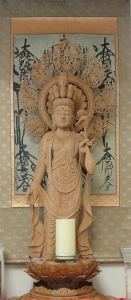
Kannon Bodhisattava (the statue) with Omandara Gohonzon (the object of veneration, behind the statue)
There is a big difference between statues of Buddha and those of Bodhisattvas. Statues of the Buddha only have one robe because they have renounced worldly matters and attained Buddhahood leaving them with no attachments to anything. On the other hand, Bodhisattvas are lay people. Therefore most statues wear garments, crowns, necklaces, and bracelets. Some Bodhisattvas hold a flower or a medicine bottle in their hand. Thus the Bodhisattvas are decorated with many jewels.

Bodhisattva means, “One who seeks enlightenment not only for himself but also for others.” The most well-known Bodhisattva is “Kannan” described in the Lotus Sutra Chapter 25. The title of the chapter is “The Universal Gate of World-Voice-Perceiver Bodhisattva.” Many Buddhists consider this chapter as an independent sutra, therefore it is widely accepted and read regardless of their denomination. The “Universal Gate” symbolizes that it is open to everyone! Some Kannan Bodhisattva statues, such as the one enshrined in the Nevada Kannan Temple, have eleven faces to perceive all directions.

The sutra teaches about benefits in this world. It says, “If living beings call the name of World-Voice-Perceiver Bodhisattva with all their heart when they are under various sufferings, the Bodhisattva will immediately perceive their voices and cause them to emancipate themselves from their suffering.”

There are two kinds of people who come to our temple. One group is seeking salvation from Kannan Bodhisattva. For these people, we do counseling, memorial services, kito blessings and teach them to have peace of body, mind and soul. The other group who comes to the temple wants to learn how to behave like a Bodhisattva. The Kannan Bodhisattva called them to come to the temple. They practice. chanting, Shodaigyo meditation, and studying the Lotus Sutra and Nichiren Buddhism. They are the leaders in our communities.

To behave like a Bodhisattva means to keep up your work in the office, do chores at home and help the community. Bringing happiness to others is behaving like a Bodhisattva.

Day 28

Day 28 covers all of Chapter 24, Wonderful-Voice Bodhisattva, and concludes the Seventh Volume of the Sutra of the Lotus Flower of the Wonderful Dharma.

Last month covered the benefits obtained by Wonderful-Voice Bodhisattva-mahasattva, and now we return to the All-Pure-Light-Adornment World and complete Chapter 24.

Thereupon Wonderful-Voice Bodhisattva-mahasattva made offerings to Sakyamuni Buddha and to the stupa of Many­Treasures Buddha, [benefited the living beings of the Saha­World,] and left for his home world] accompanied by the eighty-­four thousand Bodhisattvas. As they passed through the [one hundred and eight billion nayuta] worlds, the ground of those worlds quaked in the six ways; lotus-flowers of treasures rained down; and hundreds of thousands of billions of kinds of music were made. Having reached his home world, accompanied by the eighty-four thousand Bodhisattvas who surrounded him, he came to Pure-Flower-Star-King-Wisdom Buddha. He said to the Buddha:

World-Honored One! I went to the Saha-World and benefited the living beings there. I saw Sakyamuni Buddha and the stupa of Many-Treasures Buddha. I bowed and made offerings to them. I also saw Manjusri Bodhisattva, the Son of the King of the Dharma. [I also saw] Medkine-King Bodhisattva, Endeavor-Power-Obtainer Bodhisattva, Brave-In-Giving Bodhisattva, and others. I also caused these eighty-four thousand Bodhisattvas to obtain the ability to practise the samadhi by which they could transform themselves into any other living being.

When [Sakyamuni Buddha] expounded this chapter of the Coming and Going of Wonderful-Voice Bodhisattva, forty-two thousand gods obtained the truth of birthlessness, and Flower-­Virtue Bodhisattva obtained the ability to practice the samadhi for the Lotus Flower of the Wonderful Dharma.

I’m pondering the position of gods and the truth of birthlessness. The truth of birthlessness is first mentioned in the Devadatta chapter as something to which some of his disciples will aspire. In The Variety of Merits, six hundred and eighty billion nayuta livings beings obtained the truth of birthlessness after Sakyamuni revealed the duration of his life in the previous chapter. Realizing the truth of birthlessness is one of the benefits obtained by a woman, reborn a man, who hears of the Previous Life of Medicine-King Bodhisattva. And, finally, 68,000 people obtained the truth of birthlessness when the Buddha expounded the Dharanis chapter.

Today’s quote from Awakening to the Lotus offers this on life and death and, I suppose, birthlessness:

The suffering of birth, old age, sickness, and death are facts of everyone’s lives. No matter how developed science may become or how far medicine may advance, these cannot be avoided. Buddhism teaches, however, that when a person discovers that he or she exists within the life of the Eternal Buddha and can perceive the great stream of life flowing endlessly from the past through the present and into the future, he or she will escape the suffering that these events normally cause.
Awakening to the Lotus

Day 27

Day 27 concludes Chapter 23, The Previous Life of Medicine-King Bodhisattva.

Having last month covered the sacrifice and restoration of Gladly-Seen-By-All-Beings Bodhisattva, we come to the big reveal about Medicine-King Bodhisattva and some more flaming offerings.

The Buddha said to Star-King-Flower Bodhisattva:

What do you think of this? Gladly-Seen-By-All-Beings Bodhisattva was no one but Medicine-King Bodhisattva of today. He gave up his body in this way, offered it [to the Buddha], and repeated this offering many hundreds of thousands of billions of nayutas of times [in his previous existence]. [He knows that he can practice any austerity in this Saha-World. Therefore, he does not mind walking about this world.]

Star-King-Flower! Anyone who aspires for, and wishes to attain Anuttara-samyak-sambodhi, should offer a light to the stupa of the Buddha by burning a finger or a toe. Then he will be given more merits than the person who offers not only countries, cities, wives and children, but also the mountains, forests, rivers and ponds of the one thousand million Sumeru-worlds, and various kinds of treasures. But the merits to be given to the person who fills the one thousand million Sumeru-worlds with the seven treasures and offers that amount of the seven treasures to the Buddhas, to the Great Bodhisattvas, to the Pratekabuddhas, and to the Arhats, are less than the merits to be given to the person who keeps even a single gatha of four lines of this Sutra of the Lotus Flower of the Wonderful Dharma.

The Daily Dharma from Sept. 7, 2016, offers this:

What do you think of this? Gladly-Seen-By-All-Beings Bodhisattva was no one but Medicine-King Bodhisattva of today. He gave up his body in this way, offered it [to the Buddha], and repeated this offering many hundreds of thousands of billions of nayutas of times [in his previous existence]. [He knows that he can practice any austerity in this Sahā-World. Therefore, he does not mind walking about this world.]

The Buddha gives this explanation to Star-King-Flower Bodhisattva in Chapter Twenty-Three of the Lotus Sūtra. The story of the previous life of Medicine-King Bodhisattva shows us the capacities we have already developed and are not aware of. When we see ourselves as choosing to come into this world of conflict to benefit all beings, rather than stuck where we do not want to be and just making the best of it, then it is much easier to let go of our delusions.

The Daily Dharma is produced by the Lexington Nichiren Buddhist Community. To subscribe to the daily emails, visit zenzaizenzai.com