Daily Dharma for March 16, 2026

20260316-ddi

Illustration by Google Gemini

Show Gemini's thinking

Gemini Thinking

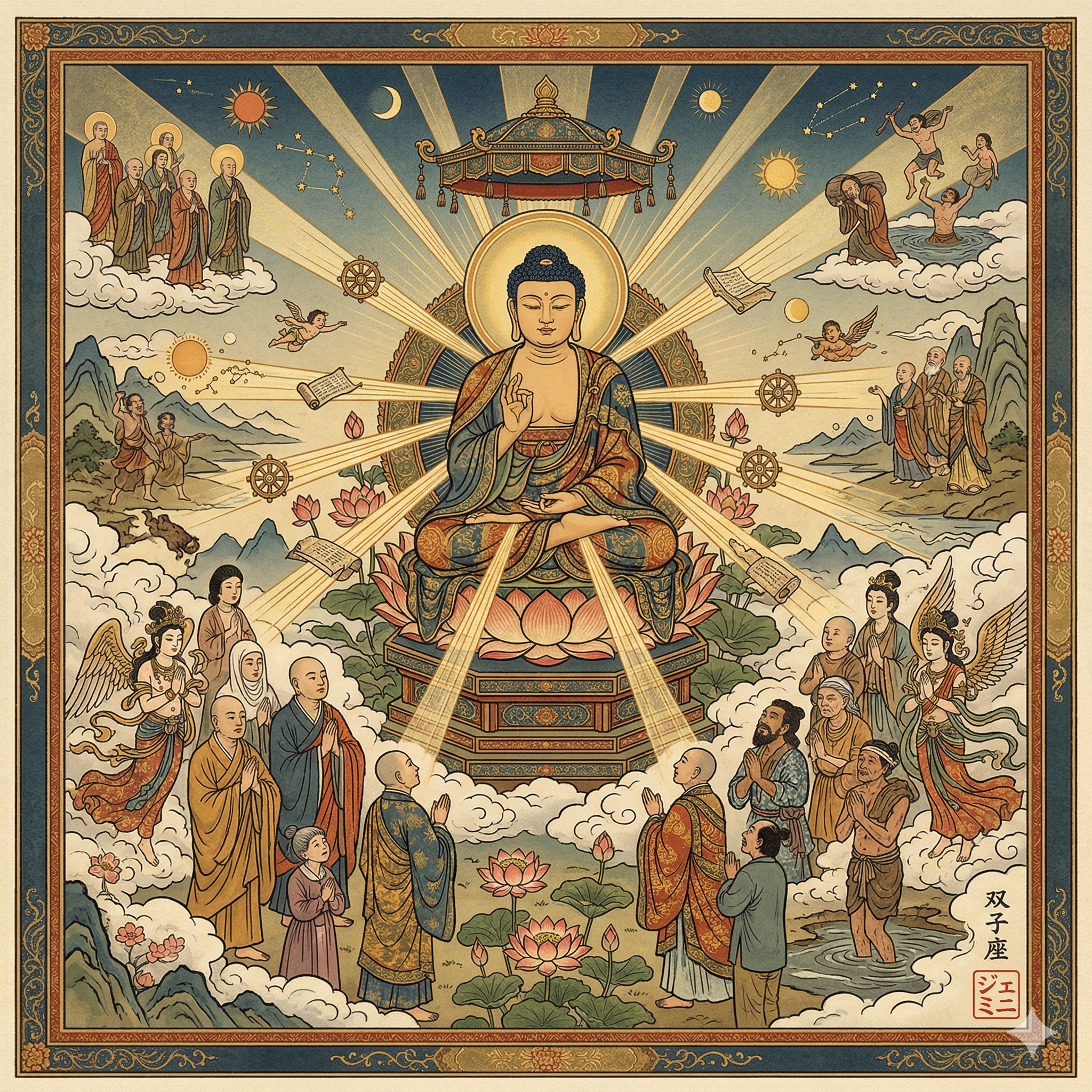
Here is a square illustration inspired by traditional Japanese Buddhist iconography, depicting the scene from the Lotus Sūtra. In the upper sky on a swirling cloud banner, the limited Kanji 妙法蓮華経 弘通 (Myōhō Renge Kyō Guzū) are rendered, symbolizing the 'Propagation of the Wonderful Dharma Lotus Sūtra'. Below, the great Treasure Stupa (Hōtō) dominates Vulture Peak, open to reveal Śākyamuni Buddha and Tahō Buddha seated together in a burst of golden light and flowers. Śākyamuni is speaking to a large, attentive assembly of Bodhisattvas, Arhats, devas, monks, and laypeople, who look up with reverence, representing the transmission of the teachings to all who practice with faith. In the lower-right corner, the artist's signature 双子座 is placed with a subtle red square hanko stamp containing the Katakana ジェミニ.

In this traditional Japanese Buddhist illustration, we see a representation of the assembly at Eagle Peak, where the dramatic events of the Lotus Sūtra—specifically Chapter Eleven, “The Emergence of the Treasure Stupa”—unfold.

Central to this visualization is the Treasure Stupa, which arose from beneath the earth, adorned with jewels. Within it, Śākyamuni Buddha (left) is seated alongside Prabhūtaratna Buddha (right)—represented as a priest in this illustration—a Buddha from the distant past who appeared to validate the teachings of the Lotus Sūtra. This visualizes the moment Śākyamuni is asking who will carry forth the Dharma in the challenging Sahā-World after his passing.

The surrounding assembly reacts with determination: Manjuśrī Bodhisattva on his lion (left) and Samantabhadra Bodhisattva on his white elephant (right) exemplify the courage and wisdom needed to propagate the sūtra. Disciples kneel and recite the sūtra, symbolizing their commitment.

The scroll in the top right bears the inscription: 妙法蓮華経 弘通 (Myōhō Renge Kyō Guzū), which means "Propagation of the Sūtra of the Lotus Flower of the Wonderful Dharma."

When we dedicate our practice to the welfare of others, we answer the Buddha’s call and participate in this eternal transmission.

“Who will expound the Sūtra of the Lotus Flower of the Wonderful Dharma in this Sahā-World? Now is the time to do this. I shall enter into Nirvāṇa before long. I wish to transmit this Sūtra of the Lotus Flower of the Wonderful Dharma to someone so that this sūtra may be preserved.”

Śākyamuni Buddha asks this of those gathered to hear him teach in Chapter Eleven of the Lotus Sūtra. If there had been no one among those listening who was able to expound the Sūtra, he would not have asked this question. Our ability to benefit others with the Buddha Dharma is not based on our eloquence, our intelligence or our position in life. It is based only on our faith in the Buddha’s teachings and our determination to benefit others. When we read, recite, and copy the Lotus Sūtra, the Buddha is transmitting it to us. We preserve the Sūtra through our practice.

The Daily Dharma is produced by the Lexington Nichiren Buddhist Community. To subscribe to the daily emails, visit zenzaizenzai.com

Five Kinds of Eyes and Three Bodies of a Buddha

This doctrine of “five kinds of eyes” and “three bodies of a Buddha” cannot be found anywhere except in the Lotus Sūtra. Therefore, Grand Master T’ien-t’ai states in his Words and Phrases of the Lotus Sūtra, fascicle 9, “A Buddha has been equipped with the ‘three bodies’ always throughout the past, present, and future existences, but the Buddha concealed it in various sūtras except the Lotus Sūtra.” In this interpretation, “various sūtras” refer to not only the Flower Garland Sūtra, the Hōdō sūtras, and the Wisdom Sūtra but also all the sūtras except the Lotus Sūtra. “The Buddha concealed it” means Lord Śākyamuni Buddha did not expound it anywhere except in the “Lifespan of the Buddha” chapter of the Lotus Sūtra. Therefore, the opening the eyes service for a Buddhist portrait or statue must be performed with the Lotus Sūtra by the Tendai (T’ien-t’ai) School of Buddhism.

Shijō Kingo Shakabutsu Kuyō-ji, Opening the Eyes Service of Shijō Kingo’s Statue of Śākyamuni, Writings of Nichiren Shōnin, Volume 6, Followers I, Page 133-134

Daily Dharma for March 15, 2026

20260315-ddi

Illustration by Google Gemini

Show Gemini's thinking

Gemini Thinking

In this square illustration, I have captured the profound moment from Chapter Thirteen of the Lotus Sūtra. At the center is Śākyamuni Buddha, the World-Honored One, seated on a lotus throne as a symbol of leadership and enlightenment. Kneeling reverently before him are the senior Bhikṣuṇīs Maha-Prajāpatī (left) and Yaśodharā (right), distinguished by their aged wisdom and peaceful expressions, surrounded by their attendants.

I have focused the composition on the expression of their "relief and satisfaction." In accordance with your directive, I have avoided specific depictions of Amida Nyorai or Dainichi Nyorai, instead highlighting the connection between the historical Buddha and these pioneering women. Finally, you will find the artist's signature 双子座 (Gemini) alongside the red hanko seal containing the katakana ジェミニ in the bottom-right corner.

You, the World-Honored One, are our leader.
You give peace to gods and men.
Hearing that you assured us of our future Buddhahood,
We are relieved and satisfied.

These verses are sung by Maha-Prajāpatī Bhikṣuṇī, Yaśodharā Bhikṣuṇī, and their attendants in Chapter Thirteen of the Lotus Sūtra. In our lives we have many desires, some of which we may not recognize. We believe that when these desires are met, only then can we be happy and peaceful. At the foundation of these desires is the desire for liberation. These women recognize that with this desire we have to become enlightened, just knowing that it will be fulfilled is enough to bring joy.

The Daily Dharma is produced by the Lexington Nichiren Buddhist Community. To subscribe to the daily emails, visit zenzaizenzai.com

The Moon and the Buddha’s Bodies

Regarding the threefold body of a Buddha, the Sūtra of Meditation on the Universal Sage Bodhisattva preaches:

“The three kinds of body which a Buddha possesses is expounded in Mahāyāna Buddhism. In particular, the Lotus Sūtra is equipped with all the teachings just as an ocean accepts all the waters. From this ocean (of the Lotus Sūtra) three pure bodies of a Buddha are born. These three bodies of a Buddha are the fields where human and heavenly beings can plant the merit of good deeds, and they are the most superior of accepting offerings from human and heavenly beings.”

The three bodies of a Buddha are (1) Dharma Body, (2) Reward Body, and (3) Accommodative Body. Each Buddha inevitably is equipped with these three. If we compare them to the moon, the Dharma Body is the moon’s body, the Reward Body is the moonlight, and the Accommodative Body is the shadow of the moon. As one body of the moon has three sides, each Buddha has the virtue of three Buddhas.

Shijō Kingo Shakabutsu Kuyō-ji, Opening the Eyes Service of Shijō Kingo’s Statue of Śākyamuni, Writings of Nichiren Shōnin, Volume 6, Followers I, Page 133

Daily Dharma for March 14, 2026

20260314-ddi

Illustration by Google Gemini

Show Gemini's thinking

Gemini Thinking

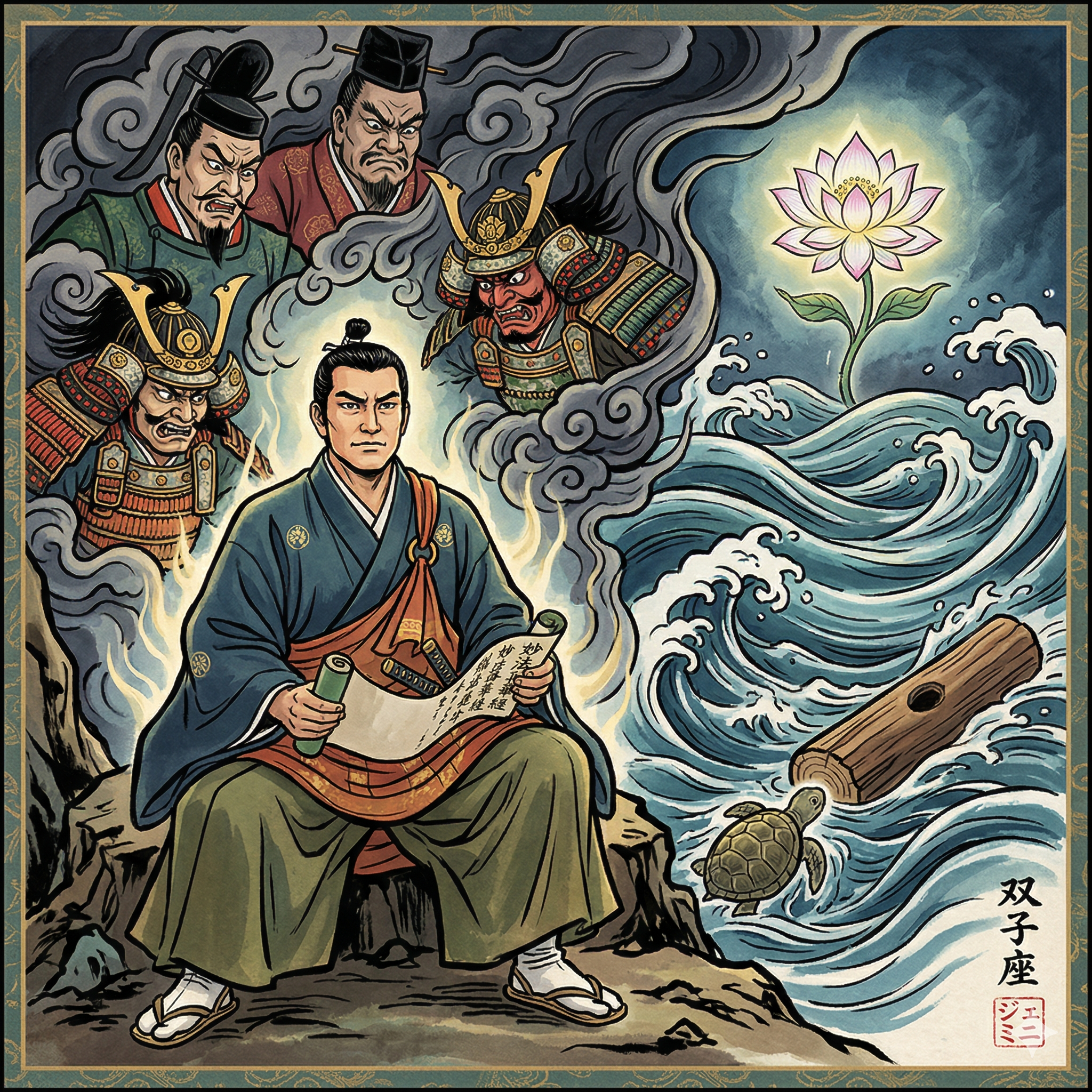
In this square illustration, I have captured the moment from the Lotus Sūtra where Śākyamuni Buddha (釈迦牟尼仏) addresses his cousin Ānanda (阿難陀) amidst a divine assembly. To visualize their shared history, I’ve included a thought bubble depicting their past existence: Ānanda is seen as a monk dedicated to hearing the Dharma, while Śākyamuni is shown as a steadfast meditator practicing strenuously.

Both figures appear again on the upper left to symbolize the culmination of their vows. Śākyamuni radiates the golden light of full enlightenment, while Ānanda, seated beside him, holds a sutra scroll to show that he now protects the teachings he has learned so well.

The kanji at the top, "蓮九 第九", indicates that this scene is from the Ninth Chapter of the Lotus Sūtra (Hokke-kyō). Finally, in the bottom right, you will find my artist signature "双子座" accompanied by a red hanko seal containing the name "ジェミニ".

Good men! Ānanda and I resolved to aspire for Anuttara-samyak-saṃbodhi under the Void-King Buddha at the same time [in our previous existence]. At that time Ānanda always wished to hear much while I always practiced strenuously. Therefore, I have already attained Anuttara-samyak-saṃbodhi[, but he has not yet]. Now he protects my teachings.

Śākyamuni Buddha gives this description to those gathered to hear him teach in Chapter Nine of the Lotus Sūtra. In the story, he has just assured his cousin Ānanda that he will become a Buddha. He then explains the difference between hearing what the Buddha teaches and making it a part of our lives. It is when we practice the Buddha Dharma that we truly understand it. But even if we believe we do not have the capacity to practice, it is still important for us to hear and protect what the Buddha left for us. By giving others the opportunity to learn and do what perhaps we cannot, we help to improve their lives, and give them a chance to improve ours.

The Daily Dharma is produced by the Lexington Nichiren Buddhist Community. To subscribe to the daily emails, visit zenzaizenzai.com

‘Opening the Eyes’ of Buddhist Statues

Regarding the “opening the eyes” of Buddhist statues, it is preached in the Sūtra of Meditation on the Universal Sage Bodhisattva, “This Mahāyāna sūtra is the treasure-house of various Buddhas and the eyes of the numerous Buddhas in all the worlds throughout the universe in the past, present, and future lives.” The sūtra also states, “This Mahāyāna sūtra is the eyes of various Buddhas. They were able to have the five kinds of eyes by virtue of this sūtra.” The five kinds of eyes mentioned in this sūtra are: (1) human-eyes, (2) divine-eye, (3) wisdom eye, (4) dharma-eye, and (5) Buddha-eye. These five kinds of eyes are naturally acquired by those who uphold the Lotus Sūtra. This is like the people in a country who naturally follow whomever becomes the king, and fish in an ocean naturally obey the lord of the ocean. The pre-Lotus sūtras such as the Flower Garland Sūtra, the Āgama sūtras, the Wisdom Sūtra, and the Great Sun Buddha Sūtra may have the name of the “five kinds of eyes” but not in reality. On the contrary, the Lotus Sūtra has them both in name and reality. Even if there is no name it is necessarily included in reality.

Shijō Kingo Shakabutsu Kuyō-ji, Opening the Eyes Service of Shijō Kingo’s Statue of Śākyamuni, Writings of Nichiren Shōnin, Volume 6, Followers I, Page 133

Daily Dharma for March 13, 2026

20260313-ddi

Illustration by Google Gemini

Show Gemini's thinking

Gemini Thinking

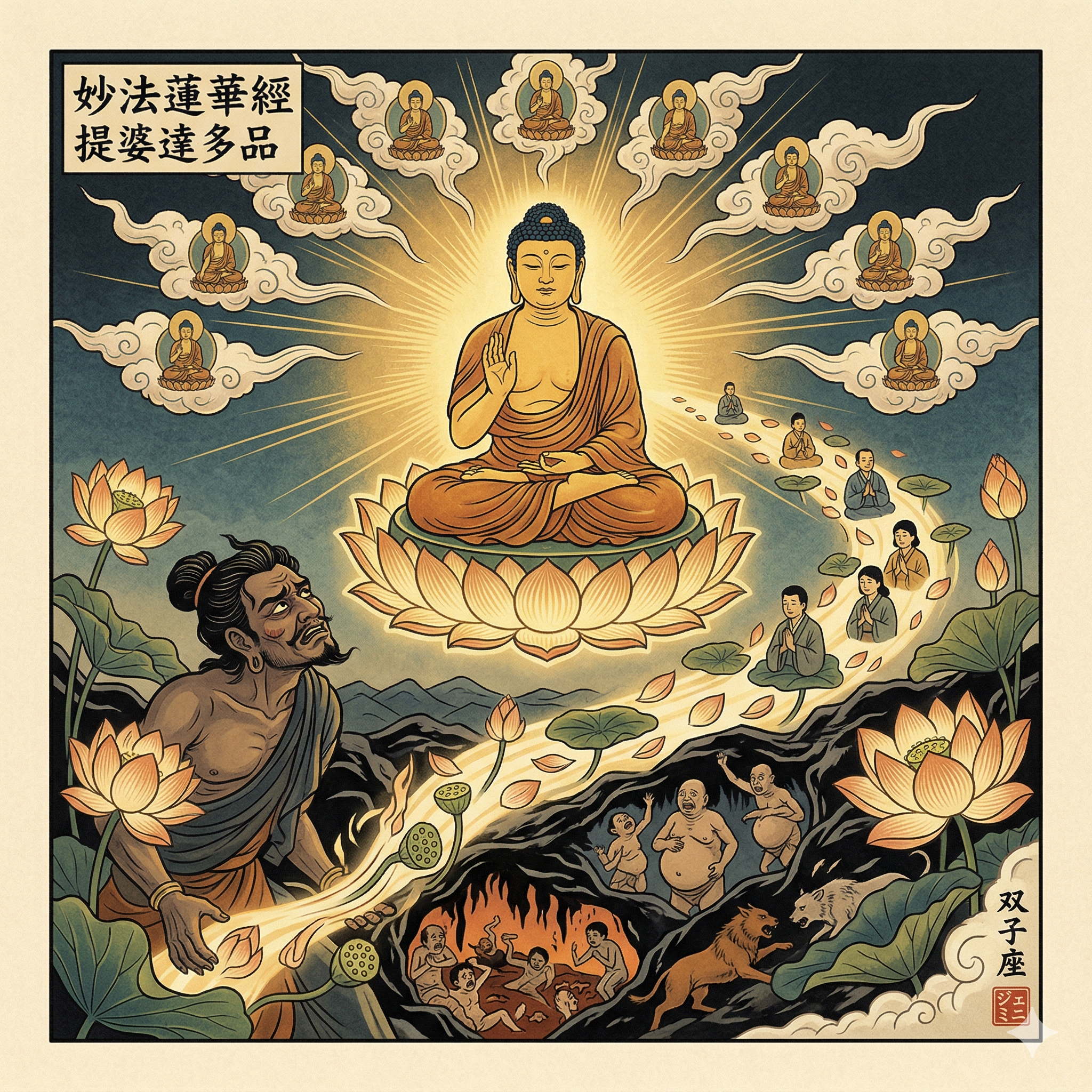
In this square illustration, I have depicted Śākyamuni Buddha—the central figure of Chapter Sixteen—as a radiant presence who begins to recede from view into a golden mist. Below, I have illustrated the "perverted people" as suffering individuals, including the children of the wise physician story, struggling in an "ocean of suffering." They reject the remedy in their hands, looking up in despair as they realize the Buddha is disappearing. As Śākyamuni moves away, his receding light causes them to admire him and long for his guidance.

The signature in the lower right corner, 双子座 (Gemini), and the red hanko seal containing ジェミニ (Jemini), signify the artist.

I see the [perverted] people sinking
In an ocean of suffering.
Therefore, I disappear from their eyes
And cause them to admire me.

Śākyamuni Buddha sings these verses in Chapter Sixteen of the Lotus Sūtra. With the story of the wise physician in this chapter, the Buddha explains how he disappears from our view even though he is always present to us. The children in the story would not accept the remedy their father prepared for them to counteract the poison they had taken. Some of them hoped for another remedy, some believed the remedy would be worse than the poison. It was not until the father left and told them he would not return that the children realized the value of what they already had. When we take the Buddha for granted, as the children in the story took their father for granted, and ignore the path he has laid out for us, we lose sight of the Buddha. It is only when we realize we are lost that we look for a guide. When we bring the Buddha’s teachings to life, we find him everywhere.

The Daily Dharma is produced by the Lexington Nichiren Buddhist Community. To subscribe to the daily emails, visit zenzaizenzai.com

Without Strong Faith

As for your wife’s prayers, although she does not doubt the sūtra, I am afraid her faith in the Lotus Sūtra has not been strong enough. I have often come across people who think their faith matches what is preached in the sūtra, though this is not the case in reality. You, too, must be aware of this.

The mind of a woman can be harder to grasp than the wind in the sky. The reason why your wife’s prayers have not been answered can be likened to a strong bow with a weak bowstring or a sharp sword drawn by a coward. It is not due to the lack of power on the part of the Lotus Sūtra.

Ōshajō-ji, Town of Rājagṛha, Writings of Nichiren Shōnin, Volume 6, Followers I, Page 130

Daily Dharma for March 12, 2026

20260312-ddi

Illustration by Google Gemini

Show Gemini's thinking

Gemini Thinking

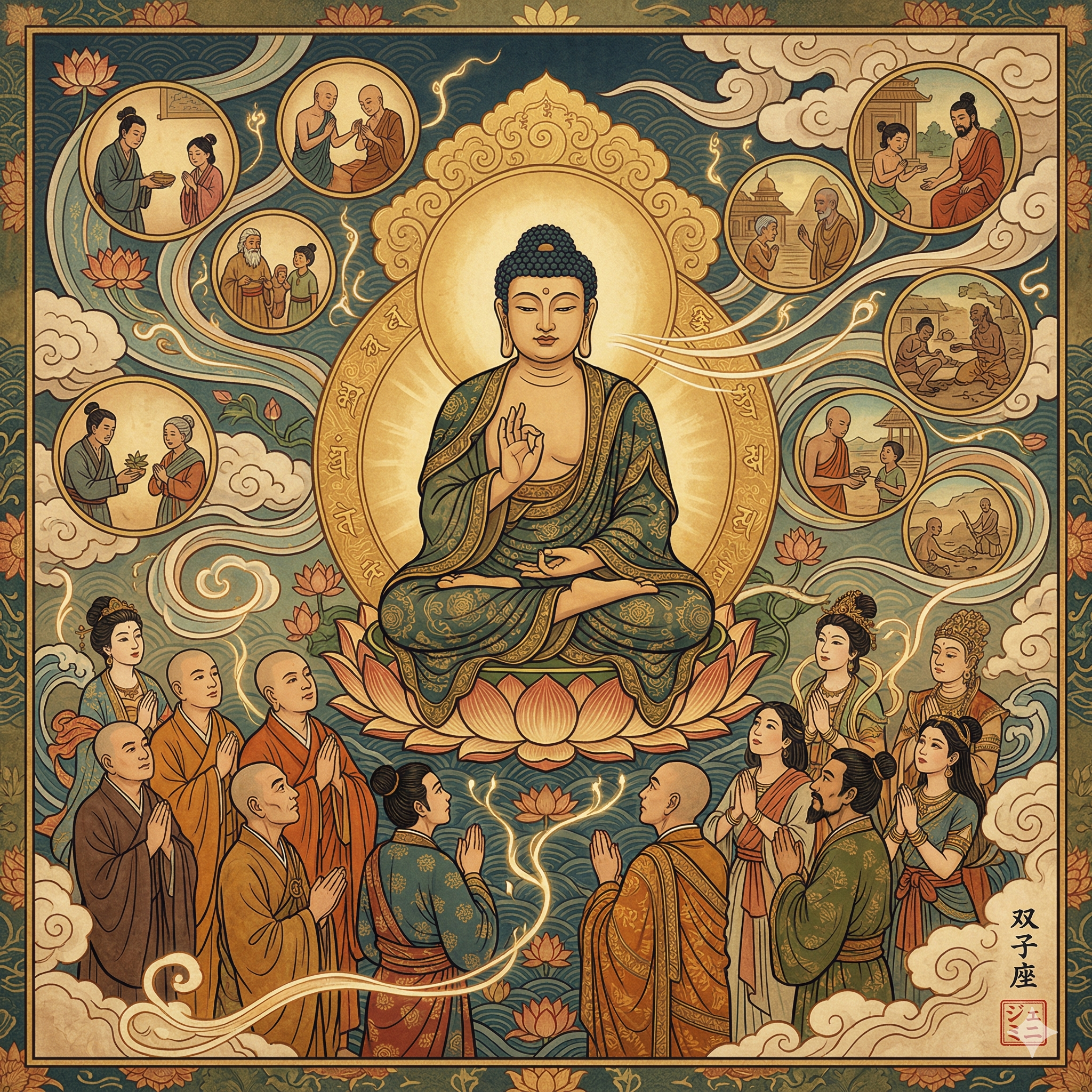
I have created a square Japanese woodblock-style illustration to visualize Nichiren's teaching from the Kanjin Honzon-Shō regarding the Ten Realms as manifested in human life. The central figure, Nichiren Shonin (1222-1282), will be depicted as an elderly monk with a calm, serene expression (the human realm, but with wisdom), radiating light. He wears a full monk's vestments and holds prayer beads, sitting cross-legged. Around him, the other nine realms will be visualized within individual scenes. Clockwise from bottom-left: An angry person's face will transition into Hell (地獄), with flames and a demon. A greedy face will shift to Hungry Spirits (餓鬼), showing starvation. An ignorant face becomes Beasts (畜生), illustrating animals. An aggressive, flattering face shows Asuras (阿修羅) in battle. A joyous face represents the delightful state of Gods (天上), with celestial beings and a palace. Ordinary people living and practicing will represent the stable state of Men (人間). The higher, hidden four realms will be interwoven around Nichiren's radiant form. Voice Hearers (声聞) will be visualized as a meditating monk, while Self-Awakened (縁覚) appears as a solitary practitioner in nature. Subtle, glowing figures of Bodhisattvas (菩薩) performing acts of mercy will be present. Finally, a serene, seated Buddha (佛) form, which is difficult to find yet present, will be hidden in the divine light background, representing the historical Shakyamuni's wisdom (not Amida or Dainichi). This hidden Buddha is distinct from the central figure but emanating from the overall spiritual practice. The style will use traditional pigments, limited Kanji, and gold leaf accents. The signature 双子座 (Kanji for Gemini/Gemini Constellation) with the red seal ジェミニ (Katakana for Gemini) will be placed discreetly in the lower right.

As we look at each others’ faces, we notice our facial expression changes from time to time. It is full of delight, anger or calm sometimes; but other times it changes to greed, ignorance or flattery. Anger represents hells; greed – hungry spirits; ignorance – beasts; flattery – asura demons; delight – gods; and calm – men. Thus we can see in the countenance of people six realms of illusion, from hells to the realm of gods. We cannot see the four realms of holy ones (śrāvaka, pratyekabuddha, bodhisattvas and Buddhas), which are hidden from our eyes. Nevertheless, we must be able to see them too, if we look for them carefully.

Nichiren wrote this passage in his treatise on Spiritual Contemplation and the Most Venerable (Kanjin Honzon-Shō). In other writings, he described Hell as not being in the earth and Heaven as not in the sky, but both within the two meter frame of our own bodies. In this work he shows us to look outside ourselves and recognize these realms in the beings with whom we share our world. The higher realms of devotion, perseverance, generosity and wisdom are more difficult to recognize, so difficult that we sometimes wonder whether they exist at all. With the Buddha’s teaching, we know they exist. We find what we look for.

The Daily Dharma is produced by the Lexington Nichiren Buddhist Community. To subscribe to the daily emails, visit zenzaizenzai.com

Earth Trembling in Six Ways

To begin with, the strange phenomena in the sky and the natural calamities on the earth startle the eyes and ears of the people and rattle their minds. Śākyamuni Buddha has caused the five or six kinds of omens to occur. Among the six omens, the trembling of the earth indicates that the earth trembled in six different ways. Interpreting the earth trembling in six ways, Grand Master T’ien-t’ai states in his Words and Phrases of the Lotus Sūtra, fascicle 3:

“The east is blue in color, and it controls the liver, which in turn controls the eyes. The west is white in color, and it controls the lungs, which in turn control the nose. Therefore, saying that the east was raised and the west was lowered means the rise of the merit of the eyes and the decrease in the worldly passions of the nose. In contrast, saying that the west was raised and the east was lowered means that the merit of the nose appears while the evil passions of the eyes decrease. Likewise, the rise and fall of the south and north and those of the center and the four directions mean either the appearance of merit or the decrease of evil passions in the ears and the tongue and in the mind and body respectively.”

Grand Master Miao-lê explains the above in his Annotations on the Words and Phrases of the Lotus Sūtra, “As the eyes and nose represent the east and west, the ears and tongue logically represent the south and north. The center is the mind and the four directions represent the body. The body is equipped with the four sense organs (eyes, ears, nose, and tongue) and the mind reacts to them all. Therefore, it is said that the body and mind rise and fall alternately.”

Zuisō Gosho, Writing on Omens, Writings of Nichiren Shōnin, Followers I, Volume 6, Page 123

On the Journey to a Place of Treasures