
Category Archives: LS32

Another Innumerable Day Before Day 1

Having begun last month with the explanation of the practice of the great Bodhisattvas, I want to conclude the great-being bodhisattvas wondrous power to do beneficial works.

These are the true companions of good influence for all living beings. These are bountiful spheres of kindness for all living beings. These are the spontaneous teachers of all living beings. These are centers of joyful tranquility, places of deliverance, shelters for protection, and great havens of reliability for all living beings. As such, they serve everywhere as extraordinary guides who are of benefit to all—capable of acting as eyes for those who do not see, as ears for those who do not hear, as a nose for those with no sense of smell, as a tongue for those who do not speak. They are able to make deficient faculties become whole, and to turn contrariness, unbalance, frenzy, and confusion into complete right mindfulness. They are the shipmasters and great captains that ferry living beings across the river of birth and death, landing them on nirvana ‘s shore. They are the greatest physicians and master doctors who distinguish the aspects of illnesses, know well the properties of medicines, offer remedies appropriate to an affliction, and have beings trustingly take them. They are directors and master directors who never lose control—like tamers of elephants or horses who are capable of training without fail. They are like valiant lions whose unconquerable majesty invites respect from all other beasts. Comfortably progressing in all bodhisattva practices of perfection, steadfast and immovable in the Tathāgata realm, serenely abiding in the strength of their resolve, and refining buddha lands far and wide, they will realize and achieve the full dynamic of ultimate enlightenment before long. All such great-being bodhisattvas possess this kind of wondrous power to do beneficial works.

For me, Buddhism is bodhisattva practice. As the translators note in their introduction:

While the Lotus Sutra is never mentioned by name in this text, the Infinite Meanings Sutra, like the Lotus, is a strong proponent of the concept of bodhisattva practice. In his discourse in the sutra, the Buddha emphasizes that leading others to the Way is a prime factor in attaining ultimate enlightenment, and that the teaching of the sutra itself is infinite in its meanings because it relates to the unlimited desires of living beings.
The Fortune to Study the Lotus Sutra Today

PDF copy of text of this book is available for download
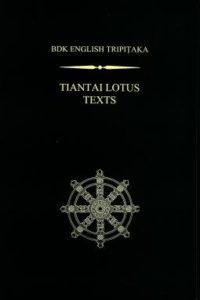
Tiatai Lotus Texts bookcover
A PDF copy of this book is available for download
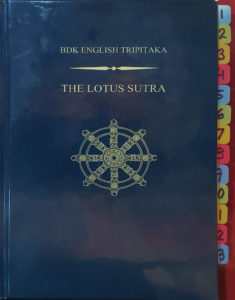
Today I begin my elongated 32 Days of the Lotus Sutra practice with a new translation of the Lotus Sutra and its opening and closing sutras. As a bonus, I will be able to marry my daily practice with a new book that seeks to provide a chapter-by-chapter road map through the sutra.

For someone who only reads English, the value of this opportunity to read, recite and study the Lotus Sutra cannot be explained by any calculation, parable or simile.

In my 46th and 47th cycles through the Lotus Sutra, I’m setting aside Gene Reeves translation, and picking up the BDK English Tripitaka translation of The Infinite Meanings Sutra, the Lotus Sutra and The Sutra Expounded by the Buddha on Practice of the Way through Contemplation of the Bodhisattva All-embracing Goodness.

I’m using this translation of these sutras because that’s the translation favored in Two Buddhas Seated Side by Side by Donald S. Lopez Jr. and Jacqueline I. Stone.

The Authors’ Introduction, explains the choice of texts:

All quotations from the Lotus Sūtra are taken from the translation done by Tsugunari Kubo and Akira Yuyama. See The Lotus Sūtra, rev. 2nd ed., trans. by Tsugunari Kubo and Akira Yuyama, BDK English Tripitaka Series (Berkeley: Numata Center for Buddhist Translation and Research, 2007). For the reader’s convenience, we have provided in-text page references to this translation after each quotation. Please note that the pagination of the printed version of the text (used here) differs from the pagination of the version presently available online.

Kubo and Yuyama based their translation on the celebrated Chinese version of the sūtra produced by the Central Asian scholar-monk Kumārajīva in 406. In several places, however, they chose not to follow traditional Sino-Japanese interpretation but have instead consulted the Sanskrit and, in a few instances, the Tibetan versions of the Lotus (see their “Translators’ Introduction,” xiv). One way in which their English version departs from Kumārajīva’s Chinese lies in the handling of proper names. Where Kumārajīva translated many names of figures appearing in the Lotus Sūtra, Kubo and Yuyama give them in the original Sanskrit. We have followed suit, not to give primacy to the Sanskrit text, but for consistency with the Kubo-Yuyama translation. However, some of the longer Sanskrit names can prove daunting to readers unfamiliar with that language. We have accordingly provided in parentheses with the first occurrence of such names the English rendering given by Leon Hurvitz in his translation of the Lotus Sūtra: Scripture of the Lotus Blossom of the Fine Dharma (the Lotus Sūtra), published by Columbia University Press (1976; rev. 2009), or a translation of our own.

The opening and closing sutras are included in the BDK English Tripitaka Tiantai Lotus Texts, which also includes The Commentary on the Lotus Sutra by Vasubandhu and A Guide to the Tiantai Fourfold Teachings by the Buddhist Monk Ghegwan. A PDF copy of the book is available here.

Subordinates of Śākyamuni Buddha.

[P]reaching the sixteenth chapter of the Lotus Sūtra, the Buddha declared, “All the gods, men, and asura demons believe that this Śākyamuni Buddha was the one who had left the palace of the Śākya clan and sat in meditation under the bodhi tree not far from the town of Gayā and attained perfect enlightenment.” This declaration in the Lotus Sūtra represents what all the great bodhisattvas had in mind while listening to the sūtras starting with the Flower Garland at the Hall of Enlightenment to the fourteenth “Peaceful Practices” chapter of the Lotus. “To speak the truth, good men,” continued the Buddha, “it has been countless aeons (numerous hundreds, ten thousands, 100 millions, nayuta of kalpa) since I obtained Buddhahood.”

Thus with one stroke He denied as untrue all His previous statements such as “obtaining the first enlightenment” said three times in the Flower Garland Sūtra, “the first enlightenment” in the Āgama sūtras, “the first meditation under the bodhi tree” in the Vimalakirti Sūtra, “sixteen years after the first enlightenment” in the Sūtra of the Great Assembly, “I once sat in meditation at the place of practice in Buddhagayā” in the Great Sun Buddha Sūtra, “for twenty-nine years since His enlightenment” in the Sūtra of the Benevolent King, “I once meditated under the bodhi tree in the place of enlightenment for six years” stated in the Sūtra of Infinite Meaning, and “At first I sat at the place of enlightenment, gazed on the tree, and walked about it meditating” in the “Expedients” (second) chapter of the Lotus Sūtra.

Thus it was revealed that Śākyamuni had long been the Buddha since the eternal past, and it became clear that various Buddhas were all manifestations (funjin) of Śākyamuni Buddha. In the pre-Lotus sūtras, as well as in the theoretical section of the Lotus Sūtra, various Buddhas and Śākyamuni Buddha were on the same level, each practiced Buddhism on their own. Therefore, those who considered various Buddhas to be their Most Venerable One did not worship Śākyamuni. Now, however, as Śākyamuni proved to be the Eternal Buddha, those Buddhas on the lotus petals in the Flower Garland Sūtra, or Buddhas in the Hōdō sūtras, Wisdom and Great Sun Buddha Sūtras all became subordinates of Śākyamuni Buddha.

Kaimoku-shō, Open Your Eyes to the Lotus Teaching, Writings of Nichiren Shōnin, Doctrine 2, Page 74

Between Day 32 and Day 1 – The Lotus Connection

Having competed my 45th cycle through the Lotus Sutra, it is again time to consider The Sutra of Contemplation of the Dharma Practice of Universal Sage Bodhisattva. Today, it is appropriate to show how, early on, the link between this sutra and the Lotus Sutra is maintained.

The Buddha said to Ananda: “Listen carefully! Listen carefully!
Consider what I am about to say and remember it well! Long ago, on Holy Eagle Peak and in other places, the Tathagata has already thoroughly explained the way of one truth. But now in this place, for all living beings and others in the future who want to practice the unsurpassable Dharma of the Great Vehicle, and for those who want to learn the practice of Universal Sage and to follow the practice of Universal Sage, I will now teach this method of contemplation. For all those who are able to see Universal Sage, as well as for those who do not see him, I will now explain in detail how to eliminate evils.(Reeves, p401-402)

In Senchu Murano’s “Questions and Answers on Nichiren Buddhism,” he says this about this sutra’s role in Nichiren Buddhism:

The Kan-fugen-bosatsu-gyobo-kyo (“The Sutra of Meditation on the Bodhisattva Universal-Sage”) was also translated later than the Lotus Sutra and not by Kumarajiva. It was apparently intended to be a continuation of the last chapter of the Lotus Sutra. This sutra carries Jojakko or “Eternally Tranquil Light” as the name of the world of Sakyamuni Buddha. We say that the world of Sakyamuni Buddha is called Jakko-jodo (“the Pure World of Tranquil Light”). The word Jakko is given only in this sutra, and in no other sutras. The setup of this triple sutra: The Muryogikyo as the opening sutra, the Myoho-renge-kyo, and the Kan-fugen-gyo as the closing sutra, had been established long before the time of Nichiren. Nichiren sometimes called them Hokekyo Jikkan or the “Ten Volumes of the Lotus Sutra”, but he usually used the expression: Hokekyo Ichibu Hachikan Niju Happon, which means “The Lotus Sutra, One Book, Eight Volumes, Twenty-eight Chapters.” We usually put the eight volumes of the Lotus Sutra in front of the statue of Nichiren. (Page 23-24)

Purifying Our Practice Space

When we begin our daily practice we are advised to clean our practice space. We should approach that just as the Buddha did when the congregation asked to see Many Treasures Buddha. We have approached our altar, our chance to sit before the great honzon presented to us in the Lotus Sutra, which Nichiren identified. We should prepare our space of worship the way the Buddha purified all the worlds. As we go about preparing our space we should call back our distracted thoughts, those emanations of ourselves. Put aside the need to check the cell phone, put aside the worry of email, and schedules, plans and schemes. Focus your mind completely on the one great event of being in the presence of the two Buddhas seated side by side, in the presence of the Eternal Buddha Shakyamuni.

Lecture on the Lotus Sutra

Day 32

Day 32 covers Chapter 28, The Encouragement of Universal-Sage Bodhisattva, closing the Eighth Volume of the Sutra of the Lotus Flower of the Wonderful Dharma.

Having last month heard Śākyamuni Buddha praise Universal Sage’s efforts, we consider those who keep, read and recite the Sūtra of the Lotus Flower of the Wonderful Dharma after the Buddha’s extinction.

“Universal-Sage! If you see anyone who keeps, reads and recites the Sūtra of the Lotus Flower of the Wonderful Dharma in the later five hundred years after my extinction, you should think, ‘Before long be will go to the place of enlightenment, defeat Mara and his followers, attain Anuttara-samyak-saṃbodhi, turn the wheel of the Dharma, beat the drum of the Dharma, blow the conch-shell horn of the Dharma, send the rain of the Dharma, and sit on the lion-like seat of the Dharma in the midst of the great multitude of gods and men.’

“Universal-Sage! Anyone who keeps, reads and recites this sūtra [in the later five hundred years] after [my extinction], will not be attached to clothing, bedding, food or drink, or any other thing for living. What he wishes will not remain unfulfilled. He will be able to obtain the rewards of his merits in his present life. Those who abuse him, saying, ‘You are perverted. You are doing this for nothing,’ will be reborn blind in their successive lives in retribution for their sin. Those who make offerings to rum and praise him, will be able to obtain rewards in their present life. Those who, upon seeing the keeper of this sūtra, blame him justly or unjustly, will suffer from white leprosy in their present life. Those who laugh at him will have few teeth, ugly lips, flat noses, contorted limbs, squint eyes, and foul and filthy bodies, and suffer from bloody pus of scabs, abdominal dropsy, tuberculosis, and other serious diseases in their successive lives. Therefore, Universal-Sage! When you see the keeper of this sūtra in the distance, you should rise from your seat, go to him, receive him, and respect him just as you respect me.

The Daily Dharma from Aug. 24, 2019, offers this:

Universal-Sage! If you see anyone who keeps, reads and recites the Sūtra of the Lotus Flower of the Wonderful Dharma in the later five hundred years after my extinction, you should think, ‘Before long he will go to the place of enlightenment, defeat Māra and his followers, attain Anuttara-samyak-saṃbodhi, turn the wheel of the Dharma, beat the drum of the Dharma, blow the conch-shell horn of the Dharma, send the rain of the Dharma, and sit on the lion-like seat of the Dharma in the midst of the great multitude of gods and men.’

The Buddha gives this instruction to Universal-Sage Bodhisattva (Fugen, Samantabhadra) in Chapter Twenty-Eight of the Lotus Sūtra. Nichiren explained that the later five hundred years mentioned in this passage is the time in which we are living today. The Buddha is therefore talking about all of us who practice the Wonderful Dharma. When we can grow our capacity to respect each other as we respect the Buddha, it inspires the respect at the core of all beings, and transforms this world.

The Daily Dharma is produced by the Lexington Nichiren Buddhist Community. To subscribe to the daily emails, visit zenzaizenzai.com

The Light of One Character of the Lotus Sūtra

The Lotus Sūtra is like the moon. The rays of light emitted by stars reach the distance of half a mile, 1, 10, or 20 miles at the most whereas the rays of the moon light reach as far as 1,000 miles or so. Even if all stars in the four continents and all the worlds throughout the universe, 100, 1,000, 10,000, 1,000,000 in number, are put together, they are not comparable to the moon in brightness. It goes without saying that one star can never be compared to the moon in brightness. Likewise, all the sūtras such as the Flower Garland Sūtra, the Āgama sūtras, the Hōdō sūtras, the Wisdom Sūtra, the Nirvana Sūtra, the Great Sun Buddha Sūtra, and the Sūtra of Meditation on the Buddha of Infinite Life put together, do not amount to one character of the Lotus Sūtra.

Yakuō-bon Tokui-shō, The Essence of the “Medicine King Bodhisattva” Chapter, Writings of Nichiren Shōnin, Faith and Practice, Volume 4, Page 30-31

Day 31

Day 31 covers Chapter 27, King Wonderful-Adornment as the Previous Life of a Bodhisattva.

Having last month considered the preparations to see Cloud-Thunderpeal-Star-King-Flower-Wisdom Buddha, we witness King Wonderful-Adornment, Queen Pure-Virtue, and their two sons travel to the Buddha and hear Cloud-Thunderpeal-Star-King-Flower-Wisdom Buddha.

“Thereupon King Wonderful-Adornment, Queen Pure-Virtue, and their two sons came to that Buddha. The king was accompanied by his ministers and attendants; the queen, by her ladies and attendants; and their two sons, by forty-two thousand men. They worshiped the feet of that Buddha with their heads, walked around the Buddha three times, retired, and stood to one side.

“Thereupon the Buddha expounded the Dharma to the king, showed him the Way, taught him, benefited him, and caused him to rejoice. The king had great joy. The king and queen took off their necklaces of pearls worth hundreds of thousands, and strewed the necklaces to the Buddha. The necklaces flew up to the sky [seven times as high as the tala-tree], and changed into a jeweled platform equipped with four pillars. On the platform was a couch of great treasures, and thousands of millions of heavenly garment were spread [on the couch]. The Buddha [went up,] sat cross-legged [on the couch], and emitted great rays of light. King Wonderful-Adornment thought, ‘The Buddha is exceptional. He is exceedingly handsome. He has the most wonderful form.’

The Daily Dharma from April 24, 2019, offers this:

The king and queen took off their necklaces of pearls worth hundreds of thousands, and strewed the necklaces to the Buddha. The necklaces flew up to the sky [seven times as high as the tāla-tree], and changed into a jeweled platform equipped with four pillars. On the platform was a couch of great treasures, and thousands of millions of heavenly garments were spread [on the couch]. The Buddha [went up,] sat cross-legged [on the couch], and emitted great rays of light. King Wonderful-Adornment thought, ‘The Buddha is exceptional. He is exceedingly handsome. He has the most wonderful form.’

The Buddha uses this description as part of the story of King Wonderful-Adornment in Chapter Twenty-Seven of the Lotus Sūtra. This King was led by the supernatural powers of his children to meet Cloud-Thunderpeal-Star-King Flower-Wisdom Buddha who was teaching the Wonderful Dharma in that world. The King and his wife the Queen were both so inspired by that Buddha that they allowed the symbols of their wealth and power to be transformed into a sacred platform from which the Buddha could lead all beings to enlightenment. When they found that Buddha, the beauty of his wisdom far outshone the beauty of their jewels.

The Daily Dharma is produced by the Lexington Nichiren Buddhist Community. To subscribe to the daily emails, visit zenzaizenzai.com

Day 30

Day 30 covers all of Chapter 26, Dhāraṇīs

Having last month considered Vaiśravaṇa Heavenly-King’s offering, we consider World-Holding Heavenly-King’s offering.

Thereupon World-Holding Heavenly-King, accompanied by thousands of billions of nayutas of gandharvas who were surrounding him respectfully, came to the Buddha, joined his hands together, and said to him, “World-Honored One! I also will protect the keeper of the Sūtra of the Lotus Flower of the Wonderful Dharma with dhārānis, with divine spells.”

Then he uttered spells,” Akyanei (1), kyanei (2), kuri (3), kendari (4), sendari (5), matōgi (6), jōguri (7), furoshani (8), atchi (9).”

[He said to the Buddha:]

“World-Honored One! These dhārānis, these divine spells, have already been uttered by four thousand and two hundred million Buddhas. Those who attack and abuse this teacher of the Dharma should be considered to have attacked and abused those Buddhas.”

Vaiśravaṇa, last month, and World-Holding Heavenly-King are present at the top of the Mandala Gohonzon, Vaiśravaṇa on the top left and World-Holding Heavenly-King, top right.

Lotus World offers this about World-Holding Heavenly-King:

The Flammarion Iconographic Guide: Buddhism describes Dhritarashtra (Jikoku Tenno, Heavenly King of the East) as follows: “This guardian king governs in the east and presides over the spring. He is ‘He who maintains the kingdom (of the Law)’; ‘the maintainer of the state’ … He commands an army of celestial musicians (gandharvas) and vampire demons (pishachas). The gandharvas are one of the eight kinds of supernatural beings who are said to revere and protect the Dharma; the pishachas are a type of hungry ghost.

According to the Kumarajiva translation of the Lotus Sutra, it is Dhritarashtra who offers dharanis in chapter 26 for the benefit of those who keep the Lotus Sutra.

Lotus World: An Illustrated Guide to the Gohonzon

Day 29

Day 29 covers all of Chapter 25, The Universal Gate of World-Voice-Perceiver Bodhisattva.

Having last month considered some of the many ways he helps those in trouble, we consider other ways he helps.

“Those who have much lust will be saved from lust if they constantly think of World-Voice-Perceiver Bodhisattva and respect him. Those who have much anger will be saved from anger if they constantly think of World-Voice-Perceiver Bodhisattva and respect him. Those who have much stupidity will be saved from stupidity if they constantly think of World-Voice-Perceiver Bodhisattva and respect him. Endless-Intent! World-Voice-Perceiver Bodhisattva has these great supernatural powers. He gives many benefits to all living beings. Therefore, they should constantly think of him.

“A woman who, wishing to have a boy, bows and makes offerings to World-Voice-Perceiver Bodhisattva, will be able to give birth to a boy endowed with merits, virtues and wisdom. [A woman] who, wishing to have a girl, [does the same,] will be able to give birth to a beautiful girl who will be loved and respected by many people because of the roots of virtue which the [newly-born] girl planted in her previous existence. Endless-Intent! Because World-Voice-Perceiver Bodhisattva has these powers, the merits of those who respect him and bow to him will not be fruitless. Therefore, all living beings should keep the name of World-Voice-Perceiver Bodhisattva.

The Daily Dharma from Oct. 6, 2018, offers this:

Those who have much lust will be saved from lust if they constantly think of World-Voice-Perceiver Bodhisattva and respect him. Those who have much anger will be saved from anger if they constantly think of World-Voice-Perceiver Bodhisattva and respect him. Those who have much stupidity will be saved from stupidity if they constantly think of World-Voice-Perceiver Bodhisattva and respect him.

The Buddha gives this description of World-Voice-Perceiver Bodhisattva (Kannon, Kanzeon, Avalokitesvara) to Endless-Intent Bodhisattva in Chapter Twenty-Five of the Lotus Sūtra. World-Voice-Perceiver is the embodiment of compassion for all beings, the wish that all beings be freed from suffering and realize the enlightenment of the Buddha. This compassion is the antidote to the three poisons of lust, anger and stupidity. By aspiring to the example of World-Voice-Perceiver and awakening our own compassion, we can overcome these poisons and bring benefits to all beings.

The Daily Dharma is produced by the Lexington Nichiren Buddhist Community. To subscribe to the daily emails, visit zenzaizenzai.com