Category Archives: LS32

Day 4

Day 4 concludes Chapter 2, Expedients, and completes the first volume of the Sūtra of the Lotus flower of the Wonderful Dharma.

DAY 4 FULL TEXT

Having last month concluded Chapter 2, Expedients, we begin again with the gāthās explaining why the 5,000 listeners left as Śākyamuni was about to talk.

Thereupon the World-Honored One, wishing to repeat what he had said, sang in gāthās:
Some bhikṣus and bhikṣunīs
Were arrogant.
Some upāsakās were self-conceited.
Some upāsikās were unfaithful.
Those four kinds of devotees
Were five thousand in number.

They could not see their own faults.
They could not observe all the precepts.
They were reluctant to heal their own wounds.
Those people of little wisdom are gone.
They were the dregs of this congregation.
They were driven away by my powers and virtues.

They had too few merits and virtues
To receive the Dharma.
Now there are only sincere people here.
All twigs and leaves are gone.

Nichiren had this to say about the “twigs and leaves”:

When the “Expedients” chapter of the Lotus Sūtra was preached, 5,000 self-conceited ones did not believe in what they heard and withdrew from the preaching of the Lotus Sūtra. Nevertheless, they became Buddhas in three months’ time because they did not slander the Lotus Sūtra. Referring to this incident, it is preached in the Nirvana Sūtra, “Both believers and non-believers will be born in the Immovable Land.” Those who heard the Lotus Sūtra can become Buddhas even if they do not put faith in the sūtra, so long as they do not slander it, due to the inexplicable merit of having heard the sūtra. This is like the person bitten by a poisonous snake called shichibuja who is bound to fall within taking seven steps and is unable to take the eighth step due to the inexplicable work of the poison. Or it is also like an embryo that changes its shape within seven days and never stays in one shape for more than eight days.

Hōren-shō, Letter to Hōren, Writings of Nichiren Shōnin, Volume 6, Followers I, Page 52

Day 3

Day 3 covers the first half of Chapter 2, Expedients.

Having last month considered that all Buddhas use expedients, we consider the puzzlement of the Śrāvakas and Pratyekabuddhas.

The great multitude at that time included Śrāvakas. [They also included] Ājñāta-Kauṇḍinya, and other Arhats, twelve hundred altogether, who had already eliminated āsravas. [They also included] the bhikṣus, bhikṣunīs, upāsakās, and upāsikās, [that is, the four kinds of devotees] who had already aspired for Śrāvakahood or Pratyekabuddhahood. All of them thought:

“Why does the World-Honored One extol so enthusiastically the power of the Buddhas to employ expedients? Why does he say that the Dharma attained by him is profound and difficult to understand, and that the true purpose of his teachings is too difficult for Śrāvakas and Pratyekabuddhas to know? He expounded to us the teaching of emancipation. We obtained this teaching and reached Nirvāṇa. We do not know why he says all this.”

Lotus Path: Practicing the Lotus Sutra Volume 1 offers this on the followers’ puzzlement:

Previous to teaching the Lotus Sutra the Buddha taught expedients to lead people to the ultimate teaching of the Lotus Sutra. In many ways it was as if he were leading the blind to the train station so they could then find the way to the true complete teachings contained in the Lotus Sutra. But we need to remember that the train station is not the destination, the expedients are not the sum of the Buddha’s teachings.

Lotus Path: Practicing the Lotus Sutra Volume 1

Day 2

Chapter 1, Introductory (Conclusion).

Having last month considered what Mañjuśrī saw as a result of the light emitted by the Buddha in the past, we witness what happened when Sun-Moon-Light Buddha emerged from his samādhi.

The four kinds of devotees
Of the world of Sun-Moon-Light Buddha
Also saw the Buddha displaying this great wonder.
They had great joy.
They asked one another:
“Why is he doing this?”

He who was honored by gods and men
Emerged from his samādhi,
And praised Wonderful-Light Bodhisattva, saying:
“You are the eyes of the world.

You are believed and relied on
By all living beings.
You are keeping the store of the Dharma.
Only you will understand the Dharma which I shall expound.”

Having praised Wonderful-Light
And caused him to rejoice,
That World-Honored One expounded
The Sūtra of the Lotus Flower of the Wonderful Dharma.
He never rose from his seat for sixty small kalpas.
Wonderful-Light, the Teacher of the Dharma,
Kept the Wonderful Dharma
Expounded by that World-Honored One.

That the Buddha expounded the Sūtra of the Lotus Flower of the Wonderful Dharma for sixty small kalpas underscores that there are many versions of the Lotus Sutra beyond what we read here.

Daily Dharma – July 26, 2019

The Buddhas joyfully display
Their immeasurable, supernatural powers
Because [the Bodhisattvas from underground]
[Vow to] keep this sūtra after my extinction.

The Buddha sings these verses to Superior-Practice Bodhisattva (Jōgyo, Viśiṣṭacārītra) in Chapter Twenty-One of the Lotus Sūtra. Superior-Practice is the leader of the Bodhisattvas who came up from underground in Chapter Fifteen when the Buddha asked who would continue to keep and practice this sūtra after his physical extinction in this world. Nichiren saw himself as the embodiment of Superior-Practice, and all of us who are determined to lead all beings to enlightenment through this Wonderful Dharma as embodiments of the Bodhisattvas who came up from underground. The powers of the Buddhas only seem supernatural to those who are mired in delusion and ignorance. They are nothing more than turning the poison of anger into the medicine of energy; the poison of isolation into the medicine of compassion; the poison of attachment into the medicine of wisdom.

The Daily Dharma is produced by the Lexington Nichiren Buddhist Community. To subscribe to the daily emails, visit zenzaizenzai.com

Which Lotus Sutra

20190725_Reeves_LotusSutra
Tabbed and ready to go

Today I began what will be my 44th cycle of 32 Days of the Lotus Sutra posts. At the start of cycle 43 I had intended to make two cycles through The Threefold Lotus Sutra as translated by Bunnō Katō, et al. and revised by W.E. Soothill et al. in 1975. I just couldn’t make it. Today’s post 21 Days: Lost in Translation illustrates part of my disappointment with this translation. But, worse still, this is just not a translation that lends itself to reading aloud and that is a serious failing when you are using it as I am.

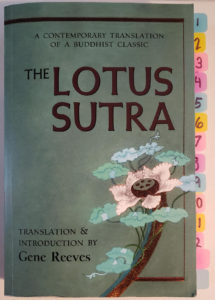
As a result I’ve switched a cycle early to Gene Reeves 2008 translation of The Lotus Sutra. Like the Threefold Lotus Sutra, Reeves translation includes The Sutra of Innumerable Meanings and The Sutra of Contemplation of the Dharma Practice of Universal Sage Bodhisattva. It was Reeves’ translation that I have used most often in my 21-Day Retreat posts.

Having read those auxiliary sutras I know what to expect as I cycle through the 28 chapters of the Lotus Sutra. For example, I am not a fan of Reeves’ decision to change “dragons, yakṣas, gandharvas, asuras, garuḍas, kiṃnaras, mahoragas” to “dragons, satyrs, centaurs, asuras, griffins, chimeras, pythons.” I’m also not a fan of using Law in place Dharma.

Still as I start this cycle I know Reeves’ translation at the very least lends itself well to my daily reading aloud.


Update July 27, 2019: I was in error saying Reeves’ translation uses Law instead of Dharma. The Threefold Lotus Sutra translation is the one that uses Law instead of Dharma.

Day 1

Day 1 covers the first half of Chapter 1, Introductory

Having last month met King Ajatasatru and the the four kinds of devotees, we witness the Buddha emit a ray of light from the white curls between his eyebrows illumining all the corners of eighteen thousand worlds in the east.

Thereupon the Buddha emitted a ray of light from the white curls between his eyebrows, and illumined all the corners of eighteen thousand worlds in the east, down to the Avchi Hell of each world, and up to the Akanistha Heaven of each world. The congregation saw from this world the living beings of the six regions of those worlds. They also saw the present Buddhas of those worlds. They also heard the Dharma expounded by those Buddhas. They also saw the bhikṣus, bhikṣunīs, upāsakās and upāsikās of those worlds who had already attained [the various fruits of] enlightenment by their various practices. They also saw the Bodhisattva-mahāsattvas [of those worlds] who were practicing the Way of Bodhisattvas [in various ways] according to the variety of their karmas which they had done in their previous existence, and also according to the variety of their ways of understanding [the Dharma] by faith. They also saw the past Buddhas [of those worlds] who had already entered into Parinirvana. They also saw the stupas of the seven treasures which had been erected to enshrine the śarīras of those Buddhas after their Parinirvana.

Nichiren writes about omens:

Grand Master T’ien-t’ai states in his Profound Meaning of the Lotus Sūtra fascicle 6, “It is said in a secular society that a cobweb is an advance notice of a happy event and chirps of a magpie foretell the arrival of a traveler. Even such trifle matters in the secular world are foreshadowed by an omen, how much more so the advent of the Buddhist Dharma. Based on worldly matters, we can conjecture the profound truth of Buddhism.” Thus, the Buddha showcased the greatest omens that had never been seen during the more than 40 years in His lifetime when He expounded the theoretical section of the Lotus Sūtra.

Zuisō Gosho, Writing on Omens, Writings of Nichiren Shōnin, Volume 6, Followers I, Page 122

The Innumerable Day Before Day 1

As mentioned yesterday, I am inserting the Sutra of Innumerable Meanings into my 32 Days of the Lotus Sutra practice as a way to keep this sutra and The Sutra of Contemplation of the Dharma Practice of Universal Sage Bodhisattva in my practice after concluding my 21-Day Retreat Encouraged by Universal Sage Bodhisattva.

Not everything in the Sutra of Innumerable Meanings is easy to digest. For me, I stumble over the many places where negation is used to emphasize the nature of emptiness. This comes early in the sutra when the Bodhisattvas are describing the Buddha (Reeves, p26-27).

His body is neither existing nor non-existing,
Neither caused nor conditioned,
Neither itself nor other,
Neither square nor round,
Neither short nor long.

It does not appear or disappear.
It is not born and does not die.
It is neither constructed nor raised up,
Neither made nor produced.

It is neither sitting nor lying,
Neither walking nor standing still,
Neither moving nor turning over,
Neither at rest nor idle.

It does not advance or retreat,
Knows not safety or danger,
Neither right nor wrong.
It is neither virtuous nor improper.

It is neither this nor that,
Neither going nor coming.

It is neither blue nor yellow,
Neither red nor white;
Neither crimson nor purple,
Nor a variety of colors.

Chih-i, the founder of the T’ien T’ai School upon which much Nichiren Doctrine rests, took such discussions as this and applied  the Threefold Truth – Emptiness, Provisional and Middleway. All things are essentially empty of any enduring, unchanging, self. What we perceive is our provisional existence that flows from causes and conditions of dependent origination. The Middle Way recognizes the non-duality of emptiness and provisional existence.

So what’s left with after all of those negations? The Middle Way.

Or at least that’s my understanding.  For an interesting discussion of how Chih-i applied the Threefold Truth to the Ten Suchnesses of Chapter 2 of the Lotus Sutra, see this quote from the Profound Meaning of the Lotus Sutra.

Between Day 32 and Day 1

Daily during my self-styled 21-Day Retreat Encouraged by Universal Sage Bodhisattva I recited The Sutra of Innumerable Meanings and The Sutra of Contemplation of the Dharma Practice of Universal Sage Bodhisattva. Having finished the retreat I was left wanting to fit those sutras into my practice on a regular basis.

I have decided to extend my 32 Days of the Lotus Sutra by two additional days. Today I recited the Contemplation of Universal Sage, splitting it evenly between morning and evening services. (I don’t have romanized shindoku versions of these sutras.) Tomorrow, I will recite Innumerable Meanings, again half in the morning and the remainder in the evening. Both days I will offer a quote that caught my attention from the day’s sutra. After the additional days, I will cycle again through the 32 days of the Lotus Sutra.


Expanding the message of Never-Despising Bodhisattva in the Lotus Sutra, the Contemplation of Universal Sage offers this guidance (Reeves, p405):

Followers should read the Great Vehicle sutras and recite them, think about the meaning of the Great Vehicle, and reflect on its practice. Reverence should be given and offerings made to those who embrace it. All people should be regarded as though they were the Buddha, and all living beings as though they were one’s father and mother.

Day 32

Day 32 covers Chapter 28, The Encouragement of Universal-Sage Bodhisattva, closing the Eighth Volume of the Sutra of the Lotus Flower of the Wonderful Dharma.

Having last month received Universal-Sage’s dhārāṇi spells, we hear Universal Sage prediction for anyone who keeps the Sūtra of the Lotus Flower of the Wonderful Dharma.

[He said to the Buddha:]

“World-Honored One! It is by my supernatural powers, know this, that a Bodhisattva can hear these dhārāṇis. Anyone who keeps the Sūtra of the Lotus Flower of the Wonderful Dharma [while it is] propagated in the Jambudvipa, should think, ‘I can keep [this sūtra] only by the supernatural powers of Universal-­Sage.’ Anyone who keeps, reads and recites this sūtra, memorizes it correctly, understands the meanings of it, and acts according to it, know this, does the same practices that I do. He should be considered to have already planted deeply the roots of good under innumerable Buddhas [in his previous existence]. He will be caressed on the head by the hands of the Tathāgatas. Anyone who copies this sūtra will be reborn in the Heaven of the Trāyastriṃs̒a Gods immediately after his present life. On that occasion, eighty-four thousand goddesses will come and receive him, making many kinds of music. A crown of the seven treasures will be put on his head, and he will enjoy himself among the ladies in waiting. Needless to say, [more merits will be given to] the person who [not only copies this sūtra but also] keeps, reads and recites it, memorizes it correctly, understands the meanings of it, and acts according to it. Anyone who keeps, reads and recites this sūtra, and understands the meanings of it, will be given helping hands by one thousand Buddhas immediately after his present life. He will be fearless. He will not fall into any evil region. He will be reborn in the Tusiita Heaven. There he will go to Maitreya Bodhisattva who, adorned with the thirty-two marks, will be surrounded by great Bodhisattvas, and attended on by hundreds of thousands of billions of goddesses. He will be given the benefits of these merits. Therefore, anyone who has wisdom should copy this sūtra with all his heart, cause others to copy it, and also keep, read and recite it, memorize it correctly, and act according to it.

The Daily Dharma from Feb. 9, 2019, offers this:

Therefore, anyone who has wisdom should copy this sūtra with all his heart, cause others to copy it, and also keep, read and recite it, memorize it correctly, and act according to it.

The Buddha declares this to Universal-Sage Bodhisattva in Chapter Twenty-Eight of the Lotus Sūtra. It is important to remember that early in the sūtra, the Buddha explained that he teaches only Bodhisattvas, beings who exist for the benefit of all beings. Our practice of the Lotus Sūtra is not just for ourselves. When we use it to lead others to enlightenment, we create the cause for our own enlightenment.

The Daily Dharma is produced by the Lexington Nichiren Buddhist Community. To subscribe to the daily emails, visit zenzaizenzai.com

Day 31

Day 31 covers Chapter 27, King Wonderful-Adornment as the Previous Life of a Bodhisattva.

Having last month considered the effect of wonders displayed by the two sons on their father, we witness the two asking their mother to be allowed to join the Buddha.

“Thereupon the two sons descended from the sky, came to their mother, joined their hands together, and said to her, ‘Our father, the king, has now understood the Dharma by faith. He is now able to aspire for Anuttara-samyak-saṃbodhi. We did the work of the Buddha for the sake of our father. Mother! Allow us to renounce the world and practice the Way under that Buddha!’

“Thereupon the two sons, wishing to repeat what they had said, said to their mother in gāthās:

Mother! Allow us to renounce the world
And become śramaṇas!
It is difficult to see a Buddha.
We will follow that Buddha and study.
To see a Buddha is as difficult
As to see an udumbara[-flower ]
To avert a misfortune is also difficult.
Allow us to renounce the world!

“The mother said, ‘I allow you to renounce the world because it is difficult to see a Buddha.’

Concluding my 21-day retreat encouraged by Universal-Sage Bodhisattva, we consider Day 21 of 21.