
Category Archives: LS32

Day 6

Day 6 continues Chapter 3, A Parable

Having last month covered the gathas description of the burning manor house, we come to the owner of this burning house and his dilemma.

This old and rotten house
Was owned by a man.
Shortly after he went out
To a place in the neighborhood,
Fires broke out suddenly
In the house.

Raging flames came out
Of all sides at the same time.
The ridges, rafters,
Beams and pillars
Burst, quaked, split, broke and fell.
The fences and walls also fell.

All the demons yelled.
The eagles, crested eagles,
And other birds, and kumbhandas
Were frightened and perplexed
They did not know
How to get out of the house.
The wild beasts and poisonous vermin
Hid themselves in holes.

In that house also lived
Demons called pisacakas.
Because they had few merits and virtues,
They suffered from the fire.
They killed each other,
Drank blood, and ate flesh.

The small foxes were
Already dead.
Large wild beasts
Rushed at them and ate them.
Ill-smelling smoke rose
And filled the house.

The centipedes, millipedes,
And poisonous snakes
Were driven out of their holes
By the fire,
And eaten
By the kumbhanda-demons.

The hair of the hungry spirits caught fire.
With hunger, thirst and burning,
The spirits ran about
In agony and dismay.

The house was so dreadful.
[In that house] there were
Poisonings, killings and burnings.
There were many dangers, not just one.

At that time the house-owner
Was standing outside the gate.
He heard a man say to him:
“Some time ago
Your children entered this house to play.
They are young and ignorant
They are engrossed in playing.”

The Parable of the Burning House in gathas is significantly different from the prose version. Last month, we detailed the all of the creatures in the house and this time around the reaction of the occupants to the sudden fire. And it was just today when I was reading this section that I appreciated that of all of the occupants of the house, only the children, who are engrossed in playing, fail to realize their dilemma. What does that say about our “higher” intelligence? Are we too smart for our own good?
Day 5

Day 5 begins Chapter 3, A Parable

Having last month covered Sariputra’s realization that the deception he experienced was his own, we come to the gathas and return to Śāriputra’s doubts.

Hearing this truthful voice,
I have the greatest joy
That I have ever had.
I have removed all the mesh of doubts.

You have taught us the Great Vehicle without a break from of old.
Your voice is rare to hear.
It dispels the sufferings of all living beings.
I once eliminated asravas.
Hearing this voice of yours,
I have now removed all sorrows.

I walked about mountains and valleys,
Or sat under a tree in a forest, thinking this over.
I reproached myself with a deep sigh:
‘Why was I deceived?
We also are sons of the Buddha
[Just as the Bodhisattvas are].
We entered the same [ world]
[Of the] Dharma-without-asravas.
But we shall not be able to expound
Unsurpassed enlightenment in the future.
We are in the same [world of the] Dharma.
But we shall not be given
The golden body with the thirty-two marks,
The ten powers, and the emancipations [of the Buddha].
We are deprived of the hope
To have the eighty wonderful marks,
The eighteen unique properties
And the other merits [of the Buddha].’

[Sitting] in the midst of the great multitude,
You benefited all living beings.
Your fame extended over the worlds of the ten quarters.
When I was walking alone,
I saw all this, and thought:
‘I am not given this benefit. I have been deceived.’

I thought this over day and night,
And wished to ask you,
‘Am I disqualified
[From having this benefit] or not?’

I always saw you praising the Bodhisattvas.
Therefore, I thought this over day and night.
Now hearing from you,
I understand that you expound the Dharma
According to the capacities of all living beings.
You lead all living beings
To the place of enlightenment
By the Dharma-without-asravas, difficult to understand.

The Daily Dharma from June 1, 2016, offers this:

Hearing this truthful voice of yours, I feel like dancing [with joy]. I have never felt like this before. Why is that? We [Śrāvakas and the Bodhisattvas] heard this Dharma before. [At that time] we saw that the Bodhisattvas were assured of their future Buddhahood, but not that we were. We deeply regretted that we were not given the immeasurable insight of the Tathāgata.

The Buddha’s disciple Śāriputra makes this proclamation to the Buddha in Chapter Three of the Lotus Sūtra. The Buddha had just explained that everything he taught before the Lotus Sūtra was not his true enlightenment; it was preparation for receiving his highest teaching. Śāriputra, the wisest of the Buddha’s disciples, understood immediately that he would be able to do far more than end his own suffering. He would eventually become a Buddha himself. Those gathered were also overjoyed, knowing that Śākyamuni was not the only Buddha they would meet. This ties together the Buddha’s insight that when we are assured of our enlightenment, we are able to meet innumerable enlightened beings.

The Daily Dharma is produced by the Lexington Nichiren Buddhist Community. To subscribe to the daily emails, visit zenzaizenzai.com

Day 4

Day 4 finishes Chapter 2, Expedients, and completes the first volume of the Sutra of the Lotus flower of the Wonderful Dharma.

Having last month covered why expedients were necessary, we come to the truth of the reality of all things.

The Buddhas’ sons who complete the practice of the Way
Will become Buddhas in their future lives.

I expounded the teaching of the Three Vehicles
Only as an expedient.
All the other World-Honored Ones also
Expound the teaching of the One Vehicle [with expedients].

The great multitude present here
Shall remove their doubts.
The Buddhas do not speak differently.
There is only one vehicle, not a second.

The number of the Buddhas who passed away
During the past innumerable kalpas was
Hundreds of thousands of billions,
Uncountable.

All those World-Honored Ones expounded
The truth of the reality of all things
With various stories of previous lives, parables and similes,
That is to say, with innumerable expedients.

All those World-Honored Ones expounded
The teaching of the One Vehicle,
And led innumerable living beings [with expedients]
Into the Way to Buddhahood.

All those Great Saintly Masters
Who knew the deep desires
Of the gods, men, and other living beings
Of all the worlds,
Revealed the Highest Truth
With various expedients.

In browsing my quotes looking for something to say on this point, I wandered off into something else I’ve been thinking about: Why we chant. That brought me to this quote from Lotus Path: Practicing the Lotus Sutra Volume 1:

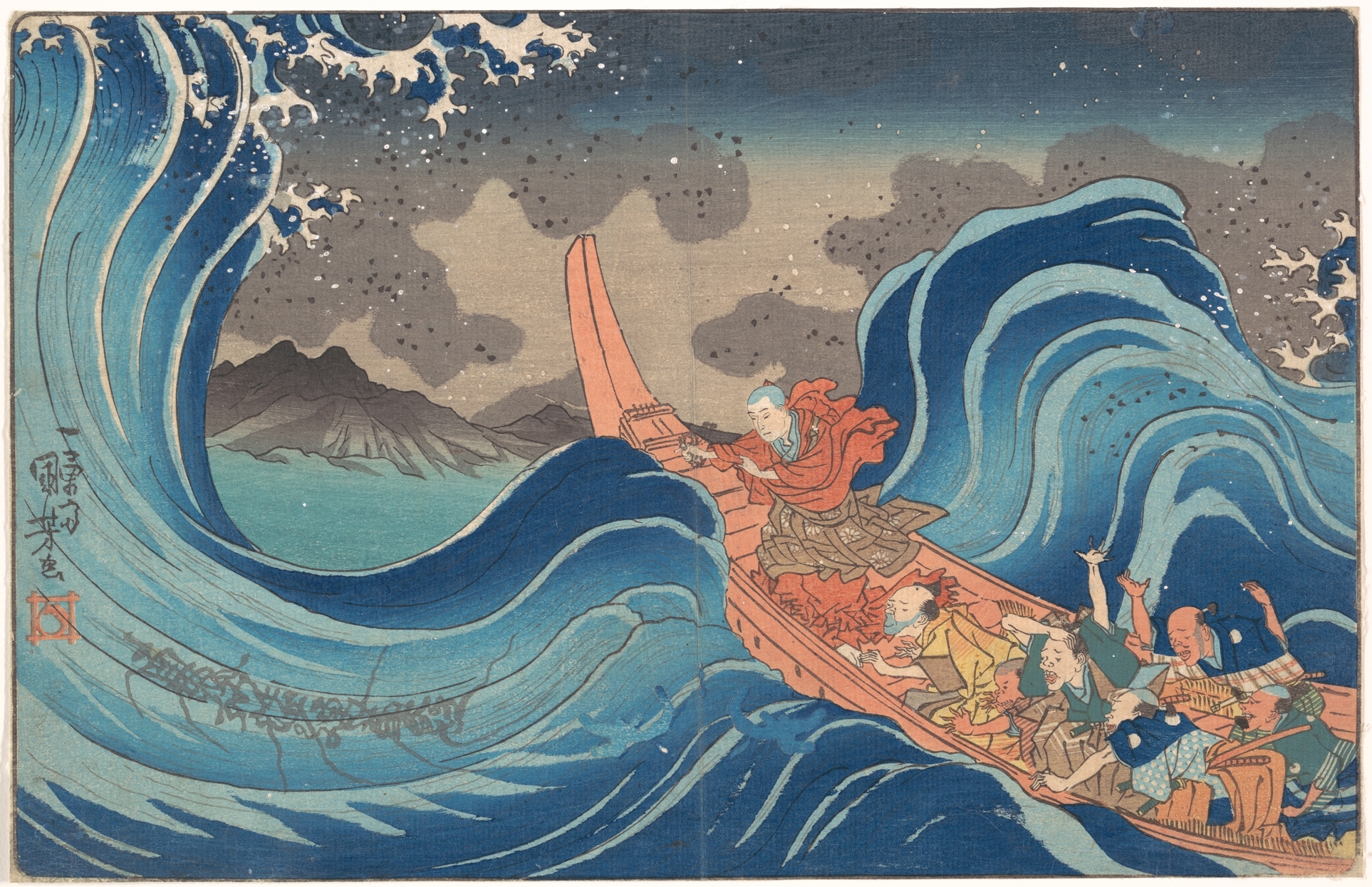
There is a story told of Nichiren on his way to his second exile, his trip to Sado Island. It is said that the water was so rough that all those on board the boat feared for their lives. According to the story, Nichiren took one of the oars and with the blade wrote the Odaimoku onto the surface of the water in order to calm the sea.

Whether or not you believe this happened exactly as it is told, there is certain documentary support for believing that he actually did attempt to do this. Still, the fact of the matter is that Nichiren placed all of his faith in the power of the Lotus Sutra. We too can cast the Odaimoku upon the ocean of our suffering, and with our practice we can calm the waters. We can change ourselves so that we can safely and confidently navigate the rough seas in which we may find ourselves.
Lotus Path: Practicing the Lotus Sutra Volume 1

And this plays into news I learned yesterday that the New York Metropolitan Museum of Art is making high-resolution digital copies of works in its collection of 441,175 items available online. Among that offering is Utagawa Kuniyoshi’s (1797–1861) woodblock print “A Vision of Prayer on the Waves

A Vision of Prayer on the Waves by Utagawa Kuniyoshi (1797–1861)

Day 3

Day 3 covers the first half of Chapter 2, Expedients.

Having last month covered the gathas concerning the unknown wisdom of the Buddhas, we witness the confusion sown by the Buddha’s revelations.

The great multitude at that time included Sravakas. [They also included] Ajnata-Kaundinya, and other Arhats, twelve hundred altogether, who had already eliminated asravas. [They also included] the bhiksus, bhiksunis, upasakas, and upasikas, [that is, the four kinds of devotees] who had already aspired for Sravakahood or Pratyekabuddhahood. All of them thought:

Why does the World-Honored One extol so enthusiastically the power of the Buddhas to employ expedients? Why does he say that the Dharma attained by him is profound and difficult to understand, and that the true purpose of his teachings is too difficult for Sravakas and Pratyekabuddhas to know? He expounded to us the teaching of emancipation. We obtained this teaching and reached Nirvana. We do not know why he says all this.

I’ll continue next month with Sariputra’s request for an explanation. For now, I want to insert this wonderful explanation of “expedients” from Lotus Path: Practicing the Lotus Sutra Volume 1:

Previous to teaching the Lotus Sutra the Buddha taught expedients to lead people to the ultimate teaching of the Lotus Sutra. In many ways it was as if he were leading the blind to the train station so they could then find the way to the true complete teachings contained in the Lotus Sutra. But we need to remember that the train station is not the destination, the expedients are not the sum of the Buddha’s teachings.
Lotus Path: Practicing the Lotus Sutra Volume 1

Day 2

Day 2 completes Chapter 1, Introductory.

Having last month considered what Manjusri saw in a previous life a long, long time ago, we come to the story of a Bodhisattva who was called Fame Seeking.

One of the eight hundred disciples [of Wonderful-Light] was called Fame­Seeking. He was attached to gain. He read and recited many sutras, but did not understand them. He forgot many parts of those sutras. Therefore, he was called Fame-Seeking. But he [later] planted the roots of good, and became able to see many hundreds of thousands of billions of Buddhas. He made offerings to them, respected them, honored them, and praised them.

Maitreya, know this! Wonderful-Light Bodhisattva at that time was no one but myself; and Fame-Seeking Bodhisattva, no one but you. This good omen we see now is not different from what I saw at that time. Therefore, l think that the Tathagata of today also will expound the sutra of the Great Vehicle called the ‘Lotus Flower of the Wonderful Dharma, the Dharma for Bodhisattvas, the Dharma Upheld by the Buddhas.’

It never fails to amaze me to hear that the next Buddha of the Saha World, Maitreya. was once a slacker more interested self-interest than in his Buddhist practice. There’s hope for me yet. Planting roots of good; looking forward to seeing many hundreds of thousands of billions of Buddhas.

Day 1

Day 1 covers the first half of Chapter 1, Introductory

Having last month covered the preliminaries, its time for the light.

Thereupon the Buddha emitted a ray of light from the white curls between his eyebrows, and illumined all the corners of eighteen thousand worlds in the east, down to the Avici Hell of each world, and up to the Akanistha Heaven of each world. The congregation saw from this world the living beings of the six regions of those worlds. They also saw the present Buddhas of those worlds. They also heard the Dharma expounded by those Buddhas. They also saw the bhisus, bhiksunis, upasakas and upasikas of those worlds who had already attained [the various fruits of] enlighterunent by their various practices. They also saw the Bodhisattva-mahasattvas [of those worlds] who were practicing the Way of Bodhisattvas [in various ways] according to the variety of their karmas which they had done in their previous existence, and also according to the variety of their ways of understanding [the Dharma] by faith. They also saw the past Buddhas [of those worlds] who had already entered into Parinirvana. They also saw the stupas of the seven treasures which had been erected to enshrine the sariras of those Buddhas after their Parinirvaha.

The Lotus Path: Practicing the Lotus Sutra Volume 1 offers this perspective:

Because of the ray of light the Buddha emitted those present in the congregation were able to see far into the past. They were able to see Buddhas, and stupas of those Buddhas. In various places in the Lotus Sutra, the Buddha reveals the past causes of a variety of people so they can know the causes made that enabled them to become Buddhas.

We may think that these are not things we can accomplish, yet through our daily practice of the Odaimoku and faith in the Lotus Sutra, we are able to reveal the historical truth of the Bodhisattvas who arose from beneath the earth. We can, by chanting Odaimoku, manifest the life of these great Bodhisattvas and reveal our infinite connection with the Eternal Buddha.Because of the ray of light the Buddha emitted those present in the congregation were able to see far into the past. They were able to see Buddhas, and stupas of those Buddhas. In various places in the Lotus Sutra, the Buddha reveals the past causes of a variety of people so they can know the causes made that enabled them to become Buddhas.

We may think that these are not things we can accomplish, yet through our daily practice of the Odaimoku and faith in the Lotus Sutra, we are able to reveal the historical truth of the Bodhisattvas who arose from beneath the earth. We can, by chanting Odaimoku, manifest the life of these great Bodhisattvas and reveal our infinite connection with the Eternal Buddha.
Lotus Path: Practicing the Lotus Sutra Volume 1

Day 32

Day 32 covers Chapter 28, The Encouragement of Universal-Sage Bodhisattva, closing the Eighth Volume of the Sutra of the Lotus Flower of the Wonderful Dharma.

Having last month covered the promise Sakyamuni makes to those who keep Universal Sage’s name, we now get the promise Sakyamuni makes to those who keep, read and recite the Sutra of the Lotus Flower of the Wonderful Dharma.

Universal-Sage! Anyone who keeps, reads and recites this Sutra of the Lotus Flower of the Wonderful Dhanna, memorizes it correctly, studies it, practices it, and copies it, should be considered to see me, and hear this sutra from my mouth. He should be considered to be making offerings to me. He should be considered to be praised by me with the word ‘Excellent!’ He should be considered to be caressed by me on the head. He should be considered to be covered with my robe. He will not be attached to worldly pleasures. He will not like to read heretical scriptures or any other writings of heretics. He will not be intimate with heretics, slaughterers, boar-breeders, sheep-breeders, fowl-breeders, dog-­breeders, hunters, prostitutes, or any other evil people. He will be upright. He will have correct memory and the powers of merits and virtues. He will not be troubled by the three poisons. He will not be troubled by jealousy, arrogance from selfishness, arrogance from self-assumed attainment of enlightenment, or arrogance from self-assumed acquisition of virtues. He will want little, know contentment, and practice just as you do.

The Daily Dharma from Jan. 5, 2017, offers this:

He will have correct memory and the powers of merits and virtues. He will not be troubled by the three poisons. He will not be troubled by jealousy, arrogance from selfishness, arrogance from self-assumed attainment of enlightenment, or arrogance from self-assumed acquisition of virtues. He will want little, know contentment, and practice just as you do.

The Buddha gives this description of the person who keeps and practices the Lotus Sūtra to Universal-Sage Bodhisattva (Fugen, Samantabhadra) in Chapter Twenty-Eight of the Lotus Sūtra. Powers of merits are what we have when we see things clearly. The three poisons are greed, anger and ignorance. The practice of Universal-Sage is to support and encourage everyone who takes on this difficult practice of the Wonderful Dharma. This is another Bodhisattva who gives us an example of how we can live in this world of conflict.

The Daily Dharma is produced by the Lexington Nichiren Buddhist Community. To subscribe to the daily emails, visit zenzaizenzai.com

Day 31

Day 31 covers Chapter 27, King Wonderful-Adornment as the Previous Life of a Bodhisattva.

Having last month reviewed the father’s reaction to the wonders performed by his two sons, we come to the preparations prior to going to see Cloud-Thunderpeal-Star-King-Flower-Wisdom Buddha.

The mother said [to her two sons], ‘I allow you to renounce the world because it is difficult to see a Buddha.’

Thereupon the [father came to them. The] two sons said to their parents, ‘Excellent, Father and Mother! Go to Cloud-Thunderpeal­Star-King-Flower-Wisdom Buddha, see him, and make offerings to him because to see a Buddha is as difficult as to see an udumbara ­flower or as for a one-eyed tortoise to find a hole in a floating piece of wood! We accumulated so many merits in our previous existence that we are now able to meet the teachings of the Buddha in this life of ours. Allow us to renounce the world because it is difficult to see a Buddha, and also because it is difficult to have such a good opportunity as this to see him.’

Thereupon the eighty-four thousand people in th harem of King Wonderful-Adornment became able to keep the Sutra of the Lotus Flower of the Wonderful Dharma.

Pure-Eyes Bodhisattva had already practiced the samadhi for the Lotus Flower of the Wonderful Dharma for a long time. Pure-Store Bodhisattva had already practiced the samadhi for the release from evil regions in order to release all living beings from evil regions for many hundreds of thousand of billions of kalpas.

Now the queen practiced the samadhi for the assembly of Buddhas, and understood the treasury of their hidden core. The two sons led their father by these expedients and caused him to understand the teachings of the Buddha by faith and to wish [to act according to those teachings].

Recently I’ve been reading “Readings of the Lotus Sutra,” a book of essays on the Lotus Sutra edited by Stephen F. Teiser and Jacqueline I. Stone. One essay, Gender and Hierarchy in the Lotus Sutra, uses the parables of the sutra to conclude that the sutra focuses on children who are clearly inferior to their father in wisdom and realization. And, if you only read the parables of the Burning House, the Rich Man and His Poor Son and the Skillful Physician and His Sick Children that’s a reasonable conclusion. And yet clearly that is not true in Chapter 27, King Wonderful-Adornment as the Previous Life of a Bodhisattva.

Day 30

Day 30 covers all of Chapter 26, Dhāraṇīs

Having last month heard Medicine-King Bodhisattva’s dharani spells, we come to Brave-In-Giving Bodhisattva.

Thereupon Brave-In-Giving Bodhisattva said to the Buddha:

World-Honored One! I also will utter dharanis in order to protect the person who reads, recites and keeps the Sutra of the Lotus Flower of the Wonderful Dharma. If he keeps these dharanis, this teacher of the Dharma will not have his weak points taken advantage of by any yaksa, raksasa, putana, krtya, kumbhanda or hungry spirit.

Then he uttered spells before the Buddha:

Zarei, makazarei, ukki, mokki, arei, arahatei, netsureitei, netsureitahatei), ichini, ichini, shichini, netsureichini, netsurichihachi.

[He said to the Buddha:]

World-Honored One! These dharanis, these divine spells, have already been uttered by as many Buddhas as there are sands in the River Ganges. Those Buddhas uttered them with joy. Those who attack and abuse this teacher of the Dharma should be considered to have attacked and abused those Buddhas.

And now I have a chance again to play this jazz version of the dharanis.

Day 29

Day 29 covers all of Chapter 25, The Universal Gate of World-Voice-Perceiver Bodhisattva.

Having last month enumerated some of the supernatural powers of World-Voice-Perceiver Bodhisattva-­mahasattva, we come to my personal favorite promise of the Lotus Sutra:

Those who have much lust will be saved from lust if they constantly think of World-Voice-Perceiver Bodhisattva and respect him. Those who have much anger will be saved from anger if they constantly think of World-Voice-Perceiver Bodhisattva and respect him. Those who have much stupidity will be saved from stupidity if they constantly think of World-Voice-Perceiver Bodhisattva and respect him. Endless-Intent! World-Voice-Perceiver Bodhisattva has these great supernatural powers. He gives many benefits to all living beings. Therefore, they should constantly think of him.

Among all of my many failings, lust, anger and stupidity have been with me constantly and of all my many benefits from this practice the lessening of those failings, especially anger, has been most pronounced.

The Daily Dharma from Sept. 25, 2016, offers this:

The Buddha gives this description of World-Voice-Perceiver Bodhisattva (Kannon, Kanzeon, Avalokitesvara) to Endless-Intent Bodhisattva in Chapter Twenty-Five of the Lotus Sūtra. World-Voice-Perceiver is the embodiment of compassion for all beings, the wish that all beings be freed from suffering and realize the enlightenment of the Buddha. This compassion is the antidote to the three poisons of lust, anger and stupidity. By aspiring to the example of World-Voice-Perceiver and awakening our own compassion, we can overcome these poisons and bring benefits to all beings.

The Daily Dharma is produced by the Lexington Nichiren Buddhist Community. To subscribe to the daily emails, visit zenzaizenzai.com