This is the prompt used to generate this Gemini Notebook article: What did Nichiren have to say about the Four Sublime Attitudes?
Four_Infinite_Virtues
The Writer, Gemini NotebookIn the Buddhist tradition, the Four Sublime Attitudes—often referred to as the Four Infinite Virtues (Brahmavihārās or ji, hi, ki, sha in Japanese)—are Lovingkindness (ji), Compassion (hi), Sympathetic Joy (ki), and Equanimity(sha). Throughout his writings, Nichiren Shōnin reinterpreted these classical virtues through the lens of the Lotus Sutra, demonstrating how they transition from gradual, theoretical meditations into an active, living force accessible to everyone in the Latter Day of the Dharma (mappō).
Lovingkindness (Ji) and Compassion (Hi)
In traditional Buddhist commentaries, lovingkindness (ji) is defined as the desire to bestow happiness upon living beings, while compassion (hi) is the drive to relieve them of their suffering. Nichiren Shōnin notes that in pre-Lotus teachings, cultivating these states was often presented as a specialized practice aimed at attaining rebirth in the Brahmā heavens. However, in the era of mappō, Nichiren Shōnin taught that the supreme expression of great compassion (daijihi) is not merely offering temporary material relief, but bestowing the ultimate medicine of the Dharma—Namu-Myōhō-Renge-Kyō—which strikes at the root of human suffering and awakens the inherent Buddha-nature within all people.
Nichiren Shōnin emphasized that true compassion frequently requires courage and firmness. Citing the Nirvāṇa Sutra and the commentaries of Chang-an, he explained that correcting spiritual errors and refuting distortions is the highest form of parental love:
“If one befriends another but lacks the compassion to correct him, one is in fact that person’s enemy. But one who reprimands and corrects an offender… is the Buddha’s true disciple. In removing the offender’s evil, he acts like that person’s parent.”
By admonishing fundamental errors that lead to spiritual misery, a practitioner acts out of deep, protective compassion to guide living beings toward lasting peace and liberation.
Sympathetic Joy (Ki)
In classical formulations, sympathetic joy (ki) refers to rejoicing in the happiness, virtue, and liberation of others without envy. In Nichiren Shōnin’s Lotus Sutra hermeneutic, this virtue is elevated through the concept of responding with joy (zuiki).
In Chapter 18 (“Benefits of Responding with Joy”) and Chapter 10 (“Teacher of the Dharma”) of the Lotus Sutra, the Buddha declares that even a single thought-moment of joy (ichinen zuiki) upon hearing the Lotus Sutra or its title guarantees eventual Buddhahood. Furthermore, Nichiren Shōnin often spoke of immense joy (daikangi) in the context of personal practice. For a practitioner of the Lotus Sutra, experiencing hardships or opposition for the sake of the Dharma is not a cause for despair, but an occasion for profound joy, as it confirms that one is actively living the prophecies of the sutra and fulfilling the mission of a true votary.
Equanimity and Impartiality (Sha)
Equanimity (sha) represents an unshakeable, balanced mind that has released attachments to hatred, favoritism, and worldly fluctuations. In the Lotus Sutra, this impartiality is manifested as the universal transmission of the One Vehicle.
Nichiren Shōnin emphasized that the Lotus Sutra acts as an equal “Dharma rain” (ichi-mi no u) that falls indiscriminately upon all living beings—men and women, wise and unlearned, good and evil—guaranteeing universal enlightenment without exception.
In daily life, equanimity is expressed by remaining unmoved by the eight winds (happū):
Prosperous gain and decline
Disgrace and honor
Praise and censure
Suffering and pleasure
Nichiren Shōnin taught that a true sage neither takes arrogant delight in worldly triumph nor falls into despair during times of hardship. To wear the “robe of gentleness and forbearance” is to maintain serene equanimity and patience while upholding faith amidst all life’s trials.
Direct Realization Through the Odaimoku
While traditional paths required eons of arduous meditation to perfect these four infinite states, Nichiren Shōnin revealed that all the virtues, causes, and effects of Śākyamuni Buddha’s enlightenment—including the Four Infinite Virtues and the six pāramitās—are fully contained within the five characters of Myō-Hō-Ren-Ge-Kyō.
When you chant Namu-Myōhō-Ren-Ge-Kyō with sincere faith, the Buddha spontaneously transfers the merit of all these virtues to your life. You do not need to seek Lovingkindness, Compassion, Sympathetic Joy, or Equanimity as distant, external ideals; by embracing the Odaimoku, these four sublime attitudes naturally emerge from within your own Buddha-nature and illuminate your daily thoughts, words, and actions.
Conceptual Summary
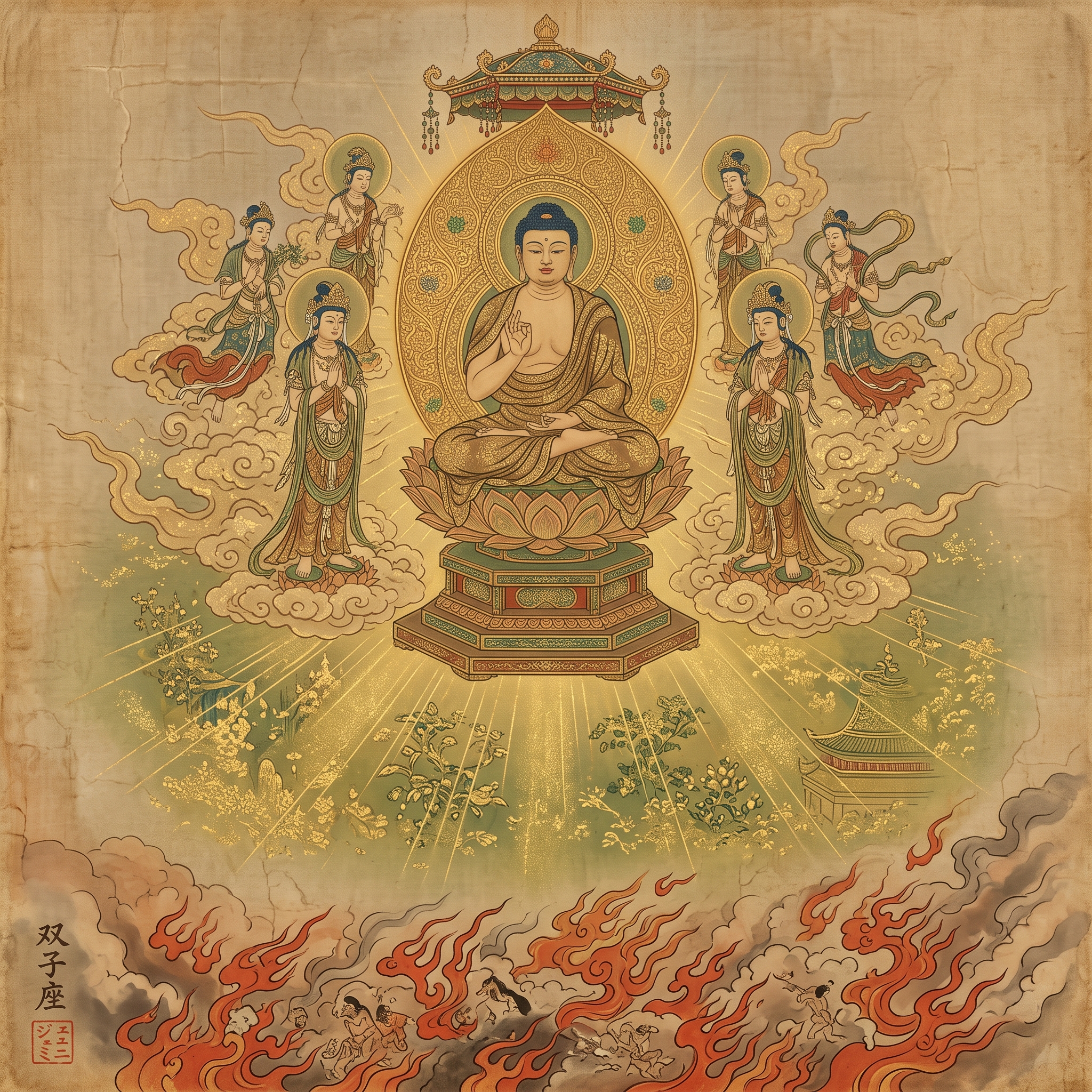
The illustration visualizes Śākyamuni Buddha’s discourse in Chapter Sixteen of the Lotus Sūtra, illustrating the dual perception of our world. At the top, Śākyamuni Buddha sits serene and indestructible on a lotus throne, enveloped in a radiant, golden divine realm that represents the ever-present pure world. He is flanked by bodhisattvas and celestial beings (tennyo) amidst swirling, auspicious clouds and falling blossoms, signifying the spiritual potential and peace available to all. Below this transcendent assembly, the earthly plane is depicted in a state of turmoil, consumed by the fiery "sorrow, fear, and other sufferings" perceived by the unenlightened. Crucially, the golden light from the Buddha’s realm pierces downward into this chaotic, flaming landscape, transforming the obstacles into "stepping stones" and showing the gradual sanctification of the world. Painted on aged silk with mineral pigments, delicate ink, and subtle gold leaf, the composition emphasizes the Buddhist truth that despite the apparent decay and pain, the Buddha's pure world remains indestructible and accessible through awakening.
Iconography & Character Identification
Deities/Figures Featured:
Śākyamuni Buddha (Shaka Nyorai): The central Buddha, seated in the dhyana/vitarka mudra, signifying teaching and meditation, distinctive with a ushnisha (cranial bump) and simple monastic robes, excluding any Amida or Dainichi iconography.
Attendant Bodhisattvas: The two prominent figures flanking the Buddha, representing compassionate and wise guides (such as Yakuō/Medicine King and Kannon/Avalokiteshvara or Fugen and Monju, though depicted generally to signify the bodhisattva path).
Celestial Attendants (Tennyo / Apsaras): Hovering in the upper clouds, playing music and scattering flowers to celebrate the Dharma.
Sentient Beings (Mundane World): Small, distressed figures at the bottom, navigating the flames of the "sutra's burning world" but being reached by the golden, transforming light.
Text Translations:
双子座 (Kanji, bottom-left): "Gemini" (The Twins / Gemini constellation).
ジェミニ (Katakana, red square hanko/seal): "Gemini".
[This] pure world of mine is indestructible.
But the [perverted] people think:
“It is full of sorrow, fear, and other sufferings.
It will soon burn away.”
The Buddha sings these verses in Chapter Sixteen of the Lotus Sūtra. When we are not aware of our own potential for enlightenment, and of the Ever-Present Buddha Śākyamuni who is helping us and all beings to reach this potential, we can easily sink into despair. So long as we are preoccupied with suffering, when we live as if our purpose were to feel good as much as possible and feel bad as little as possible, we long for escape from this world of conflict. As we continue to grow the Buddha’s own mind within us, we see how this world is being transformed. When we know where we are going, all obstacles become stepping stones.
The Daily Dharma is produced by the Lexington Nichiren Buddhist Community. To subscribe to the daily emails, visit zenzaizenzai.com
This is the prompt used to generate this Gemini Notebook article: Considering Charles Sheldon’s 1896 novel “In His Steps,” are there any similar movements in Nichiren Buddhism that seek to have those who chant Namu-Myoho-renge-kyo embrace the four Sublime Attitudes or other fundamental Buddhist practices?
Person_chanting_and_community_activism
The Writer, Gemini NotebookCharles Sheldon’s 1896 Social Gospel novel In His Steps introduced the famous question, “What Would Jesus Do?”, inspiring believers to move beyond passive theology and apply Christian ethics directly to economic inequality, poverty, and social reform. In Nichiren Buddhism, a remarkably parallel impulse exists—one that seeks to translate faith in Namu-Myōhō-Renge-Kyō into active social transformation, human rights, and the alleviation of suffering.
This social imperative is rooted in Nichiren Shōnin’s foundational principle of Risshō Ankoku (“Establishing the Correct Teaching for the Peace of the Land”). Based on the Mahāyāna doctrine of the nonduality of life and environment (eshō funi), Nichiren Shōnin taught that personal spiritual practice cannot be separated from the state of society. Where the Lotus Sutra is embraced, the physical and social world is transformed into a peaceful Buddha land.
Throughout the 20th century and into the present day, several key movements within Nichiren Buddhism have sought to operationalize this vision, challenging practitioners to embody the four sublime attitudes—Lovingkindness, Compassion, Sympathetic Joy, and Equanimity—in direct response to societal crises.
Girō Senoo & The Emerging Buddhist Youth League (Buddhist Socialism)
The closest historical parallel to Sheldon’s Social Gospel movement arose in the 1930s with Girō Senoo (1890–1961) and the Emerging Buddhist Youth League (Shinkō Bukkyō Seinen Dōmei).
Deeply moved by the plight of impoverished tenant farmers, urban laborers, and economic crises during the Interwar period, Senoo declared that he wished to “throw off Saint Nichiren’s old coat”—by which he meant stripping away stagnant, institutional clericalism to revive Nichiren Shōnin’s radical, compassionate spirit for the modern era.
Under the banners of “faith and love” and social justice, Senoo argued that preaching abstract sermons while ignoring real-world exploitation was contrary to the Buddha’s intent. He mobilized young Lotus Sutra followers to intervene in labor disputes, defend impoverished agricultural workers, and critique rampant greed, seeking to establish an earthly Buddha land founded on economic equality and human dignity.
Nipponzan Myōhōji & Ven. Nichidatsu Fujii (Active Pacifism & Civil Rights)
Founded by Ven. Nichidatsu Fujii (1885–1985), Nipponzan Myōhōji is a monastic and lay movement that takes the chanting of the Odaimoku directly into the streets as a form of non-violent social protest (shugyō).
Appalled by the devastation of World War II and the atomic bombings, Fujii embraced absolute non-violence, taking the Lotus Sutra’s Bodhisattva Sadāparibhūta (Jōfukyō or “Never Disrespectful”) as the ultimate model for daily behavior. In the Lotus Sutra, Bodhisattva Sadāparibhūta bowed in reverence to every person he met—even those who reviled or attacked him—recognizing their innate Buddha-nature.
Nipponzan Myōhōji monastics and lay followers embody “What Would A Buddha Do?” by conducting long peace marches, beating hand-drums (uchiwa daiko) while chanting Namu-Myōhō-Renge-Kyō, actively opposing nuclear proliferation, supporting Native American civil rights struggles, and building Peace Pagodas worldwide as beacons of universal harmony.
Modern Lay Movements & “Buddhism in Daily Life” (Risshō Kōsei-kai & Sōka Gakkai)
In the postwar era, large lay organizations emerged to bridge the gap between sacred chanting and civic responsibility:
Risshō Kōsei-kai: Co-founded by Nikkyō Niwano, this organization interprets the parables of the Lotus Sutra as direct directives for peace, human rights, and personal development. They instituted the “Donate One Meal” campaign—where members regularly skip a meal and donate the savings toward UNICEF, disaster relief, and international poverty alleviation—and engage extensively in United Nations peace initiatives.
Sōka Gakkai: Championed the concept of “Human Revolution” (ningen kakumei) and the ethos that “Buddhism is daily life.” This framework teaches that the inner transformation achieved through chanting Namu-Myōhō-Renge-Kyō must express itself in tangible daily behavior—fostering community harmony, promoting peace education, and engaging in grassroots volunteerism.
The Core Principle: Faith Expressed as Daily Behavior (Shugyō)
All of these movements draw their ultimate legitimacy from Nichiren Shōnin’s insistence that true faith is measured by how one treats others in daily life. Citing the Sushun Tennō Gosho, Nichiren Shōnin reminded his follower Shijō Kingo that “the true purpose of Śākyamuni Buddha appearing in this world was to teach us how to behave ourselves on a daily basis.”
Just as Charles Sheldon called on Christians to ask “What Would Jesus Do?” in every social decision, Nichiren Shōnin taught that when you chant Namu-Myōhō-Renge-Kyō with sincere faith, your daily conduct becomes the very manifestation-body (niryāna-kāya) of the Buddha—transforming Lovingkindness, Compassion, Sympathetic Joy, and Equanimity from abstract ideals into a living, social reality.
Conceptual Summary
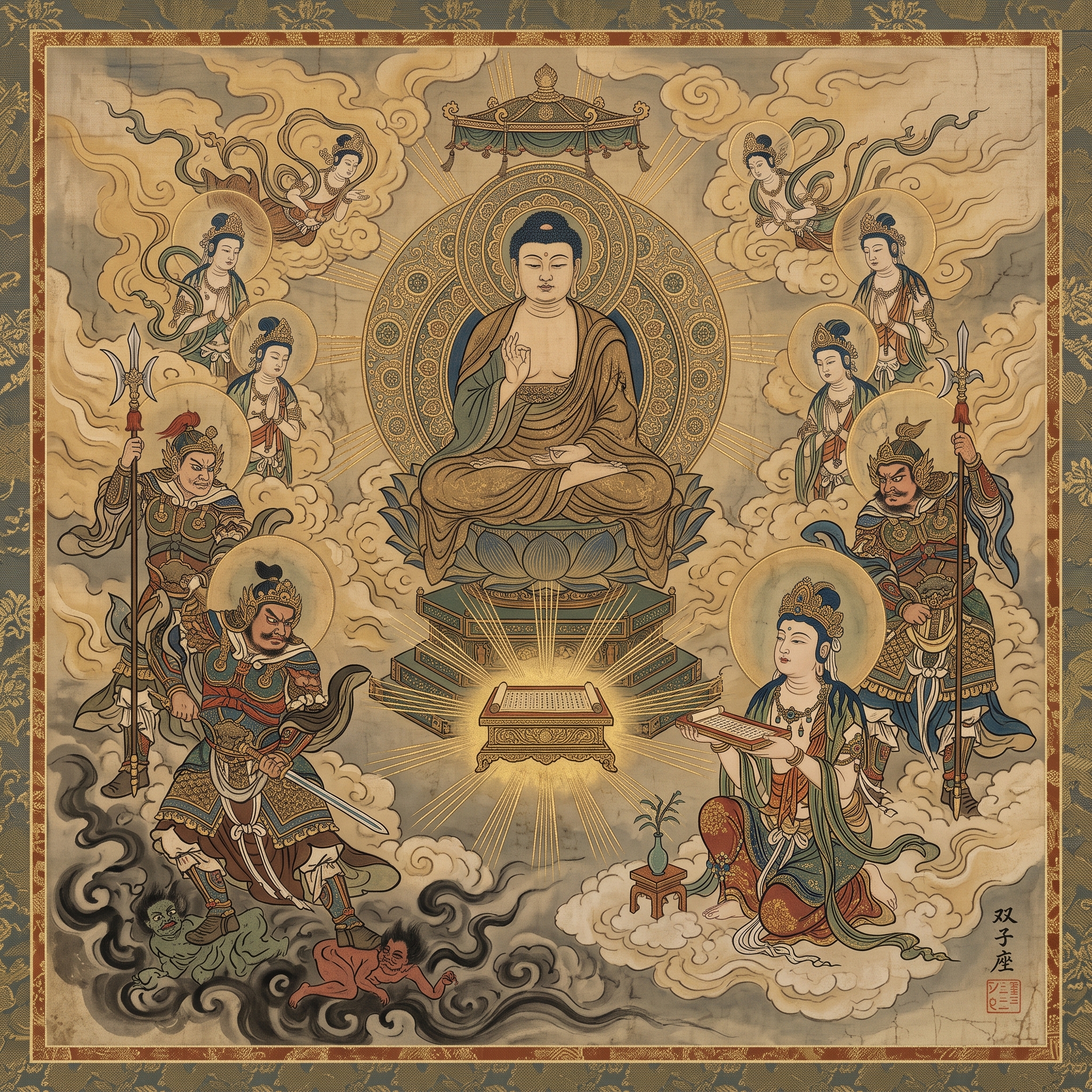
This artwork on silk captures the moment of esoteric transmission from Chapter Ten of the Lotus Sūtra, where Śākyamuni Buddha (Shaka Nyorai) entrusts the "hidden core of all the Buddhas" to Medicine-King Bodhisattva (Yakuō Bosatsu), shown reverently holding a sūtra scroll at the bottom right. The central Buddha, seated on a lotus throne beneath a canopy, radiates golden light over a jewel-encrusted casket representing the treasured, protected sūtra. To guard this teaching from the "jealousy" and "delusion" of non-believers (visualized as a dark, cowering demon at the bottom left), fearsome Buddhist guardian deities (Heavenly Kings) stand vigilant in ornate armor, wielding weapons to ward off destructive forces. Celestial apsaras (tennyo) and protective deities hover in the clouds, creating a spiritual shield. Utilizing traditional Japanese mineral pigments, inks, and gold leaf, the composition juxtaposes divine light with dark earthly ignorance, reflecting the Buddha's assurance that the teaching is eternally guarded by spiritual forces despite human rejection.
Iconography & Character Identification
Item 1: Deities/Figures Featured:
Śākyamuni Buddha (Shaka Nyorai): The central, illuminated Buddha seated on a lotus throne, raising his hand in a preaching gesture (mudra).
Medicine-King Bodhisattva (Yakuō Bosatsu): Seated at the bottom right, wearing elaborate Bodhisattva robes and halo, holding a sacred scroll (representing the Lotus Sūtra) with an offering vase/urn nearby.
Heavenly Guardian Kings (Dharmapālas / Guarding Deities): Two heavily armored warrior deities in dynamic, protective poses on the left and right, brandishing weapons. The lower-left guardian tramples a small, dark demonic figure (amanojaku), representing the taming of fear, jealousy, and delusion.
Apsaras / Celestial Maidens (Tennyo): Four gracefully flying celestial figures in the upper clouds, playing music, making offerings, and scattering blossoms.
The Sacred Reliquary/Casket: Situated in the center below the Buddha, a glowing, golden container representing "the store of the hidden core" (the Lotus Sūtra).
Item 2: Text Translations:
双子座 (Vertical Kanji Signature, lower right): "Futago-za" (meaning "Gemini").
ジェミニ (Red Square Hanko/Seal, lower right): "Jemini" (transliteration of "Gemini" in Katakana).
Medicine-King! This sūtra is the store of the hidden core of all the Buddhas. Do not give it to others carelessly! It is protected by the Buddhas, by the World-Honored Ones. It has not been expounded explicitly. Many people hate it with jealousy even in my lifetime. Needless to say, more people will do so after my extinction.
The Buddha makes this declaration to Medicine-King Bodhisattva in Chapter Ten of the Lotus Sūtra. For us who recognize how the Buddha’s teaching transforms our lives and the world, it can be hard to imagine that anyone would reject it. However, there are beings who are so filled with fear and delusion that they mistake the Buddha’s good medicine for poison. While we are committed to leading all beings to enlightenment, we realize that we are not alone in our efforts. The protective deities and the Buddha himself are always working to benefit all beings. In our current capacities, we may not be able to reach everybody immediately. We should not let this discourage us. The least we can do is hope in our hearts for the happiness of all beings, even if they are not accessible to us.
The Daily Dharma is produced by the Lexington Nichiren Buddhist Community. To subscribe to the daily emails, visit zenzaizenzai.com
I’m convinced there are no coincidences. Just as I was considering What Would A Buddha Do and Charles Sheldon’s Social Gospel, a book arrived in the mail. I had ordered this book a month before from the Princeton University Press and forgotten about it.
The book is “How to Truly Love: An Ancient Guide to a Life of Kindness.” This is a translation of the 5th century Indian Theravada scholar Buddhaghosa’s ninth chapter of his Path of Purification. Maria Heim offers an introduction followed by a Sanskrit and English bilingual explanation of the Four Sublime Attitudes – Lovingkindness, Compassion, Sympathetic Joy and Equanimity.
In her introduction, Heim points out that these attitudes are a vehicle that delivers genuine freedom:
Love, and related experiences like compassion and sympathy, not only benefit others–they also free our own minds from the constrictions and distortions of anger, hatred, envy, discontent, cruelty, and indifference that otherwise enslave us and make us miserable. Love, sympathy, and compassion can cast off these painful shackles and replace them with the freedom to flourish in solidarity with others.
How To Truly Love, Page xiii
The best way to imagine the Four Sublime Attitudes is to consider a mother with four children.
She feels lovingkindness toward the little one, wanting him to flourish; she feels compassion toward the sick child, wanting him to get well; she feels sympathetic joy toward the youth, rejoicing in his beauty and success; and she feels equanimity toward her grown-up son as he manages his own affairs (though she has, of course, never stopped loving him). The challenge is to take these very natural dispositions that we already feel toward our loved ones and extend them further and further out toward mere acquaintances, and then even hostile people, extending them eventually in every direction universally. The more we can do so, the more both we and those we encounter in the world are flooded with these happy and peaceful experiences.
How To Truly Love, Page xv-xvi
It is the expansion of these attitudes beyond immediate family to the entire world that is the challenge. In the context of Nichiren’s teachings, this is what’s meant by concentrating on the 3,000 Existences in a Single Thought Moment.
As we will see with all of the sublime attitudes, the attitude must be directed toward a specific someone, a living flesh-and-blood person toward whom you can get the emotion flowing. There is nothing abstract about this practice: it involves real emotions toward specific beings (“beings” is mentioned advisedly, as it is not just humans toward whom we will want to feel universal friendliness).
You’ll want to start where it is easy and the emotion comes naturally. We will see that Buddhaghosa does not think that you should start with enemies or even neutrals, because feeling lovingkindness toward them is just too hard at first. Instead, you should start by feeling lovingkindness toward yourself since it is very easy to long for your own happiness. The idea is to get kindness flowing, for a mind full of kindness can’t at the same time hold hate or anger. There may also be deeper psychological truth in his insisting, against possible detractors, on starting with loving yourself. He perceives that those who hate themselves can never truly love another. It may be that much hatred, cruelty, and apathy are, at bottom, the result of self-loathing.
How To Truly Love, Page 3-4
It is also very interesting how the concept of Emptiness – no self – is utilized here.
Persons are real up to a point, but on closer analysis they are only a collection of constantly changing momentary events. So the person I am angry with now is not the “same” person who initially caused me distress. Like me, they are changing all the time, and like me, they are conditioned by a complex set of processes that I can disaggregate and analyze. In fact, looking for the stable, unchanging essence of this person on which to target my anger (and anger always wants a target), I find that they dissolve into these changing parts. Toward whom, toward what, am I actually angry?
How To Truly Love, Page 10
Lovingkindness negates anger and compassion seeks to eliminate the suffering of others.
Compassion is wanting that someone suffering will be relieved of it. As with lovingkindness, one works gradually to feel compassion universally toward all beings. But to start, one begins with where it is easiest, and again with a concrete and specific person. Buddhaghosa thinks that even the most hard-hearted among us will be moved when we see a truly wretched person with hands and feet cut off and begging on the street, so we should start here to get the feeling flowing. But failing to find such a person (and we should hope such sights never occur!), we still need an actual being to focus on as the object of our compassion.
Here he takes a perhaps surprising turn: start with a guilty criminal being led to his death. Buddhaghosa thinks that reflecting on this person, who may seem to be happy as he eats the delicacies of his last meal, will be an easy object of compassion. No one will think he is actually happy as he faces his executioner; anyone considering the horror of his impending death will react with dismay. Unlike many Western conceptions of compassion, there is no sense that compassion should be directed only toward innocents, those who do not “deserve” their suffering.
How To Truly Love, Page 126-127
Sympathetic joy is simply sharing with the joys of others, even your enemies.
It is your genuine delight when good things happen to others, even to your enemies. Sympathetic joy is the removal of envy and discontent, both of which can be ubiquitous and often largely unrecognized features of our lives.
Western moral sense theorists also note that we often sympathize with happy others. We can readily shift from a sour mood when arriving at a joyful party or hearing a friend’s good news. Parents enjoy unalloyed happiness at their children’s success. What would life be like if we expanded these feelings, and shared the pleasure of all beings? Buddhaghosa recommends starting with the fun-loving pal whose easy cheerfulness is infectious. Once the feeling flows, we can extend it to others, with each new embrace of joy breaking down the walls of our own narrow self-regard, envy, and discontent.
How To Truly Love, Page 142-143
The final Sublime Attitude is equanimity. This should never be confused with apathy.
Equanimity is to be built on the foundation of the other three – only when one has flooded all beings equally with lovingkindness, compassion, and sympathetic joy should one step back from these warm feelings and aim for a less reactive and more peaceful attention to beings. Since the first three attitudes involve sizing up the experiences of other beings with strong feelings about them, they involve judgments. Such judgments of “resentment and approval” are, Buddhaghosa says, “too close.” In contrast, equanimity involves stepping back and cultivating a feeling of impartiality, equality, and neutrality toward others. It stays unruffled through the ups and downs of beings’ experience. And it reminds us of the Buddhist aspirations to achieve, perhaps above all, the freedom that comes from a truly peaceful mind.
How To Truly Love, Page 150-151
In Nichiren Buddhism, the ideal way to practice is demonstrated by Never-Despising Bodhisattva. Can we truly see the Buddha nature in all beings without manifesting Lovingkindness, Compassion, Sympathetic Joy and Equanimity? Without the Four Sublime Attitudes, are we truly bowing to the inherent Buddha nature in all beings?
Conceptual Summary
This painting interprets the sacred promise from Chapter Twenty-Eight of the Lotus Sutra, rendered in the classical Kamakura-period Buddhist art style. The visual narrative centers on the encounter between Śākyamuni Buddha (Shaka Nyorai) and Universal-Sage Bodhisattva (Fugen Bosatsu). On the right, Śākyamuni sits on an ornate tiered lotus throne, his golden halo radiating outward as he listens to the vows of his bodhisattva. To the left, Fugen Bodhisattva appears in majestic, adorned robes, riding his iconic six-tusked white elephant. He is depicted in a gesture of reverence, making his sacred vow to safeguard those who keep the sūtra.
In the bottom left, the natural world transition to rough, darker earth, capturing the "defiled world" and highlighting the small, humble monk practicing below—visualizing the "dirt under a fingernail" metaphor of the scarce devotees. Above the devotee, guardian deities (dharmapalas) emerge from swirling clouds with protective energy, manifesting Fugen's vow to defend the faithful. Subtle gold leaf, natural mineral pigments, and aged silk textures tie this grand assembly together, illustrating that while the practitioner seems alone on a vast earth, they are enveloped in the invisible, immense protection of the universe's great protectors.
Iconography & Character Identification
Item 1: Deities/Figures Featured:
Śākyamuni Buddha (Shaka Nyorai): Seated on the right upon a multi-tiered lotus throne, shown in a teaching gesture with radiant halos.
Universal-Sage Bodhisattva (Fugen Bosatsu): Seated on the left upon a majestic six-tusked white elephant, with hands in anjali mudra (prayer) to deliver his vow.
The Humble Practitioner: A small monk kneeling in prayer at the bottom left, representing the rare individuals practicing the Dharma in a defiled world.
Guardian Deities (Dharmapalas/Devas): Two armor-clad protectors surrounding the practitioner, symbolizing the unseen forces and protective aura promised by Fugen.
Item 2: Text Translations:
Kanji Signature ('双子座'): Gemini (literally "The Twins" or "Gemini" constellation)
Hanko Seal ('ジェミニ'): Gemini (written in Katakana script)
Thereupon Universal-Sage Bodhisattva said to the Buddha:
“World-Honored One! If anyone keeps this sūtra in the defiled world in the later five hundred years after [your extinction], I will protect him so that he may be free from any trouble, that he may be peaceful, and that no one may take advantage [of his weak points].”
Universal-Sage Bodhisattva (Fugen, Samantabhadra) makes this vow to the Buddha in Chapter Twenty-Eight of the Lotus Sutra. In this world of conflict, it can seem like very few people are practicing the Buddha Dharma with us. Nichiren compared those beings alive in this world of conflict to the amount of soil in the whole earth, while those who keep and practice the Lotus Sūtra are like the dirt under a fingernail. The vow of Universal-Sage reminds us that innumerable beings support our practice and that in turn, we support them with our practice.
The Daily Dharma is produced by the Lexington Nichiren Buddhist Community. To subscribe to the daily emails, visit zenzaizenzai.com
That work prompted a visitor to tell me, “I don’t understand how chanting the Odaimoku substitutes for the Eightfold Path.” I answered with my Faith and Practice in Nichiren Buddhism, which included four Gemini Notebook discussions of what Nichiren taught about practice. The final article included this:
Strict practice is not a works-based means to attain a future Buddhahood, but rather the active, necessary expression of a Buddhahood that is already inherently present within you.
But what constitutes an expression of that inherent Buddhahood? How should my life display this expression of Buddhahood?
For many years I have suggested Nichiren Buddhists should focus on demonstrating the Six Perfections – charity, morality, patience, vigor, meditation and wisdom. But my work in Gemini Notebook convinced me that Nichiren would not have focused there. For the Fall Higan week I explained why followers of Nichiren don’t need to adhere to these provisional teachings. (See “Nichiren Shōnin’s Teachings on the Six Perfections”)
And so I’m still trying to visualize how followers of the Lotus Sutra can express this inherent Buddhahood that is activated by chanting Namu-Myoho-renge-kyo.
This is all a way of introducing why I recently explored the “What Would Jesus Do?” movement. Not the 1990s evangelical fad, but the original Social Gospel movement spawned by Congregationalist minister Charles Sheldon’s 1896 bestselling novel “In His Steps: What Would Jesus Do?”
There are many parallels between the end of the 19th century and today.
The visitor to the church who inspired the movement was a homeless man:
“I lost my job ten months ago. I am a printer by trade. The new linotype machines are beautiful specimens of invention, but I know six men who have killed themselves inside of the year just on account of those machines. Of course, I don’t blame the newspapers for getting the machines. Meanwhile, what can a man do? I know I never learned but the one trade, and that’s all I can do. I’ve tramped all over the country trying to find something. There are a good many others like me. I’m not complaining, am I? Just stating facts. But I was wondering, as I sat there under the gallery, if what you call following Jesus is the same thing as what he taught. What did he mean when he said, ‘Follow me?’ The minister said” here the man turned about and looked up at the pulpit “that it was necessary for the disciple of Jesus to follow his steps, and he said the steps were obedience, faith, love and imitation.”
In His Steps, Page 13
Henry Maxwell, the pastor in the novel who starts the “What Would Jesus Do?” crusade, offers this after the movement starts applying Christian ethics directly to social problems like poverty, labor exploitation, and economic inequality, seeking to improve the material conditions of the marginalized:
“What would Jesus do?” Suppose that were the motto, not only of the churches but of the business men, the politicians, the newspapers, the working men, the society people – how long would it take, under such a standard of conduct, to revolutionize the world? What was the trouble with the world? It was suffering from selfishness. No one ever lived who had succeeded in overcoming selfishness like Jesus. If men followed Him, regardless of results, the world would at once begin to enjoy a new life.”
In His Steps, Page 251
As a child in the 1950s and 1960s I attended the Pacoima Congregational Church in Los Angeles. This church still taught Charles Sheldon’s Social Gospel. On one memorable occasion the pastor of the church, Paul Kittlaus, organized a can drive to benefit the Delano Grape Strike workers. I collected cans and traveled with other members of the church to The Forty Acres, the community center headquarters of the 1965 strike in Delano, California. I don’t remember much about this event. I was just 13 years old. Still, it is possible this Social Gospel ideal lingers in me today as I consider how best to express my inherent Buddha nature.
In Sheldon’s book, a wealthy heiress who is considering how she can better direct her legacy to help the poor ponders:
“I think we are beginning to understand,” said Virginia, “the meaning of that command, ‘Grow in the grace and knowledge of our Lord and Saviour Jesus Christ.’ I am sure I do not know all that He would do in detail until I know Him better.”
In His Steps, Page 153
In reading the book, I was struck by the realization that I don’t wonder what a Buddha would do. I mean, that’s what all of that provisional teaching was designed to instill in the Buddha’s followers. And Henry Maxwell’s suggestion that “No one ever lived who had succeeded in overcoming selfishness like Jesus” overlooks that man who lived 500 years earlier in India, a man whose teachings may have inspired Jesus during the “Lost Years” between ages 12 and 30.
Conceptual Summary
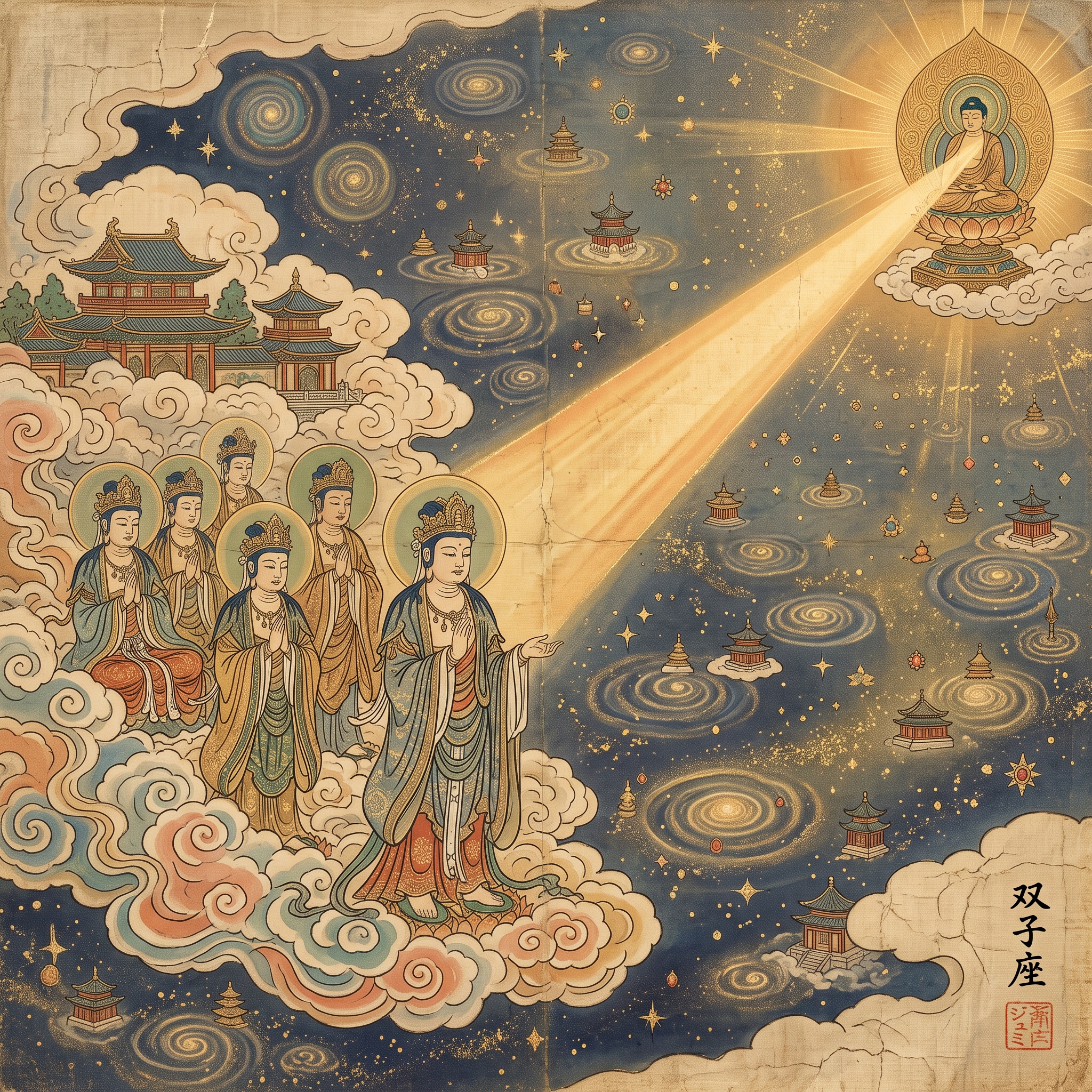
This 1:1 painting, executed in the style of Heian and Kamakura-period Japanese Buddhist art, visually narrates Chapter Seven of the Lotus Sūtra. It depicts the massive cosmic journey of the Brahma Kings leaving their luxurious palaces, shown nestled in the swirling clouds in the upper left, to pursue a newly appeared Buddha. The vast, starry void represents the "one thousand billion worlds," dotted with tiny cosmic realms, miniature tiered pavilions, and spiral galaxies rendered in soft mineral pigments and gold leaf. At the forefront, Brahma King Great Compassion (Bonten) leads a procession of celestial kings on colorful, auspicious clouds, gesturing toward a brilliant, piercing beam of golden light emanating from Shaka Nyorai (the historical Buddha) seated in the upper right. His serene presence signifies the ultimate destination of their spiritual quest. The worn silk texture and traditional patterns emphasize the reverence with which these creators search for the rare and precious Buddha Dharma.
Iconography & Character Identification
Item 1: Deities/Figures Featured:
Brahma King Great Compassion (Daibon Ten’o): The leading deity at the forefront of the celestial cloud procession, adorned with elaborate robes, a crown, and a halo, gesturing forward in reverence.
Fellow Brahma Kings (Bonten): The retinue of celestial monarchs traveling alongside Great Compassion on the auspicious, multi-colored clouds.
Shaka Nyorai (Siddhartha Gautama / Historical Buddha): Seated on a jeweled lotus throne within a multi-layered golden halo in the upper-right corner, emanating the divine light sought by the traveling kings.
Item 2: Text Translations:
双子座 (in black ink, bottom right): "Gemini"
ジェミニ (inside the red square hanko seal): "Gemini"
Let us go even to the end of one thousand billion worlds,
And find the place from where this light has come.
A Buddha may have appeared somewhere in the universe
In order to save the suffering beings.
These verses are sung by the Brahma King Great Compassion in Chapter Seven of the Lotus Sūtra. He invites his fellow Brahma Kings, creators of entire worlds, to leave the luxury of their palaces to find a Buddha who is leading all beings to enlightenment. They value the Buddha’s words more than anything that they have created for themselves, and know how rare it is to encounter an enlightened being. These kings give us an example of how we can learn to treasure the Buddha Dharma.
The Daily Dharma is produced by the Lexington Nichiren Buddhist Community. To subscribe to the daily emails, visit zenzaizenzai.com
Conceptual Summary
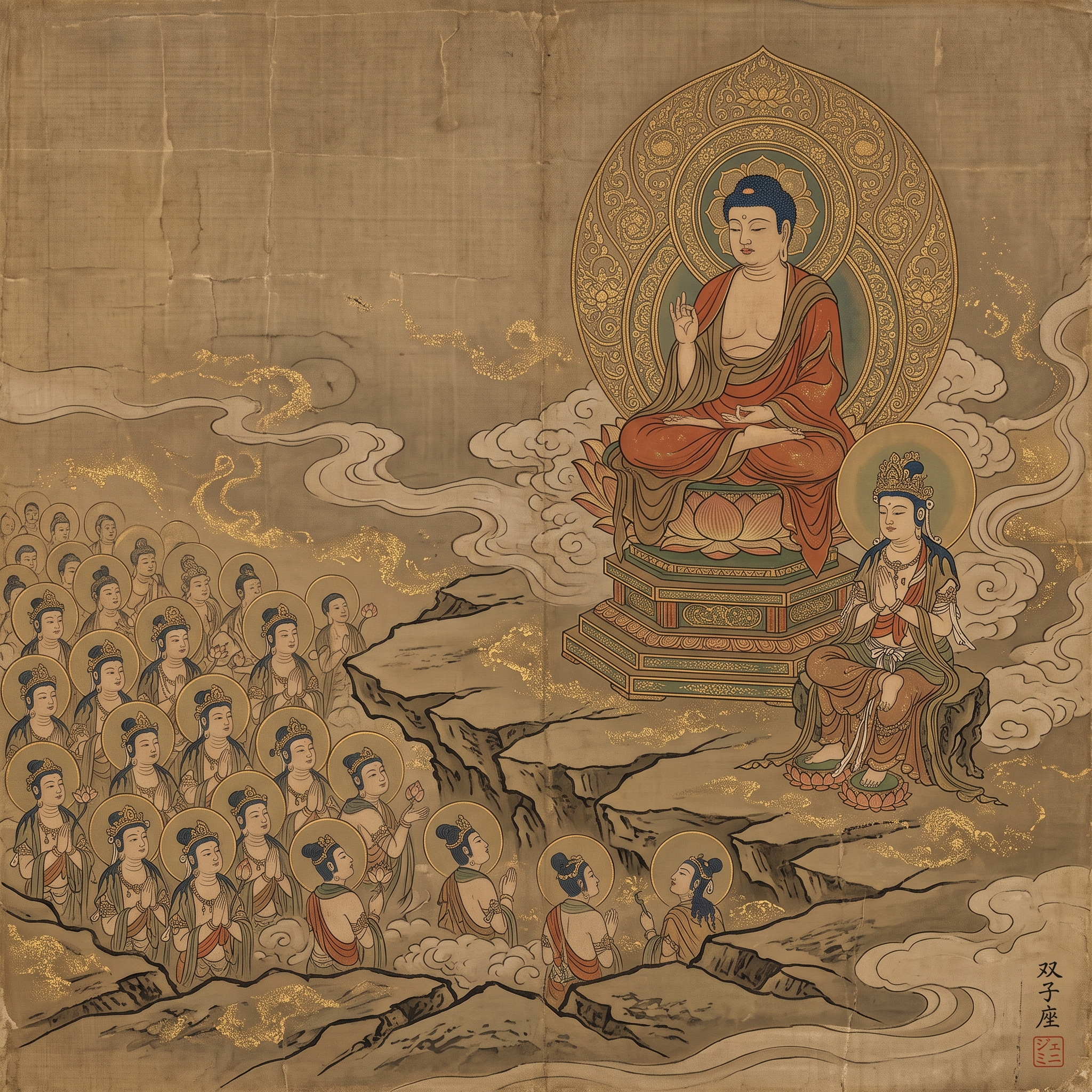
This traditional Japanese Buddhist painting (Butsuga) on aged, textured silk visually interprets Chapter Fifteen of the Lotus Sūtra, capturing the revelation of the "Bodhisattvas from underground" (Jiyū no bosatsu). At the upper right, Śākyamuni Buddha (Shaka Nyorai) sits on a majestic, multi-tiered lotus throne, gesturing with an expounding hand (Vitarka mudra) to declare that these countless beings are his own disciples from the remotest past. Seated reverently below him is Maitreya Bodhisattva (Miroku Bosatsu), who watches and receives this revelation with folded hands. The lower half of the composition is dominated by rugged, stylized earth fissures, out of which an endless host of haloed, prayerful Bodhisattvas gracefully emerge. Natural mineral pigments and gold-leaf details (kirikane) elevate this cosmic assembly, illustrating Nichiren’s teaching that the followers of the Lotus Sūtra are themselves these emergent Bodhisattvas, already present to teach the Dharma without waiting for an external savior.
Iconography & Character Identification
Item 1: Deities/Figures Featured:
Śākyamuni Buddha (Shaka Nyorai): The historical Buddha, seated at the upper right on a tiered lotus throne (rengeza), surrounded by an ornate halo (mandorla) and gesturing in a teaching pose (Vitarka mudra).
Maitreya Bodhisattva (Miroku Bosatsu): The future Buddha, shown in elaborate bodhisattva robes, jewelry, and a crown, seated lower and to the right of Śākyamuni, with hands joined in prayer (anjali mudra).
The Bodhisattvas from Underground (Jiyū no bosatsu): The vast multitude of nimbed (haloed) figures depicted rising and emerging from the natural fissures and splits in the earth below, clasping their hands and looking upward.
Item 2: Text Translations:
「双子座」 (Futago-za): The vertical handwritten Kanji signature in the bottom-right corner, which translates to "Gemini" (the zodiac sign/constellation).
「ジェミニ」 (Jemini): The red square seal (hanko) underneath the signature, which is the Katakana transliteration for "Gemini".
My words are true.
Believe me with all your hearts!
I have been teaching them
Since the remotest past.
The Buddha sings these verses to Maitreya Bodhisattva and others gathered to hear him teach in Chapter Fifteen of the Lotus Sūtra. Maitreya had never seen any of the other Bodhisattvas who sprang up from underground in this chapter, despite his memory of previous lives and other worlds. The Buddha explains that the beings who had just appeared are also his disciples and have come to spread this Wonderful Dharma in our world. Nichiren teaches that when he realized that he was an incarnation of Superior-Practice, the leader of the Bodhisattvas from underground, then all of us who follow Nichiren and continue to keep the Lotus Sūtra are the followers of Superior-Practice. We do not need to wait for someone to come to our world and lead us. The world does not need anyone other than those already here to teach the Dharma. We are the Bodhisattvas from underground.
The Daily Dharma is produced by the Lexington Nichiren Buddhist Community. To subscribe to the daily emails, visit zenzaizenzai.com
Conceptual Summary
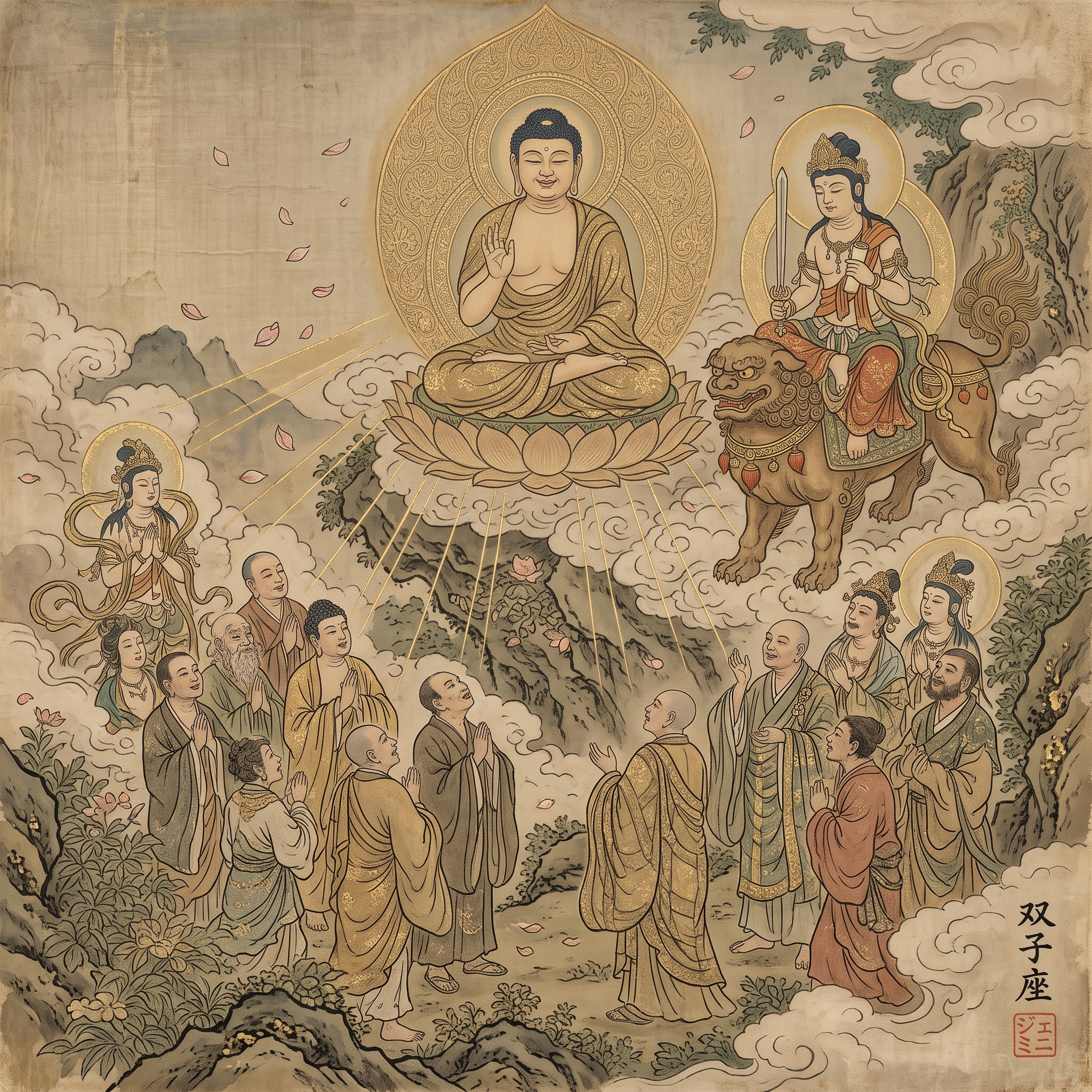
The illustration interprets Chapter Fourteen of the Lotus Sūtra by depicting Śākyamuni Buddha expounding the "Sūtra of the Lotus Flower of the Wonderful Dharma" directly to Mañjuśrī Bodhisattva, who listens attentively while seated upon his traditional lion mount. Rendered in a classical Japanese Buddhist style on aged silk, the image captures the joy of the Buddha's long-withheld revelation and the profound challenge of its reception. Below them, a diverse gathering of monks, disciples, and laypeople represents "all living beings" the sūtra aims to guide. While many figures express devotion, reverence, and spiritual awakening, others reflect the "ignorance and misery" noted in the commentary—appearing contemplative, hesitant, or overwhelmed by the truth they have long feared to live. Golden rays of light and cascading lotus petals symbolize the transformative harmony the Buddha offers, creating a visual bridge between transcendent wisdom and the earthly struggle to overcome indifference and believe.
Iconography & Character Identification
Item 1: Deities/Figures Featured:
Śākyamuni Buddha (Shaka Nyorai): Seated at the top center on a lotus pedestal, haloed in gold, gesturing in a teaching and blessing mudra as he joyfully expounds the Lotus Sūtra.
Mañjuśrī Bodhisattva (Monju Bosatsu): Seated to the Buddha's right on his traditional lion (shishi) mount, holding a scroll and a sword of wisdom, receiving the Buddha's declaration.
A Gathering of Disciples, Monks, and Celestial/Lay Beings: Located in the lower foreground and on the sides, representing the assembly of living beings. This includes figures in attitudes of devotion (Ananda, Mahakasyapa, or general monastic and lay followers) and some who appear hesitant or overwhelmed, visually embodying the difficulty of believing the teachings.
An Attendant Bodhisattva/Celestial Being: Visible on the mid-left side, joining hands in reverence within the clouds.
I now expound this Sūtra of the Lotus Flower of the Wonderful Dharma with great joy. This sūtra leads all living beings to the knowledge of all things. I did not expound it before because, if I had done so, many people in the world would have hated it and few would have believed it.
The Buddha makes this declaration to Mañjuśrī Bodhisattva in Chapter Fourteen of the Lotus Sūtra. It can be difficult to imagine anyone hating the Buddha’s teachings. We sometimes notice that the true opposite of affection and devotion is not enmity and distrust. It is indifference. When we hear the Buddha’s teaching and do not make it part of our lives, it is because we are so attached to our peculiar ignorance and misery that we are afraid to live any other way. The Buddha shows us that it is possible to exist in harmony with the world rather than in conflict. It is only when we practice his teachings that we can believe them.
The Daily Dharma is produced by the Lexington Nichiren Buddhist Community. To subscribe to the daily emails, visit zenzaizenzai.com



 Learn More About This Topic